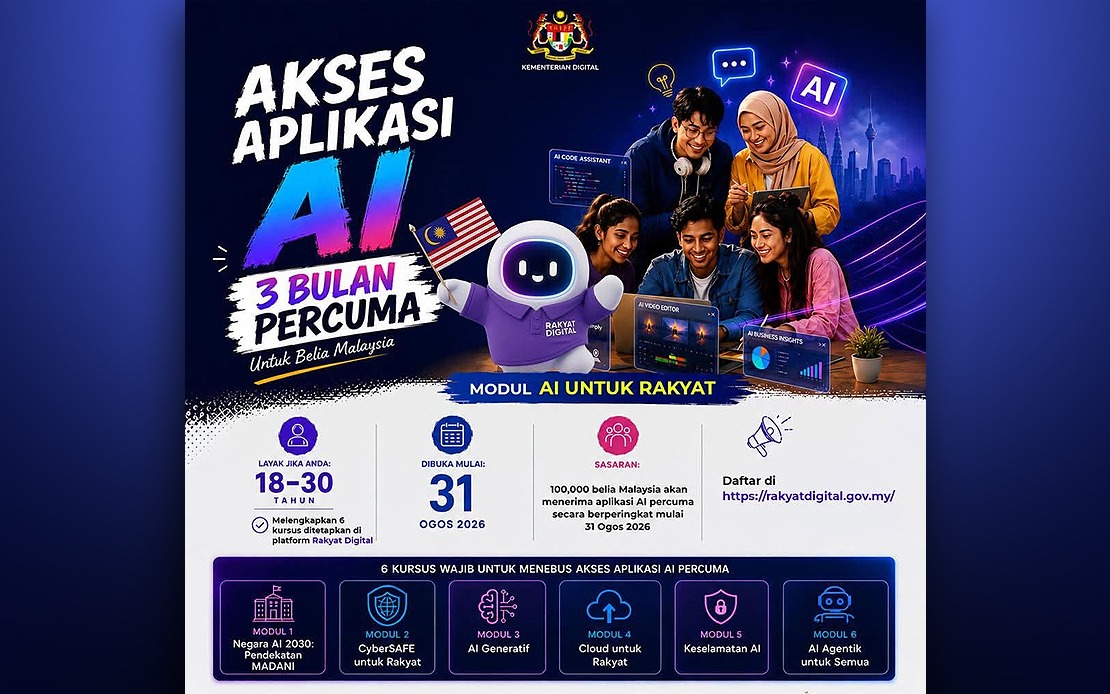
The Malaysian government has rolled out an ambitious initiative to democratise artificial intelligence access among young adults, with the AI for the People (AI Untuk Rakyat) programme launching across the country this week. Administered through the Rakyat Digital portal at rakyatdigital.gov.my, the scheme targets 100,000 Malaysians between the ages of 18 and 30, with enrolment remaining open until 2027. This phased rollout represents a significant policy push to ensure that emerging technology benefits reach beyond corporate and academic circles, extending to ordinary citizens across Malaysia's diverse regions.
The programme's architecture centres on six integrated learning modules designed to build foundational and advanced artificial intelligence competency. Participants must successfully complete all six courses—titled AI Nation 2030: The MADANI Approach, CYBERSAFE for the People, Generative AI, AI Security, Agentic AI for All and Cloud for the People—to qualify for downstream benefits. The naming convention reflects the government's alignment of digital policy with the broader MADANI framework, signalling how AI development fits into Malaysia's wider governance and economic vision.
Upon completing the educational requirement, successful participants gain a highly valuable incentive: a complimentary three-month subscription to multiple artificial intelligence applications and tools. The initial slate of providers includes established technology companies spanning both regional and global markets. YTL AI Labs' IlmuChat brings a Malaysian-developed option to the table, while international heavyweights like Alibaba contribute Wonderclip and MuleRun, and Google provides access to Gemini Enterprise. This curated mix balances supporting local innovation with exposure to internationally recognised platforms, giving young Malaysians practical experience across different AI ecosystems.
The Digital Ministry has indicated that this opening roster represents just the foundation of what will become an expanding ecosystem. Additional software and tools from other technology providers will be progressively integrated into the programme, enriching the practical learning experience over time. This approach allows the government to maintain programme flexibility while managing implementation complexity across such a large participant base. For technology companies, the arrangement creates an opportunity to introduce their solutions to a young, digitally-focused demographic within Malaysia's growing AI sector.
The initiative reflects a deliberate policy calculation about Malaysia's competitive position in the Asia-Pacific technology landscape. Rather than leaving artificial intelligence adoption to market forces alone, the government is intervening to ensure equitable access and capability-building among youth who might otherwise lack exposure to these tools. Digital Ministry secretary-general Datuk Fabian Bigar framed the programme as essential infrastructure for creating an AI-literate population, arguing that understanding and accessing AI technologies represents a prerequisite for meaningful participation in Malaysia's future digital economy.
Prime Minister Datuk Seri Anwar Ibrahim announced the programme as part of a broader package of six digital opportunity initiatives unveiled during the 2026 National Day Premier Address celebrations at the Putrajaya International Convention Centre. This positioning at a major national event underscores the government's intention to treat AI capability-building as a matter of national importance rather than sectoral interest. The announcement timing also suggests that youth digital empowerment features prominently in the government's electoral and policy messaging as Malaysia approaches the next election cycle.
The programme explicitly links to Malaysia's Digital 2030 aspirations and the stated goal of developing an inclusive AI Nation by 2030. This framing positions artificial intelligence not as an optional advanced skill but as a core competency for national development. The emphasis on inclusivity—repeated throughout official communications—acknowledges that without deliberate intervention, AI adoption would likely concentrate among urban, educated, higher-income cohorts, widening rather than narrowing digital divides.
For young Malaysians, particularly those in smaller towns and rural areas, the Rakyat Digital portal access removes traditional barriers to technology training. Rather than requiring expensive private courses or institutional enrolment, participants need only internet connectivity and motivation to complete the modules. This accessibility model could prove particularly transformative for early-career individuals in secondary cities and states where technology training options remain limited compared to Kuala Lumpur and other major urban centres.
The programme's specificity around digital security—including dedicated CYBERSAFE and AI Security modules—suggests the government recognises that widespread AI adoption without corresponding safety knowledge could create vulnerability. Young, digitally-native Malaysians adopting AI tools without understanding security implications could face fraud, data breach or other risks. By embedding security consciousness into foundational training, the government attempts to instil protective habits before problematic behaviours become entrenched.
The inclusion of Agentic AI as a dedicated module indicates the government's awareness that the field is evolving rapidly beyond the current generative AI moment. Agentic systems—AI agents that can act autonomously to accomplish tasks—represent the next frontier, and ensuring young Malaysians understand these emerging capabilities positions them to contribute to and benefit from Malaysia's participation in next-generation AI development. This forward-looking curriculum design prevents the training from becoming obsolete within a few years.
The Rakyat Digital portal, which serves as the administrative backbone for this initiative, operates under MyDIGITAL Corporation—a government-linked entity designed to coordinate digital transformation across Malaysia. By channelling the AI for the People programme through an established national digital infrastructure, the government leverages existing systems and expertise rather than building entirely from scratch. This approach economises on implementation costs while strengthening the centralised digital platform's utility and user base.
For Malaysian educators and private training providers, the programme presents both opportunity and challenge. While free government training might reduce demand for paid courses, it could also establish baseline competency that makes advanced specialist training more valuable. The government's phased approach and commitment to expanding partner providers suggests recognition that this initiative functions best as complement rather than replacement to the broader private training ecosystem.
The success of this initiative will ultimately depend on completion rates and participant persistence across all six modules. Early data from the rollout will reveal whether offering free access and subscription benefits proves sufficient motivation for large cohorts of young adults to commit to structured learning. Regional implementation differences may also emerge as the programme scales, with urban centres potentially achieving higher participation rates than rural or semi-urban areas despite equal digital access.

