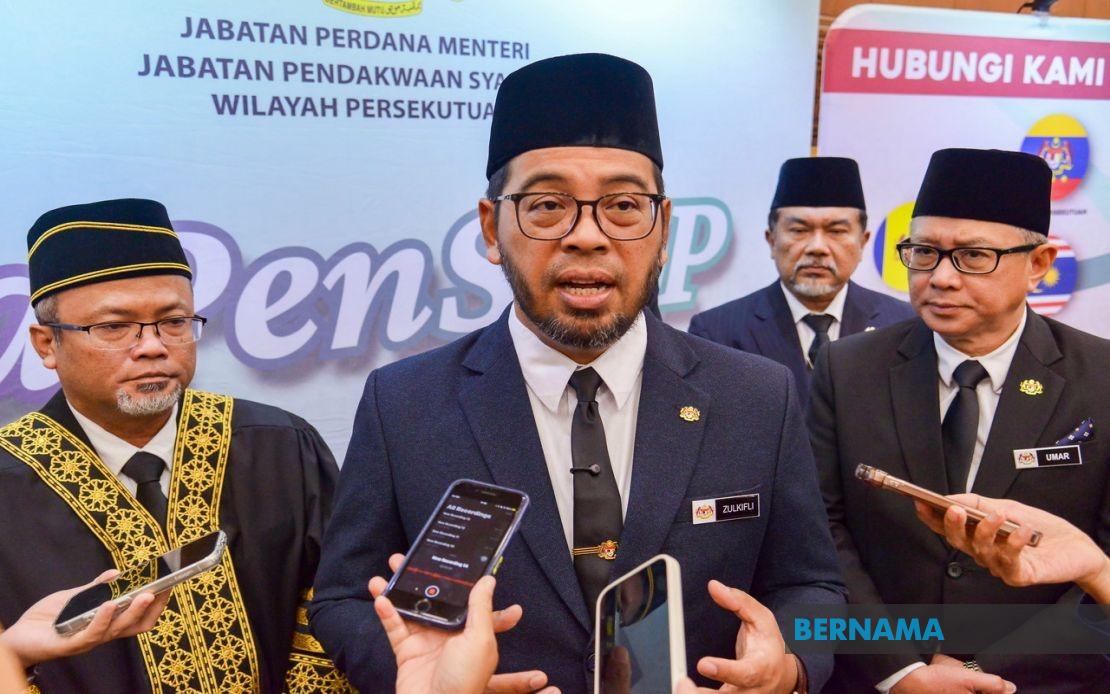
The Prime Minister's Department of Religious Affairs has launched an investigation into controversial claims surrounding marriage documentation allegedly issued by the Malaysia Rohingya Ulama Council, after a reference number bearing JAKIM's identifier sparked widespread social media concern about its legitimacy. Minister Dr Zulkifli Hasan confirmed the probe at a press conference in Putrajaya following his opening remarks at the second Malaysian Syariah Prosecutors Conference, acknowledging that his department had not yet gathered sufficient details to assess the situation comprehensively.
At the heart of the controversy sits a marriage declaration letter that recently circulated online displaying the reference number "JAKIM.PERH/LN.800-7(5)", triggering immediate questions about whether Malaysia's Islamic Development Department had endorsed or recognised the document. The emergence of this reference number proved significant because it bore all the hallmarks of official JAKIM documentation, potentially lending false legitimacy to marriage registrations within the Rohingya community.
The Perak Islamic Religious Department has already clarified its position on the matter, explicitly stating that it does not recognise the letter as a valid legal instrument for marriage purposes. State authorities have indicated that the broader question of whether the Rohingya community can register marriages through official channels remains unresolved, as it involves policy considerations that state religious authorities are currently reviewing. This bureaucratic uncertainty has left many within the affected community in a state of confusion regarding the legitimacy of their matrimonial documentation.
The investigation represents part of broader efforts by Malaysian religious authorities to maintain institutional integrity and prevent the misuse of official reference numbers or credentials. The issue underscores challenges facing Malaysia's religious governance structure, particularly regarding the authentication of documents and the control of who can issue marriage-related paperwork. For the Rohingya community in Malaysia, many of whom lack formal citizenship status, such documentation uncertainties compound existing administrative and legal vulnerabilities.
Beyond the immediate marriage document controversy, Dr Zulkifli flagged another regulatory concern occupying his department's attention: the proliferation of unaccredited religious lectures and teachings circulating across social media platforms. He acknowledged that while the Prime Minister's Department is reviewing how to address this phenomenon, regulatory authority ultimately resides with state governments, who hold jurisdiction over accreditation standards for religious instructors and teaching approval mechanisms.
The minister explained that his department maintains internal protocols to verify credentials for any religious scholars or speakers invited to participate in government-sponsored broadcasts or public platforms, but the broader challenge of monitoring and controlling unauthorised religious content across digital channels remains complex. He indicated that the government continues examining the most appropriate legislative and enforcement approaches, given the intersection of religious regulation, online freedom, and legal considerations involved.
Dr Zulkifli emphasised that religious enforcement officers encounter significant practical difficulties when attempting to curtail unapproved religious teaching online, a problem that reflects the gap between centralised oversight capacity and the decentralised, rapid nature of social media dissemination. The challenge intensifies when considering questions of free speech and the determination of what constitutes "unaccredited" instruction versus legitimate religious discourse among community members.
During his conference address, the minister positioned Malaysia's Syariah legal framework as requiring continuous evolution to confront contemporary challenges, particularly those emerging from the digital realm. He advocated for strengthened collaboration among the Malaysian Communications and Multimedia Commission, the Royal Malaysian Police, and the Attorney General's Chambers to enhance Syariah enforcement capabilities and prosecution effectiveness in an increasingly complex environment.
Critically, Dr Zulkifli called for Syariah prosecutors to develop advanced technical competencies including digital forensics, data analysis, and technology expertise, recognising that religious law enforcement in Malaysia must adapt to crimes increasingly perpetrated through online channels rather than traditional methods. This professional development imperative reflects a growing realisation that Malaysia's religious authorities cannot effectively discharge their functions without modernising their investigative and prosecutorial toolkit.
The convergence of these issues—problematic marriage documentation, unaccredited religious teaching, and cyber-related religious crimes—illustrates the multifaceted challenges confronting Malaysia's Islamic governance institutions. For Malaysian policymakers and religious authorities, the concerns raised by the Rohingya marriage document controversy and related regulatory gaps highlight the necessity of clarifying boundaries between federal and state jurisdiction, establishing transparent authentication protocols, and developing digital-era enforcement mechanisms that balance religious oversight with practical governance realities in an increasingly interconnected society.

