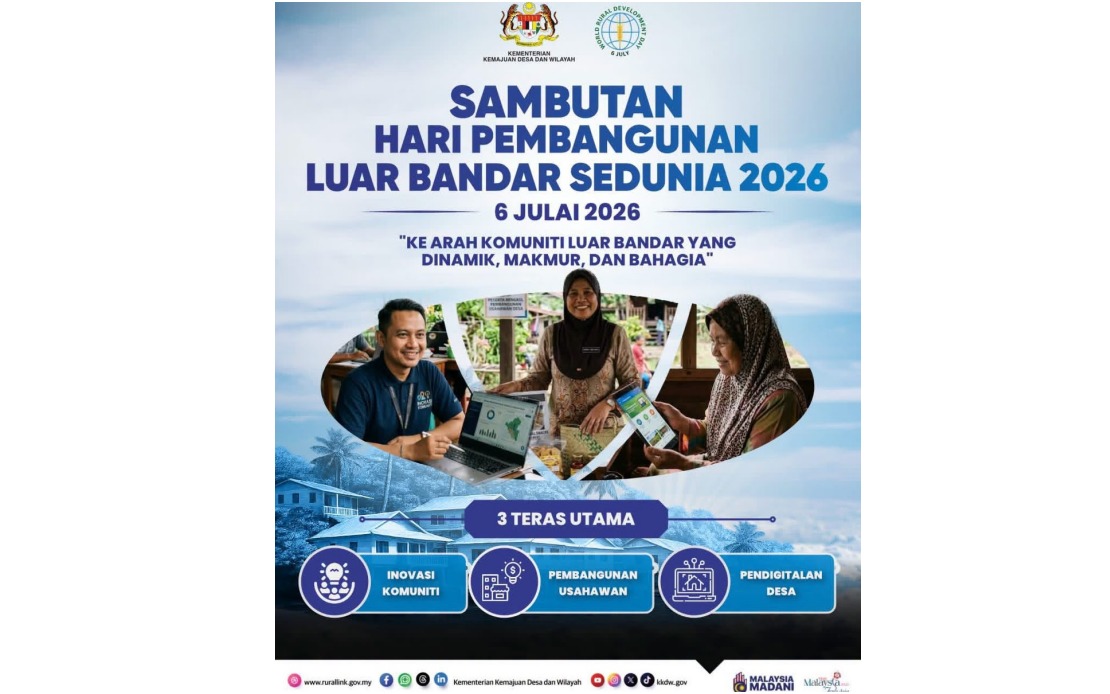
Malaysia is set to join the global community in observing the inaugural World Rural Development Day tomorrow at Tun Abdul Razak Stadium in Jengka, near Maran in Pahang. This first-time celebration marks a significant milestone for the country's commitment to recognising and supporting the rural population that has long been the backbone of national development. The occasion carries particular weight as it comes just months after the United Nations General Assembly formally established the international observance in September 2024, designating July 6 as the annual date for commemoration.
Deputy Prime Minister and Minister of Rural and Regional Development Datuk Seri Dr Ahmad Zahid Hamidi will officiate the celebration, which carries the thematic focus "Toward Vibrant, Prosperous and Happy Rural Communities." The choice of theme reflects a deliberate pivot toward aspirational rural development that goes beyond conventional approaches centred solely on infrastructure or income generation. Instead, the framing acknowledges the intricate relationship between economic opportunity, community agency and quality of life in Malaysia's rural areas, where nearly two million citizens still reside in conditions that lag significantly behind urban counterparts in terms of digital access and employment diversity.
The Ministry of Rural and Regional Development has structured the celebration around three interconnected pillars that together form a comprehensive blueprint for rural transformation. Community innovation serves as the foundation, recognising that rural residents themselves possess practical knowledge and creative solutions tailored to local contexts. Rural digitalisation represents the second thrust, addressing the persistent digital divide that has widened over the past decade despite national broadband initiatives. The third pillar, rural entrepreneur development, directly tackles unemployment and underemployment by fostering small and medium enterprise growth in non-agricultural sectors, a critical shift for rural economies heavily dependent on plantation work and subsistence farming.
These strategic priorities translate into tangible initiatives designed to expand economic participation and strengthen competitive capacity within rural communities. The government's approach signals recognition that rural development cannot be imposed from urban centres but must emerge from within communities themselves, supported by enabling infrastructure and access to markets. This philosophy aligns with international best practices highlighted in the United Nations Sustainable Development Goals, to which Malaysia remains committed through its 2030 agenda. The emphasis on digitalisation particularly addresses one of Malaysia's most pressing rural challenges: the absence of reliable broadband connectivity that prevents participation in the digital economy and limits access to education and healthcare services delivered increasingly through online platforms.
The celebration itself has been designed as an experiential event rather than a ceremonial function, featuring multiple components that showcase rural achievements and government initiatives. The Rural Aspiration Award MADANI will recognise individuals and organisations demonstrating exemplary contributions to rural advancement, while the Felda Plan Excellence Award celebrates achievements within the Federal Land Development Authority scheme that remains significant to rural livelihoods. The launch of the My Rural Insight Journal represents an institutional effort to document and disseminate best practices, creating a knowledge repository that can guide future policy interventions. Additionally, the announcement of Felcra Bhd's interim distributable profit distribution signals economic returns flowing back to rural stakeholders, with the 1/2026 declaration expected to provide direct financial benefits to Felcra members.
The choice of Jengka as the celebration venue is strategically significant, as the area represents one of Malaysia's major rural development schemes with substantial Felda settlements and agricultural operations. The location thus grounds the commemoration in a real community context where rural transformation is demonstrably occurring, lending authenticity to the government's development narrative. By situating the inaugural Malaysian celebration in an established rural development zone rather than a major city, authorities emphasise their orientation toward grassroots communities rather than symbolic gestures aimed at urban audiences.
Malaysia's participation in the World Rural Development Day observance places the country alongside other United Nations member states recognising the critical importance of rural areas to national development trajectories. The international dimension carries particular relevance across Southeast Asia, where rural-to-urban migration patterns, agricultural sector challenges and digital inequality mirror Malaysia's own experiences. Regional peers facing similar developmental pressures can potentially draw insights from Malaysia's integrated approach combining economic opportunity expansion, technological access and community empowerment as mutually reinforcing strategies rather than isolated policy domains.
The invitation to public attendance underscores an intention to make the celebration inclusive and participatory rather than an exclusive government affair. The KKDW exhibition booth and participating agency displays will provide information channels through which rural residents and urban visitors can engage directly with development initiatives, fostering greater understanding of available support mechanisms and programme opportunities. This transparency aligns with contemporary governance expectations that public celebrations serve educational functions alongside symbolic ones.
Looking forward, Malaysia's adoption of the World Rural Development Day framework creates an annual opportunity to take stock of rural progress, adjust policy priorities based on emerging evidence, and maintain political and bureaucratic attention to rural constituencies that frequently experience policy neglect outside election periods. The inaugural celebration establishes institutional momentum that can sustain focus on the three identified thrusts across government agencies and partner organisations throughout the year, potentially translating momentary high-level attention into sustained commitment to rural advancement initiatives.

