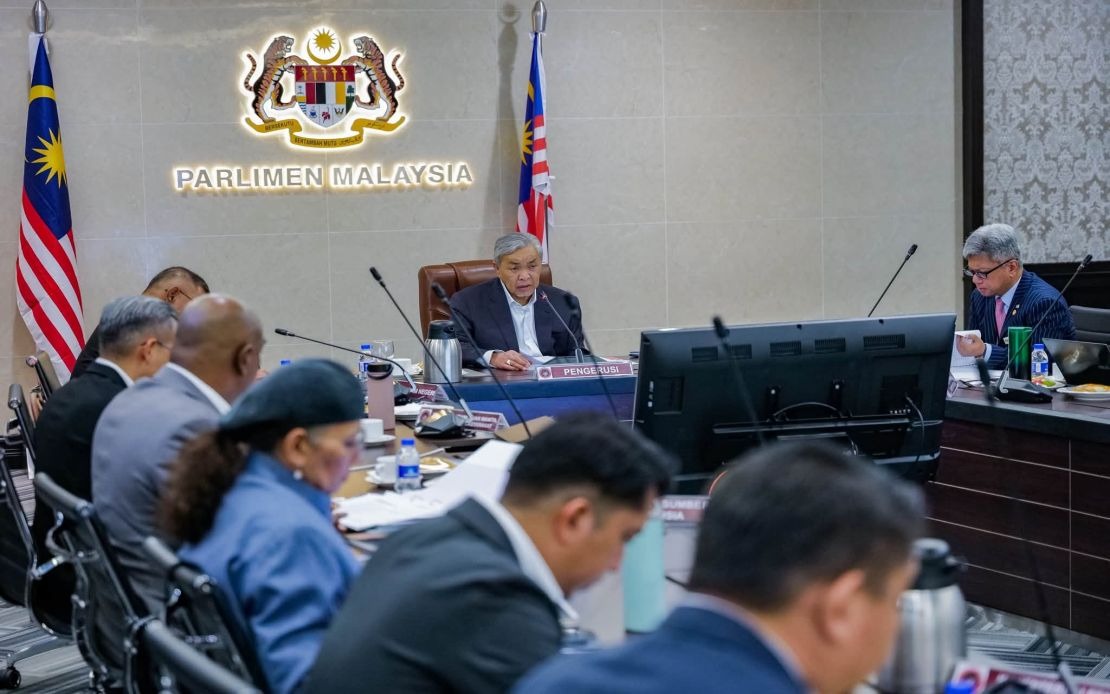
Malaysia's refugee policy must evolve to encompass both humanitarian compassion and robust national security safeguards, according to Deputy Prime Minister Datuk Seri Dr Ahmad Zahid Hamidi, who underscored the complexity of managing displacement amid unprecedented global instability. Speaking following a high-level committee meeting, Ahmad Zahid stressed that the nation cannot afford to treat refugee management as a purely administrative exercise divorced from security considerations. With the international community confronting a displacement crisis of staggering proportions, the Malaysian government recognises that sound refugee policy requires a dual-track approach that does not compromise either national interests or moral obligations.
The global context lending urgency to Ahmad Zahid's remarks is sobering. More than 122 million individuals have been forcibly displaced by armed conflict, persecution, and systemic instability across the world, creating unprecedented demand on host nations already stretched by economic and social pressures. This figure represents a historic peak in human displacement, reflecting the cascading effects of prolonged conflicts in Syria, Ukraine, Afghanistan, and the Sahel region, among others. For a middle-income Southeast Asian nation like Malaysia, which already hosts significant refugee and asylum-seeker populations, the international pressure to admit more displaced persons collides with legitimate domestic concerns about resource allocation, public safety, and social cohesion.
Ahmad Zahid's position reflects a pragmatic political stance increasingly adopted across the region. Malaysia has long been a transit point and host nation for Rohingya Muslims fleeing Myanmar, Pakistani and Afghan nationals, and others fleeing persecution. However, the sheer scale of global displacement now demands that Kuala Lumpur develop more systematic governance mechanisms rather than relying on ad-hoc humanitarian responses. The Deputy Prime Minister's emphasis on linking refugee policy to national security acknowledges domestic political sensitivities—public opinion in Malaysia, as in many countries, has grown more cautious about large-scale refugee intake, particularly when economic growth slows and competition for jobs intensifies.
The 6th Meeting of the High-Level Committee on the Management of Refugees and Asylum Seekers, which Ahmad Zahid chaired, represents an institutional effort to codify Malaysia's approach. By establishing a dedicated high-level body, the government signals that refugee management warrants sustained attention at the apex of the bureaucracy rather than being relegated to lower-tier agencies. This structural approach suggests that Kuala Lumpur views coherent refugee governance as essential to Malaysia's standing within both international humanitarian frameworks and as a sovereign nation entitled to control its borders and population flows. The committee's deliberations reflect growing recognition that ad hoc refugee policies invite inconsistency, exploitation, and public backlash.
Among the committee's concrete outputs is a review of the Refugee Registration Document (DPP), Malaysia's mechanism for identifying and tracking displaced persons. Strengthening this documentation system has dual benefits: it enables Malaysia to provide more targeted humanitarian assistance to verified refugees while simultaneously bolstering security agencies' ability to identify individuals who pose potential risks. This technical improvement exemplifies how modern refugee management need not pit security against compassion, but rather uses data and systematic processes to serve both objectives. The DPP's effectiveness directly influences whether refugee populations receive adequate healthcare, education, and livelihood support without creating parallel, ungoverned communities vulnerable to exploitation or radicalization.
Education and healthcare access represent particular flashpoints in Malaysia's refugee debate. The committee's focus on streamlining guidelines for these services reflects practical challenges: refugee children currently fall between categories—they are neither Malaysian citizens entitled to full public services nor entirely outside the state's purview. Harmonising administrative approaches across health ministries, education departments, and immigration authorities can reduce bureaucratic delays that leave refugee families without critical services. However, improved access also requires public buy-in. Malaysian citizens must perceive refugee assistance as targeted, efficient, and commensurate with aid to vulnerable Malaysian populations, or political support for refugee programmes will erode further.
Ahmad Zahid's invocation of "national interests" and "sovereignty" addresses the underlying political economy of refugee policy in Malaysia. Unlike wealthy Western nations with large social safety nets, Malaysia's middle-income status means resources devoted to refugees are resources unavailable for poverty reduction among Malaysian citizens—a politically volatile trade-off. Framing refugee policy within a security paradigm provides political cover for what would otherwise appear to be prioritising foreign nationals over locals. Whether this rhetorical strategy reflects genuine security concerns or constitutes political theatre partly depends on Malaysia's actual threat assessments, which remain classified. Either way, the government's public positioning suggests that future refugee admissions or protections will be conditioned on demonstrable alignment with national security interests.
The timing of Ahmad Zahid's statement reflects broader Southeast Asian trends. Thailand, Indonesia, and Bangladesh—all major refugee-hosting nations in the region—have similarly sought to tighten refugee policies even as displacement pressures mount. Malaysia's approach thus represents neither anomaly nor exception but rather part of a regional shift toward more managed, restrictive refugee governance. This synchronised movement raises concerns among international humanitarian organisations that the global burden-sharing mechanisms established after World War II are eroding, leaving responsibility concentrated on a handful of middle-income nations already operating near capacity.
For Malaysian policymakers, the challenge ahead involves threading a needle: maintaining sufficient refugee admission and protection mechanisms to preserve Malaysia's international reputation and honour humanitarian traditions, while implementing security and administrative controls that satisfy domestic constituencies demanding stricter immigration enforcement. The success of this balancing act will partly depend on whether Malaysian agencies can deliver on the improved coordination and simplified administration Ahmad Zahid described. If the DPP system remains cumbersome, healthcare and education guidelines continue to fragment, and refugee populations experience further marginalisation, public support for refugee protections will likely diminish further. Conversely, if the high-level committee can demonstrate that systematic management actually improves both security outcomes and humanitarian delivery, it might establish a viable model for other nations grappling with similar pressures.

