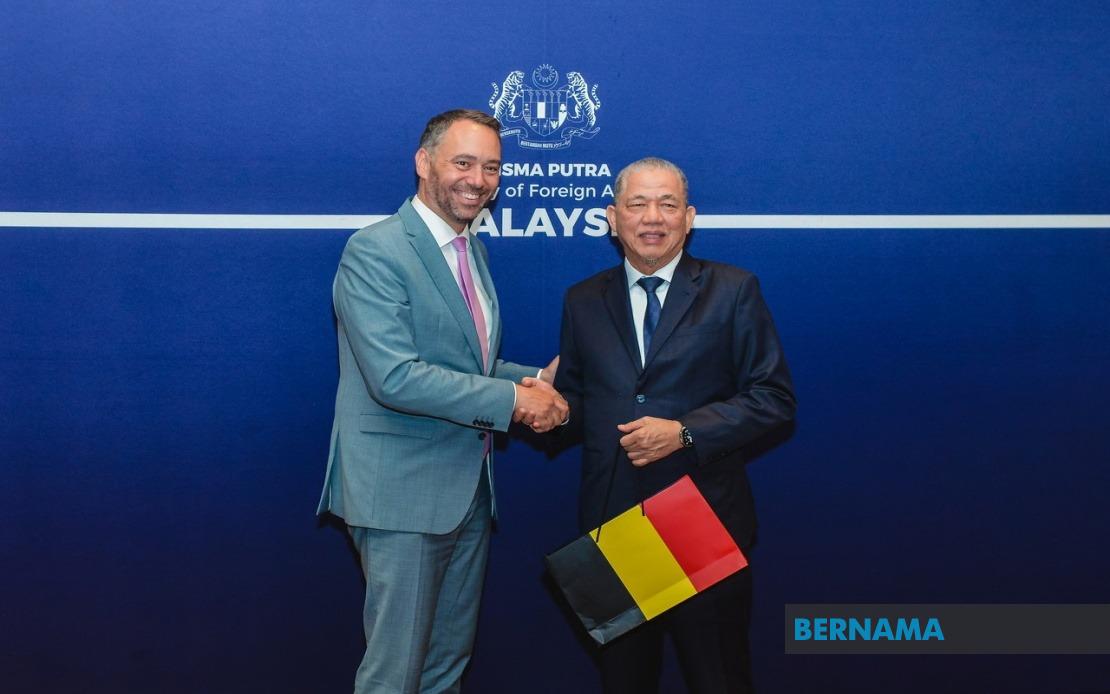
Malaysia has moved to reassure Belgium that international shipping lanes through the South China Sea will remain accessible and unobstructed, underscoring ASEAN's broader commitment to maintaining peace and neutrality in one of the world's most strategically important waterways. Deputy Prime Minister Datuk Seri Fadillah Yusof delivered this pledge during high-level talks with Belgium's Deputy Prime Minister and Minister of Foreign Affairs, European Affairs, and Development Cooperation, Maxime Prévot, who visited Malaysia on a two-day working visit beginning Thursday. The timing of the assurance reflects growing international anxiety about potential shipping disruptions in key maritime passages, with Belgium seeking clarity on whether the region faces similar risks to those experienced in the Strait of Hormuz.
Fadillah's explicit commitment that there will be no blockades of South China Sea shipping represents an important statement of regional intent, particularly given rising geopolitical tensions and competing territorial claims in the area. The deputy prime minister framed the guarantee within ASEAN's foundational principles, emphasizing that the bloc prioritizes security, neutrality, and open access as core tenets of its regional engagement strategy. This messaging appears designed to provide Brussels with confidence that Malaysia and its ASEAN partners view free maritime passage as essential to both regional stability and global trade flows.
Belgium's interest in Malaysia's assessment of South China Sea security suggests that European policymakers are increasingly attentive to maritime risks beyond their traditional spheres of concern. The comparison Prévot sought to make with the Strait of Hormuz underscores legitimate worries among international shipping stakeholders about potential chokepoints that could disrupt global commerce. For Malaysia, which maintains close economic ties to Europe and depends heavily on unobstructed maritime trade, such reassurances serve multiple purposes: they reinforce Malaysia's position as a responsible regional actor and stabilizing force in Southeast Asian affairs.
Beyond security matters, the bilateral engagement between Malaysia and Belgium encompassed a broad range of economic and strategic partnerships. Both nations agreed to intensify cooperation across government-to-government channels, business-to-business networks, and people-to-people exchanges, reflecting a mutual interest in deepening ties. Prévot signaled Belgium's commitment to expanding bilateral trade relationships and indicated his intention to review Belgium's travel advisory for Sabah, a move that could have practical implications for tourism and investment flows between the two countries.
The halal ecosystem emerged as a particularly noteworthy area of mutual interest, with Belgium proposing that Malaysia's established halal standards serve as a potential model for broader adoption across the European Union. Malaysia has developed one of the world's most comprehensive halal certification and quality assurance frameworks, and European interest in harmonizing standards with Malaysian practices could create opportunities for Malaysian enterprises while strengthening ties to the EU market. This discussion illustrates how Malaysia's expertise in specialized regulatory domains can translate into soft power and economic advantage in bilateral relationships.
Energy transition and technological innovation formed another pillar of the discussions between Fadillah, who holds the portfolio of Minister of Energy Transition and Water Transformation, and his Belgian counterpart. Belgium possesses considerable expertise in renewable technologies and advanced materials development, domains increasingly critical to Malaysia's transition toward a lower-carbon economy. The two sides explored mechanisms for encouraging Belgian corporate investment in Malaysia's energy transition initiatives, potentially opening pathways for technology transfer and joint ventures in emerging green industries.
The venue chosen for these talks—a formal luncheon hosted by Malaysia's deputy prime minister—signals the diplomatic weight assigned to strengthening the bilateral relationship. The presence of Tan Sri Amran Mohamed Zin, the Foreign Ministry Secretary-General, and Peter Van Acker, Belgium's Ambassador to Malaysia, underscored the official nature of the engagement and demonstrated institutional commitment to advancing shared interests.
PreVot's visit, his first to Malaysia since taking office in February 2025, occurs within a broader context of European nations reassessing their Asia-Pacific strategies. Belgium's focus on Malaysian regional perspectives regarding South China Sea security reflects Europe's attempt to understand regional dynamics from the standpoint of nations directly affected by territorial disputes and maritime challenges. For Malaysia, engaging with European powers on these issues allows for articulation of ASEAN's perspective to influential Western policymakers and contributes to shaping international discourse around regional stability.
The emphasis on neutrality and open access in Fadillah's statements aligns with Malaysia's consistent diplomatic positioning on South China Sea issues. Rather than aligning with any particular power in regional disputes, Malaysia has sought to maintain balanced relationships with major stakeholders while advocating for rules-based mechanisms, the implementation of the Code of Conduct currently being negotiated among ASEAN and China, and commercial freedom of navigation. This approach reflects Malaysia's understanding that its prosperity depends on maintaining good relations across the geopolitical spectrum while ensuring that maritime commerce remains unimpeded.
The timing of these discussions also warrants consideration within the context of evolving global supply chains and trade flows. Belgium, as a major European trading hub and home to significant logistics infrastructure, has tangible interest in ensuring that Asian maritime passages remain open and predictable. Malaysia's position as a Southeast Asian hub connecting multiple shipping routes makes it a natural interlocutor for such discussions.
Moving forward, the outcomes of this bilateral engagement may influence how Malaysia approaches its roles in ASEAN forums and broader regional groupings when discussing maritime security. The assurances offered to Belgium reflect not merely diplomatic courtesy but substantive commitments that will shape Malaysia's policy stance on freedom of navigation, territorial issues, and regional security architecture.
The visit underscores that while ASEAN nations manage complex regional challenges, they remain committed to engaging with international partners on matters of shared concern. Malaysia's effort to articulate ASEAN's position on South China Sea access—coupled with Belgium's receptiveness to engaging seriously on Asian security matters—demonstrates the continuing relevance of dialogue and reassurance in managing potential global disruptions to commerce and stability.

