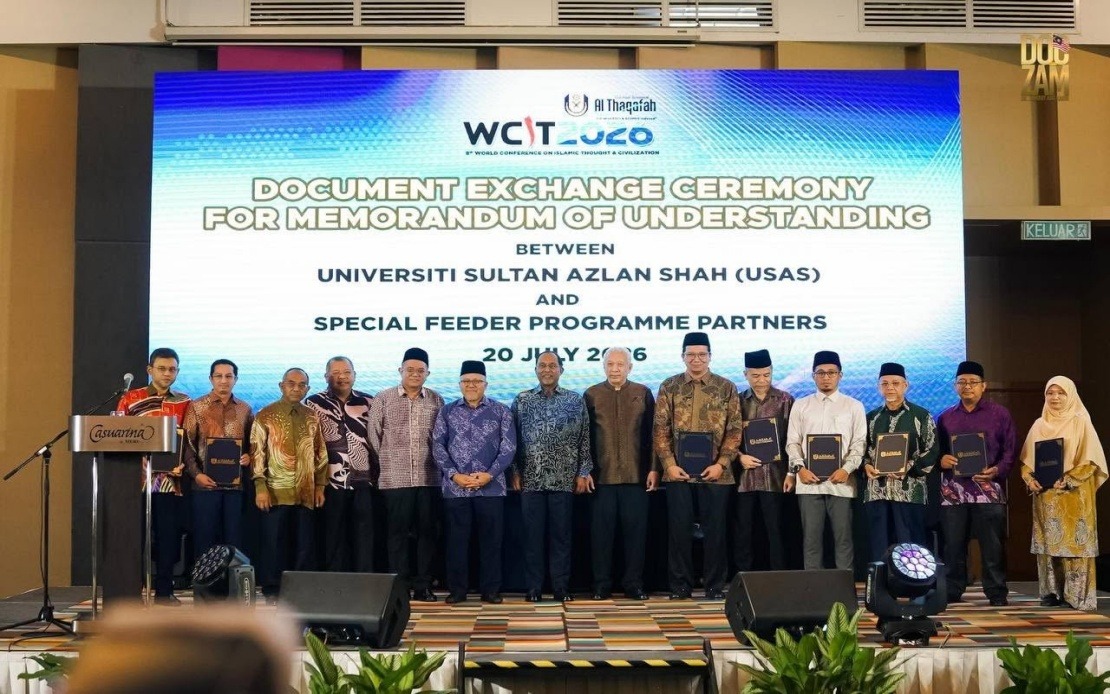
Malaysia has renewed its pledge to function as a conduit for international academic exchange and a nucleus of educational distinction, particularly within the Islamic world, as the 8th World Conference on Islamic Thought and Civilisation gets underway. Higher Education Minister Datuk Seri Dr Zambry Abdul Kadir articulated this vision during his address at a preparatory gathering in Ipoh, underscoring the nation's broader ambitions to nurture a knowledge ecosystem grounded in inclusivity, progressive thinking, and shared values. The positioning reflects Malaysia's strategic objective to leverage its multicultural character and established academic infrastructure to facilitate meaningful dialogue among diverse scholarly communities grappling with contemporary challenges.
The conference, known as WCIT2026, represents a significant gathering that aims to convene intellectual leaders, academics, and researchers from multiple nations to deliberate on pressing issues facing the Islamic world and humanity at large. Over 180 delegates, scholars, and thought leaders converged in Ipoh for the preliminary dinner event hosted by Universiti Sultan Azlan Shah (USAS), signalling the scale and ambition of this triennial assembly. The participation of such a diverse contingent underscores the appeal of Malaysia as a venue for cross-cultural and inter-faith intellectual engagement, positioning the country as more than merely a host but as an active contributor to global scholarly discourse.
In his keynote remarks, Zambry articulated a crucial message to the assembled academic community: the Muslim world cannot afford to dwell solely on historical achievements but must chart a future anchored in contemporary knowledge creation and innovation. He contended that the advancement of the ummah—the global Islamic community—depends fundamentally on robust research ecosystems, transformative educational institutions, and leadership rooted in ethical principles rather than expedience. This formulation distinguishes between nostalgic veneration of past intellectual achievements and the harder work of building modern capacity for original thought and technological advancement. For Malaysia specifically, this rhetoric positions higher education reform and research investment as national imperatives aligned with broader regional development goals.
The minister's emphasis on keeping education insulated from political manipulation and sectarian conflict carries particular resonance in contemporary Southeast Asia, where universities increasingly face pressures to serve narrow ideological agendas. Zambry's assertion that knowledge constitutes a common inheritance of all humanity rather than a possession to be monopolised by single nations or traditions reflects an integrationist approach to academic life. This framework potentially appeals to Malaysian universities seeking to maintain international competitiveness and attract global talent while remaining grounded in Islamic values. The tension between universal knowledge claims and particularist religious commitments remains delicate, yet the minister's formulation suggests these need not be irreconcilable.
The references to historical destruction—Baghdad, Granada, Sarajevo, and Palestine—serve a dual rhetorical function in the minister's discourse. Superficially, these examples illustrate the catastrophic consequences of conflict for intellectual infrastructure and cultural memory. More substantively, they anchor the conference's work within a broader narrative of civilisational vulnerability and the imperative to protect knowledge institutions as foundations of future prosperity. The invocation of Baghdad's fall to Mongol forces in 1258 particularly resonates within Islamic intellectual circles as a watershed moment when centuries of accumulated scholarship were consumed by fire. For contemporary policymakers in Malaysia and elsewhere, such historical reflections implicitly justify increased investment in universities and research facilities as strategic national assets requiring protection equivalent to military or economic infrastructure.
The three-day duration of WCIT2026 and the expectation that it will generate concrete resolutions and policy recommendations underscore the conference's ambition to transcend academic abstraction and produce actionable outcomes. For Malaysian higher education leadership, hosting such a gathering provides opportunities to position local institutions as solution-oriented and engaged with real-world challenges rather than sequestered in ivory towers. It also creates platforms for Malaysian scholars to elevate their profiles within international Islamic intellectual networks, potentially attracting research collaborations and student exchanges that strengthen the nation's educational ecosystem.
The framing of Malaysia as a strategic partner in knowledge development carries implications for regional stability and cooperation. By positioning itself as custodian of inclusive dialogue spaces, Malaysia differentiates itself from more ideologically rigid approaches to religious education and scholarship. This positioning aligns with the country's historical brand as a moderate Islamic nation capable of balancing religious commitment with pluralism. For neighbouring countries managing their own tensions between religious identity and secular governance, Malaysia's model offers both inspiration and cautionary lessons.
The conference also represents an opportunity to examine how Islamic thought traditions address contemporary governance challenges including climate change, technological disruption, and economic inequality. By bringing together diverse perspectives under the rubric of Islamic civilisation, WCIT2026 potentially generates insights applicable far beyond religious contexts, contributing to global conversations on sustainable development and ethical innovation. Malaysian universities participating in such deliberations gain credibility and visibility as institutions capable of engaging substantively with both traditional Islamic learning and modern scientific inquiry.
Moving forward, the success of WCIT2026 will be measured not merely by attendance figures or media coverage but by the durability of networks established and the practical application of ideas generated. For Malaysia's higher education sector, the conference represents both an immediate diplomatic achievement and a longer-term investment in positioning the country as an indispensable node within global knowledge networks. The minister's framing of education as lying beyond politics, while aspirational, reflects the genuine stakes involved in protecting academic autonomy and intellectual freedom as foundations for national and regional progress. Whether Malaysia can sustain this vision amid competing pressures remains an open question requiring sustained commitment from policymakers and institutional leaders alike.

