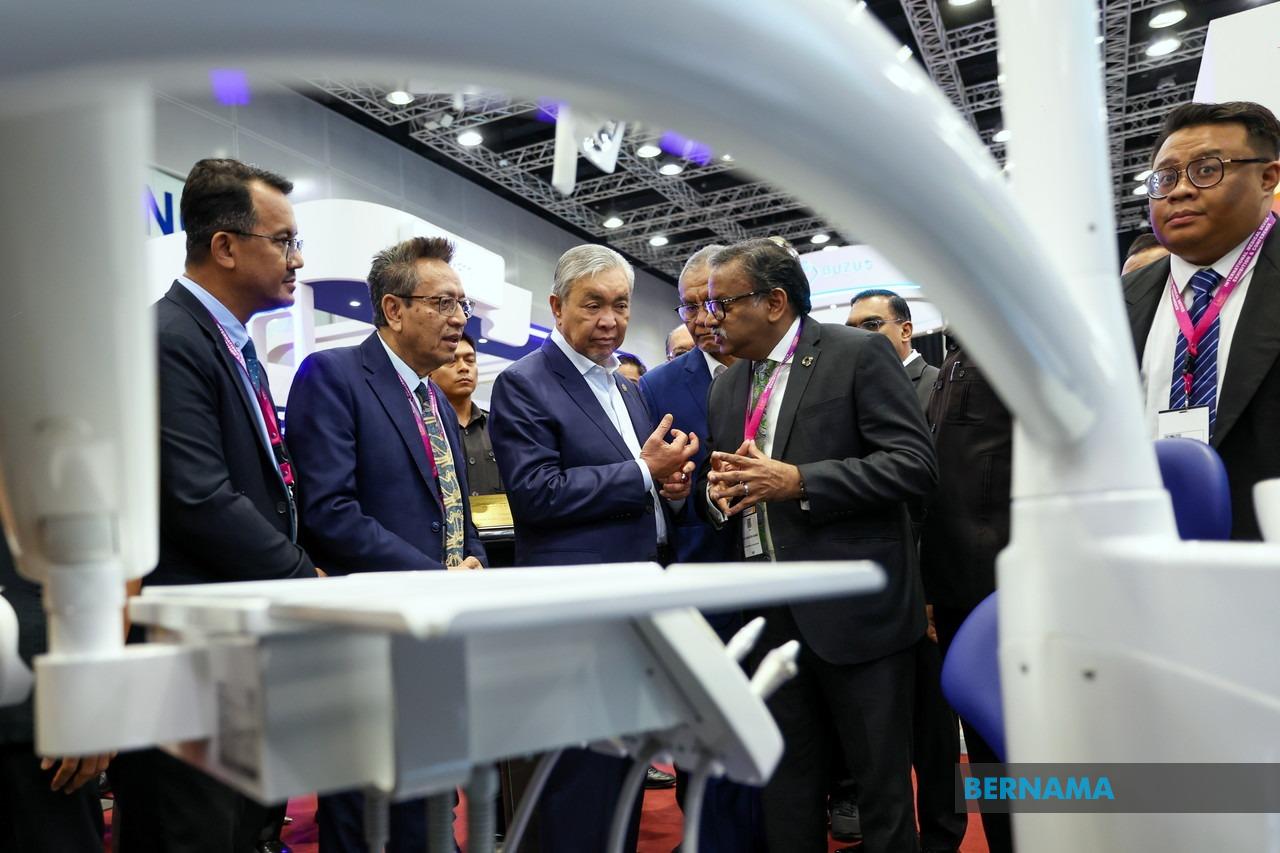
Malaysia has set an ambitious course to transform its medical technology sector by 2030, with Deputy Prime Minister Datuk Seri Dr Ahmad Zahid Hamidi declaring that the nation should surpass RM50 billion in medical device exports—a significant jump from the RM34.54 billion achieved in the previous year. The target represents a deliberate shift in economic strategy, moving beyond Malaysia's traditional role as a manufacturing hub for established international firms towards becoming a centre of innovation and intellectual property creation in the region.
Ahmad Zahid presented three interconnected ambitions designed to chart the sector's trajectory over the coming decade, each addressing a critical dimension of industrial development. Beyond the headline export target, Malaysia intends to cultivate at least ten homegrown MedTech champions capable of standing alongside regional and global competitors. This aspiration reflects a recognition that sustainable growth depends not merely on attracting foreign investment but on nurturing domestic enterprises that own their technologies and control their competitive advantages. The strategy acknowledges that Malaysia possesses the foundational elements—established manufacturing infrastructure, proven market access, and demonstrated credibility with international partners—but must now leverage these strengths to move up the value chain.
The third pillar of the strategy concerns workforce quality and composition. Ahmad Zahid emphasised that at least half of all employment generated by new MedTech investments should comprise managerial, technical, and supervisory positions, a significant upgrade from the current 33.1 per cent achieved in 2025. This focus on job quality underscores a broader concern that rapid industrialisation without corresponding skills development can trap countries in low-wage, low-skill equilibrium. By insisting that capital investments be paired with capability-building initiatives, Malaysia seeks to ensure that the sector's expansion translates into genuine economic uplift for workers and sustainable competitive advantage for the nation.
Ahmad Zahid's remarks at the closing ceremony of the International Medical Device Exhibition and Conference 2026 stressed an important principle: attracting investment is necessary but insufficient. "Capital may enter Malaysia, but capability must remain in Malaysia," he stated, articulating a concern that characterises discussions about industrial development throughout Southeast Asia. The statement reflects frustration with arrangements where multinational corporations establish low-value assembly operations in developing nations, capture most profits through intellectual property, and depart when labour costs rise. Malaysia's strategy seeks to invert this dynamic by making domestic capability—in research, design, manufacturing, and management—the foundation of competitiveness.
The Deputy Prime Minister, who also chairs the National Technical and Vocational Education and Training Council, called for closer collaboration between educational institutions and private investors before investment commitments materialise. Rather than waiting until workforce gaps emerge, international firms should engage early with Malaysian educational partners to shape training programmes, anticipate future skill requirements, provide practical industrial experience, and expand apprenticeship opportunities. This proactive approach to skills development aims to reduce time-to-productivity for new investments while building a pipeline of workers genuinely prepared for advanced manufacturing roles.
Context for these ambitions emerged from recent performance data. In 2025 alone, Malaysia approved RM4 billion in new medical device investments spanning forty-six separate projects, which collectively created nearly 3,400 employment opportunities. These figures demonstrate that Malaysia remains an attractive destination for MedTech capital, but also highlight the scale of transformation required. If current investment levels persist and employment generation continues at similar rates, Malaysia will need sustained policy focus and targeted interventions to ensure that the quality dimension keeps pace with quantitative expansion.
The global context amplifies both the opportunity and the urgency. The worldwide medical device industry, valued at over USD572 billion in the previous year, is projected to expand beyond USD1 trillion by 2034—a trajectory driven by ageing populations, rising chronic disease prevalence, and technological advancement. Malaysia's target of RM50 billion in exports represents an effort to capture growing market share as global demand accelerates. However, competition remains fierce, with established players in Europe and North America, rising producers in India and China, and other Southeast Asian nations pursuing similar strategies. Malaysia's differentiation must rest on consistent quality, innovative capacity, and the availability of skilled technical workforces.
The IMDEC 2026 gathering, held from 26 to 28 August, brought together more than 160 exhibitors and over fifty regional and international speakers focused on regulation, innovation, and healthcare transformation. The conference reflected Malaysia's position as a convening point for MedTech discussions in the region and an increasingly sophisticated market for medical device innovation. The breadth of participation suggests that international companies and regional competitors regard Malaysia as strategically important to their expansion plans, validating the government's assessment that Malaysia possesses genuine competitive strengths.
For Malaysian readers and policymakers, the significance of Ahmad Zahid's pronouncements extends beyond sectoral economics. The MedTech industry represents a test case for whether Malaysia can transition from manufacturing-dependent growth to innovation-driven development. Success would demonstrate that the nation can attract sophisticated investment, develop world-class technical talent, and build globally competitive enterprises. Conversely, failure would suggest that structural constraints—whether in education, regulatory frameworks, or institutional capacity—limit Malaysia's upward mobility. The three-pillar strategy addresses these dimensions explicitly, making the coming decade a critical period for assessing Malaysia's capacity for industrial transformation in a competitive regional environment.

