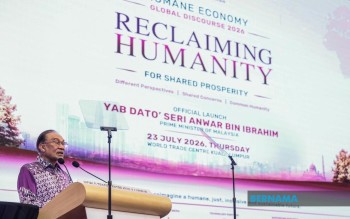
Prime Minister Datuk Seri Anwar Ibrahim has signalled that the government's budget preparation machinery will shift into high gear next month, with formal submission to Parliament targeted for early October. Speaking in his capacity as both head of government and Finance Minister, Anwar outlined the timeline during his keynote address at the Humane Economy Global Discourse (HEGD) 2026 in Kuala Lumpur, providing clarity on the administration's fiscal planning calendar as Malaysia charts its economic direction for the coming year.
The announcement underscores the government's commitment to maintaining a structured and deliberate approach to budgetary planning, a process that requires coordination across multiple ministries and agencies to align spending priorities with broader policy objectives. The August commencement date allows roughly two months for comprehensive formulation before the October tabling, a window that encompasses departmental consultation, economic modelling, and parliamentary coordination. This timeline sits within Malaysia's established practice of presenting budgets during the final quarter of the preceding calendar year, allowing lawmakers adequate time for scrutiny and amendment before implementation.
Crucially, Anwar framed Budget 2027 not merely as a fiscal exercise in revenue and expenditure management, but as a mechanism for realigning economic philosophy toward human welfare and dignity. He articulated a fundamental reorientation of how government measures economic success, rejecting the notion that stronger growth figures, expanded consumption, or increased wealth concentration constitute adequate measures of prosperity. This departure from conventional economic metrics reflects growing international discourse around inclusive growth and stakeholder capitalism, concepts that have gained traction among policymakers grappling with rising inequality and social fragmentation.
The Prime Minister's emphasis on translating growth into tangible improvements in daily life speaks to palpable anxieties among Malaysian households about purchasing power, employment security, and access to essential services. Wage stagnation, housing affordability crises, and healthcare costs remain flashpoint issues for ordinary citizens, particularly in urban areas where cost-of-living pressures have intensified. By positioning Budget 2027 as a vehicle for addressing these concerns, Anwar signals that future fiscal policy will prioritise outcomes measurable in household income, job quality, and service accessibility rather than aggregate growth rates alone.
Anwar's philosophical framework demands that policymakers interrogate major fiscal decisions through a moral lens, asking whether specific spending allocations widen or narrow economic opportunity for ordinary Malaysians. This questioning mirrors emerging frameworks in global development economics that distinguish between growth that disperses opportunity broadly versus growth that concentrates wealth among existing power holders. For Malaysia, a middle-income nation grappling with persistent regional inequality and skill gaps in its workforce, such scrutiny carries practical implications for infrastructure investment, education spending, and social safety net design.
The government's concurrent pursuit of semiconductor strategy, energy transition, and digital transformation will feature prominently in Budget 2027's architecture. These sectoral priorities represent Malaysia's attempt to position itself within global value chains undergoing rapid reconfiguration due to geopolitical tensions and technological change. However, Anwar's framing insists that these ambitious industrial policies cannot succeed without anchoring them to social purpose. A semiconductor manufacturing boom that generates wealth concentrated among foreign investors and urban elites, for instance, would contradict the human-centred development framework he articulated.
Prosperty must manifest as improved wage outcomes for working Malaysians, the Prime Minister stressed, reflecting acknowledgement that headline growth figures obscure stagnant real incomes for many households. The emphasis on meaningful work recognises that employment quality matters as much as employment quantity in shaping life satisfaction and economic security. Similarly, positioning affordable housing, accessible healthcare, and quality education as explicit prosperity measures elevates these perennially underfunded areas into central budget considerations rather than peripheral social expenditures.
Sustainability emerged as another pillar in Anwar's vision, framed distinctly as an intergenerational obligation to avoid transferring environmental, fiscal, or social burdens to future generations. This articulation carries particular resonance in Malaysia, where environmental degradation from palm oil expansion, plastic pollution, and uncontrolled development has accelerated in recent decades. Budget 2027's approach to natural resource pricing, environmental compliance mechanisms, and climate adaptation investments will test whether this rhetoric translates into fiscal reality.
Innovation's role in expanding rather than deepening human capabilities represents perhaps the most transformative aspect of Anwar's framework. Technology adoption in Malaysia has generated concerns about job displacement, skill obsolescence, and widening divides between digital-literate and digital-excluded populations. By positioning innovation as serving human flourishing rather than merely productivity gains, Anwar suggests Budget 2027 will allocate resources toward digital literacy programmes, skills retraining, and technology access infrastructure alongside capital-intensive innovation projects.
The budgetary process beginning next month will reveal whether this philosophical reorientation possesses sufficient practical force to reshape spending priorities or remains confined to rhetorical positioning. Past Malaysian budgets have frequently articulated ambitious social objectives while fiscal allocations reflected competing pressures and institutional inertia. Implementation capacity, political will to reorder entrenched spending patterns, and resilience against revenue shortfalls will ultimately determine whether Budget 2027 emerges as genuinely transformative or merely incremental tinkering within existing frameworks.
The early October tabling timeline also positions Budget 2027 within Malaysia's broader political calendar, offering government an opportunity to demonstrate responsiveness to public concerns during a period when electoral sentiment may begin hardening toward the next national polls. The messaging around human-centred economics appeals to broad constituencies—from workers anxious about employment quality to young families struggling with housing costs—potentially recalibrating public perception of the administration's economic priorities before potentially consequential electoral contests.

