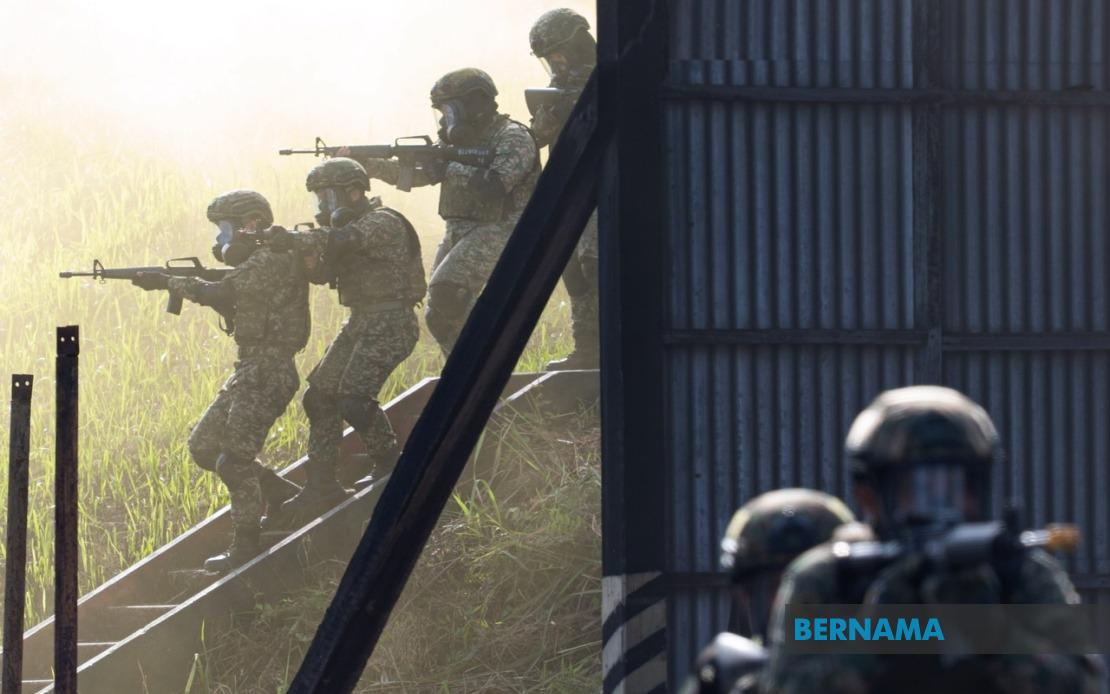
Prime Minister Datuk Seri Anwar Ibrahim has committed to securing a higher defence budget allocation for 2027, signalling the government's determination to strengthen operational capabilities across the Malaysian Armed Forces. Speaking in Melaka on August 7, Anwar, who also holds the Finance Minister portfolio, underscored the critical importance of maintaining robust military readiness in an increasingly complex regional security environment. The pledge reflects a strategic reassessment of Malaysia's defence priorities as the country navigates evolving threats and challenges in Southeast Asia's geopolitical landscape.
Anwar's remarks on defence spending underscore a fundamental principle: that national peace represents the country's most valuable asset and requires continuous investment to protect. His statement that "conflicts do not occur when expected" carries particular resonance given the fluid security situation across Southeast Asia, where territorial disputes, maritime tensions, and transnational security threats remain persistent concerns. The Prime Minister's emphasis on proactive preparedness rather than reactive crisis management suggests a shift towards more systematic long-term defence planning, a departure from ad-hoc spending patterns that have historically characterised Malaysian defence budgets.
The government has already demonstrated commitment to defence modernisation through substantial budget increases. Over the past three years under the MADANI administration, defence allocation has grown by more than 35 per cent—a significant expansion that Anwar noted remains underappreciated by the general public. This funding increase has already begun reshaping the military landscape, though the Prime Minister acknowledged that visible improvements in equipment condition and operational capability have not matched public awareness of these investments. The disconnect between actual spending and public perception suggests that communication about defence investments requires improvement.
The planned increases for 2027 will address multiple dimensions of military readiness beyond hardware procurement. Personnel welfare constitutes a substantial component, including upgraded accommodation facilities, construction of a new military hospital, and maintenance of essential infrastructure such as water supplies at barracks and bases. These welfare improvements carry significant implications for force retention and morale, particularly as the military competes with civilian employers for skilled professionals in a tightening labour market. Better living conditions and healthcare facilities at military installations help attract and retain quality personnel, directly translating to operational effectiveness.
Anwar placed particular emphasis on the transparency and accountability mechanisms governing defence procurement, a sensitive issue that has historically attracted controversy in Malaysia and across Southeast Asia. His directive that military acquisitions proceed "systematically and transparently, without profiteering or excessive commissions paid to outside agents" signals renewed focus on preventing corrupt practices in defence spending. This approach aligns with broader government anti-corruption initiatives and international defence procurement standards, potentially positioning Malaysia as a regional leader in defence governance transparency. The focus on eliminating middlemen and unnecessary commissions could significantly improve the value-for-money proposition of defence spending.
Macroeconomic conditions have created fiscal space for enhanced defence investments. Anwar connected the defence spending increase to improving economic fundamentals, including a strengthening ringgit, increased foreign direct investment inflows, and inflation contained within acceptable ranges. These positive economic indicators provide the government with greater budgetary flexibility compared to recent years when currency weakness and fiscal constraints limited policy options. The correlation between economic health and defence capacity underscores how broader economic management directly influences military capabilities—a consideration often overlooked in defence policy discussions.
The timing of Budget 2027, scheduled for presentation to Parliament on October 9, creates a focal point for defence policy debates. The budget announcement will provide concrete figures on defence allocation increases and reveal specific procurement priorities, equipment modernisation programmes, and personnel development initiatives. For defence analysts, regional observers, and military stakeholders, these details will indicate whether the government's defence commitments translate into sustained resource commitments or represent aspirational statements constrained by competing fiscal priorities.
The announcement included symbolic investments in military-linked welfare activities, with RM147,000 allocated to the Armed Forces Family Welfare Association and RM1 million dedicated to maintaining mosques and prayer halls at four military installations in Melaka—Terendak, Sungai Udang, Masjid Tanah, and Bukit Beruang. These allocations, while modest in budgetary terms, reflect government attention to the holistic welfare of military personnel and their families, acknowledging that military readiness depends partly on quality-of-life considerations beyond operational equipment.
For Malaysia and the broader Southeast Asian region, enhanced defence spending carries multiple implications. Regional powers including Singapore, Thailand, Indonesia, and Vietnam have substantially increased military investments in recent years, creating competitive dynamics that Malaysia cannot entirely ignore. However, Malaysian defence spending remains constrained by competing development priorities and fiscal limitations, requiring strategic prioritisation of capabilities most relevant to maritime security, cyber threats, and counterterrorism operations. The 2027 budget will reveal how defence planners reconcile ambitious readiness objectives with realistic budgetary constraints.
Anwar's defence spending commitment also reflects evolving security perceptions within Malaysia's political and military establishment. The emphasis on territorial protection, equipment modernisation, and personnel welfare suggests recognition that military capabilities require sustained investment rather than episodic funding bursts. This longer-term perspective potentially improves defence planning coherence and allows for more sophisticated acquisition strategies that balance immediate needs against emerging future requirements.
The government's defence spending trajectory will face scrutiny from multiple quarters—international defence analysts evaluating regional military balances, domestic constituencies concerned about fiscal prioritisation, and military leadership seeking resources for modernisation programmes. The success of the 2027 budget in advancing defence objectives will depend not merely on total allocation levels but on how effectively resources are deployed, how transparently procurement processes operate, and whether spending priorities align with Malaysia's specific security requirements and geographical circumstances.

