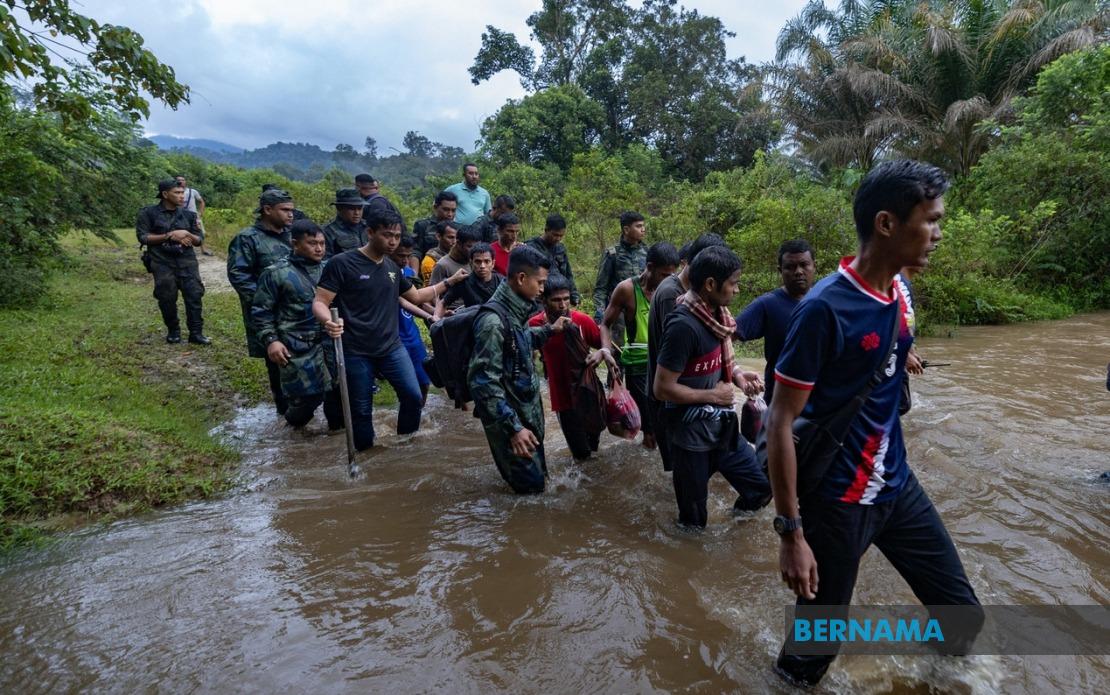
Malaysia has committed to deepening its engagement with both ASEAN member states and the United Nations High Commissioner for Refugees in tackling the ongoing Rohingya refugee emergency, moving towards a framework that combines diplomatic pressure with humanitarian provision. Deputy Foreign Minister Datuk Lukanisman Awang Sauni outlined this multifaceted strategy during a parliamentary session, signalling that Kuala Lumpur recognises the complexity of an issue that extends far beyond border management into questions of regional security and human rights protection.
The Malaysian government's dual-track approach reflects a fundamental tension in regional policymaking. On one hand, the country has consistently leveraged ASEAN forums to advocate for a negotiated end to the Myanmar crisis that would address its root causes. On the other, Malaysia works alongside the UNHCR to ensure immediate protection for the hundreds of thousands of Rohingya who have fled persecution, with many currently sheltering in Malaysian communities or attempting perilous sea crossings to reach safety. This balancing act underscores Kuala Lumpur's view that neither diplomatic pressure alone nor humanitarian assistance in isolation can resolve what remains one of Asia's most intractable displacement crises.
Lukanisman acknowledged a critical reality that often goes unstated in public discourse: the structural constraints that limit both ASEAN's collective impact and the UNHCR's ability to engineer lasting change. ASEAN's founding principle of non-interference in member states' internal affairs, whilst designed to respect sovereignty, has effectively prevented the bloc from taking decisive action against the Myanmar military regime. Similarly, the UNHCR's mandate, though essential for refugee protection, does not extend to addressing the political grievances and ethnic tensions that originally displaced the Rohingya. These institutional limitations mean that current regional efforts, despite genuine commitment from countries like Malaysia, remain primarily focused on damage mitigation rather than root-cause resolution.
The existence of cross-border spillover effects gives Malaysia particular urgency in pursuing this agenda. Rohingya displacement has created conditions for human trafficking networks to flourish, enabling organised crime groups to exploit vulnerable refugees. Irregular migration patterns triggered by the crisis also strain Malaysia's capacity to manage its own maritime boundaries and internal security. Beyond these law-and-order concerns lies a humanitarian dimension: Malaysia hosts one of the largest Rohingya populations outside of camps in Bangladesh and Cox's Bazar, placing substantial burdens on local communities and social services. These interlocking challenges explain why Kuala Lumpur views the Rohingya question not merely as a Myanmar problem but as a direct threat to regional stability and a test of ASEAN's collective commitment to human rights.
Looking ahead, Malaysia has signalled openness to exploring several complementary strategies designed to move beyond the current holding pattern. Enhanced responsibility-sharing mechanisms among ASEAN member states would distribute the burden of hosting and supporting Rohingya populations more equitably across the region, rather than concentrating pressure on frontline countries like Malaysia, Bangladesh, and Indonesia. Such an approach would require each ASEAN nation to commit resources and political capital proportionate to its capacity and geographic position, a proposition that remains contentious among bloc members with varying economic resources and security concerns.
A second strategic pillar involves rekindling political dialogue aimed at creating conditions for voluntary, safe, and dignified return. This phrasing is deliberately precise: forced repatriation without genuine security guarantees and political reform in Myanmar would simply recreate the conditions that generated displacement in the first place. Malaysia's emphasis on dignity and voluntarism suggests it will not endorse schemes that merely move the problem from one location to another. Any viable return framework would require credible commitments from the Myanmar authorities regarding citizenship rights, minority protection, and accountability for past atrocities—commitments that currently appear distant given the military junta's grip on power.
The deputy foreign minister's remarks also position Malaysia's Rohingya engagement within a broader international identity that Kuala Lumpur wishes to project. By framing this issue through the lens of regional stability, humanitarian responsibility, and peace-building, Malaysia seeks to reinforce its role as a constructive ASEAN actor while also signalling to the international community that it takes its obligations to vulnerable populations seriously. This matters not only for Malaysia's diplomatic standing but also for its relationship with countries that have been critical of ASEAN's perceived passivity on Myanmar.
The parliamentary statement itself deserves scrutiny as a political act. By allowing the Rohingya question to be raised and addressed directly in the Dewan Rakyat, the government demonstrates that this is no longer a peripheral issue discussed quietly in back channels. The query from Datuk Seri Dr Shahidan Kassim, representing a Perlis constituency, also hints at domestic political dimensions: opposition-aligned or independent lawmakers may be signalling to their constituents that the government's management of this crisis warrants parliamentary oversight.
Looking across Southeast Asia, Malaysia's strategic recalibration holds lessons for neighbouring countries facing similar dilemmas. Thailand, Indonesia, and Bangladesh each host significant Rohingya populations and face comparable pressures from trafficking networks and irregular migration. A more coordinated regional approach, if Malaysia's proposal gains traction, could establish norms and mechanisms that benefit all affected states. Conversely, if ASEAN consensus continues to fracture on Myanmar issues, individual countries may pursue unilateral policies that further destabilise the regional landscape.
The fundamental challenge remains that neither Malaysia nor any other ASEAN state possesses sufficient leverage to force political change in Myanmar. The military leadership has shown little interest in the diplomatic overtures that ASEAN has offered, and external pressure from Western countries is often dismissed as neo-colonial interference. Within this constrained environment, Malaysia's strategy of reinforcing humanitarian frameworks while quietly pushing for incremental political progress may represent the most realistic path forward, even if it falls short of the comprehensive solution that the scale of the crisis demands.

