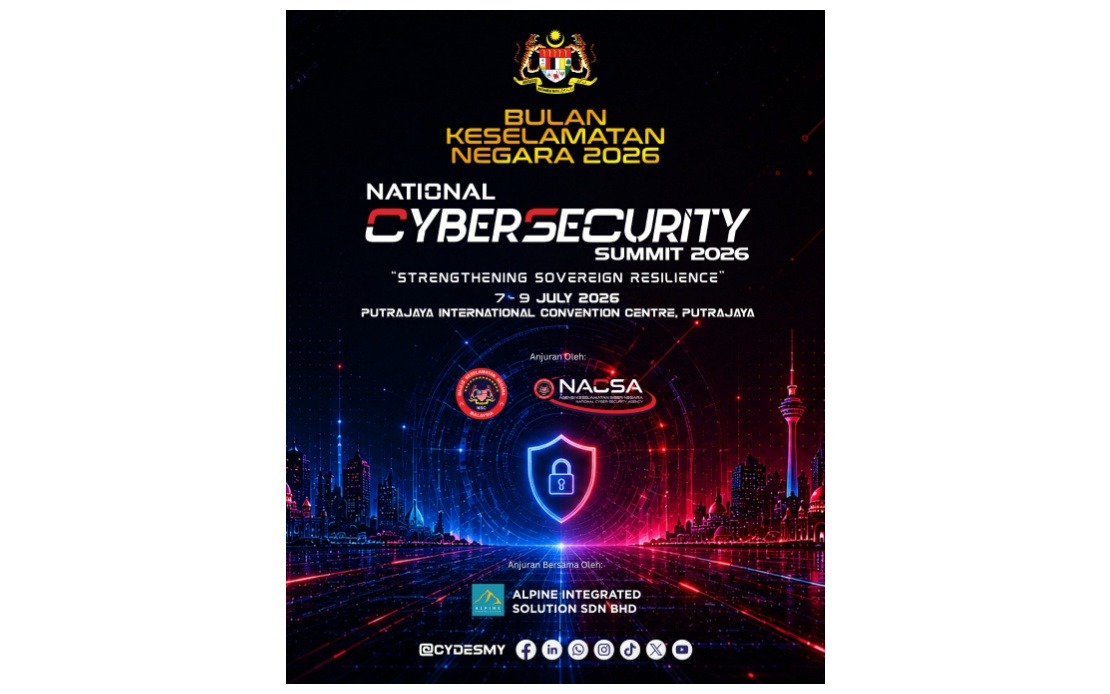
Malaysia's National Cyber Security Agency (NACSA), operating under the National Security Council (MKN) within the Prime Minister's Department, will convene the National Cyber Security Summit (NCSS) 2026 from July 7 to 9 at the Putrajaya International Convention Centre (PICC). The three-day event represents a critical moment for the country's digital security agenda, coinciding with heightened awareness around cyber threats facing both public institutions and private enterprises across Southeast Asia.
The summit brings together a diverse coalition of stakeholders spanning government ministries, corporate executives, security practitioners, and academic researchers. Their collective participation underscores recognition across Malaysia's institutional landscape that cybersecurity is no longer a technical specialisation but a foundational element of national competitiveness and sovereignty. The gathering carries particular significance following the Dewan Rakyat's passage of the Cybercrimes Bill 2026 on July 1, legislation that criminalises a broader spectrum of digital offences and provides law enforcement agencies with enhanced investigative powers.
This legislative development reflects the practical implementation of the Malaysian Cyber Security Strategy (MCSS) 2025-2030, a comprehensive national framework that guides Malaysia's medium-term approach to digital security. Rather than operating as an isolated technical initiative, the strategy positions cybersecurity as integral to economic resilience, institutional trust, and strategic autonomy in an increasingly contested digital environment. The summit serves partly as a reporting mechanism for progress under this strategy and partly as a forum to align stakeholder expectations around evolving threats.
Centred on the theme "Strengthening Sovereign Resilience," NCSS 2026 explicitly addresses the tension between Malaysia's integration into global digital systems and the need to maintain domestic control over critical information assets. The concept of "sovereign resilience" acknowledges that cyber threats originate globally but their consequences impact national prosperity and security. This framing resonates across Southeast Asia, where smaller economies face asymmetric pressures from well-resourced threat actors and foreign state entities seeking to exploit digital vulnerabilities.
The summit programme encompasses 41 high-impact sessions covering specialised domains within cybersecurity. These include forums dedicated to the Malaysian Cyber Security Strategy itself, a dedicated space for discussing cyber crime trends and enforcement approaches, conventions bringing together information and communications technology security officers, discussions on gender representation in the cyber field, presentations of advanced cryptographic solutions, and closed workshops addressing specific technical challenges. This breadth reflects the recognition that cybersecurity spans policy, law enforcement, technical implementation, and workforce development.
Participation reflects both regional and international engagement. The event will host 96 speakers and panellists representing government bodies, private sector technology firms, enforcement agencies, academic institutions, and civil society actors. Alongside them will be 122 companies—78 domestic firms and 44 international enterprises from seven countries—establishing NCSS 2026 as a platform for technology transfer and cross-border knowledge sharing. For Malaysian companies and practitioners, the international presence creates networking opportunities and exposure to global standards and emerging threats.
Attendance is projected to reach 3,000 participants, including conference delegates, trade visitors, and 250 domestically prominent guests. This scale indicates that Malaysian government and industry leadership views cybersecurity as deserving of the same institutional prominence accorded to major economic forums. For regional observers, the attendance volume signals Malaysia's positioning as a significant cyber security market and a hub for digital security knowledge dissemination within Southeast Asia.
A particularly consequential dimension of NCSS 2026 involves the scheduled launch of three major policy instruments under the auspices of MKN and NACSA. The National Security Policy (DKN) 2026-2030 will articulate Malaysia's overarching approach to security challenges, positioning cybersecurity within a holistic national security framework alongside traditional defence and public order concerns. Simultaneously, the government will launch the National Cryptography Policy (MyKriptografi) and its accompanying action plan, establishing standards and governance mechanisms for encryption technologies that underpin secure digital communications. These tools are essential as Malaysia expands digital identity systems, financial technology infrastructure, and government service delivery platforms.
Equally significant is the launch of the Artificial Intelligence Systems Cybersecurity Framework (AISCF), addressing one of the most pressing concerns facing technology-adopting economies. As Malaysian institutions increasingly deploy machine learning models in critical infrastructure, financial services, and government decision-making, the security of these systems becomes paramount. A dedicated framework signals government awareness that artificial intelligence introduces novel attack vectors and security challenges not adequately addressed by conventional cybersecurity approaches. For businesses and public agencies implementing AI solutions, the framework will provide guidance on embedding security throughout the AI lifecycle.
Prime Minister Datuk Seri Anwar Ibrahim's scheduled role in launching these three instruments elevates their political weight and signals whole-of-government commitment to the cybersecurity agenda. Ministerial involvement at this level indicates that digital security is recognised not merely as an operational necessity but as a strategic priority comparable to physical defence, economic policy, or infrastructure development. This messaging carries implications for budget allocation, inter-agency coordination, and public sector workforce recruitment in the coming years.
The summit's organisation in conjunction with National Security Month (BKN) contextualises cybersecurity within Malaysia's broader security consciousness. This linkage acknowledges that digital threats blur traditional boundaries between domestic security concerns and foreign intelligence activities, between criminal activity and state-sponsored aggression. For Malaysian citizens and organisations, the emphasis on awareness and preparedness suggests government intends to distribute security responsibility across society rather than concentrating it within specialist agencies.
The event represents Malaysia's positioning within the region's cyber security landscape at a moment when digital threats are escalating in sophistication and frequency. As Southeast Asian economies deepen digital integration and cross-border data flows, cybersecurity governance becomes increasingly consequential for competitiveness and social stability. NCSS 2026 provides a venue for Malaysia to articulate its approach, benchmark against peers, and catalyse the institutional and technological investments required to maintain digital resilience. The outcomes will likely influence how Malaysian organisations approach cyber risk management and how policymakers calibrate regulatory frameworks governing the digital economy for the coming years.

