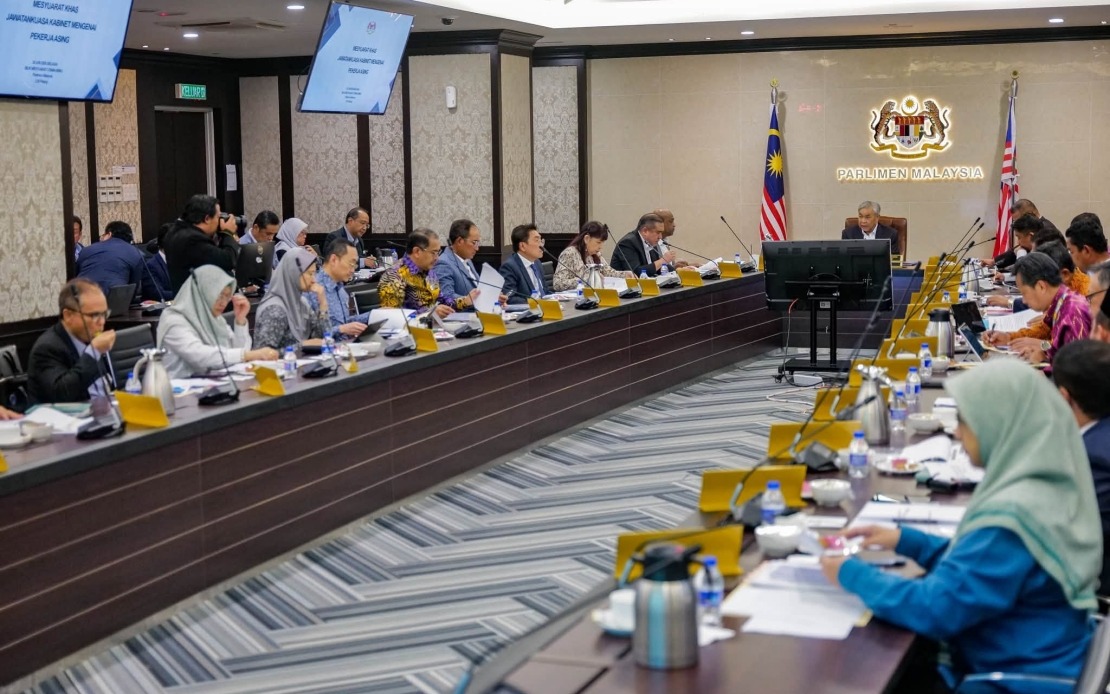
Malaysia's government is moving forward with a comprehensive restructuring of how it manages the country's foreign workforce, seeking to create a more streamlined and effective system that better serves both economic and social objectives. Deputy Prime Minister Datuk Seri Dr Ahmad Zahid Hamidi outlined the strategic shift following a special cabinet session focused on foreign labour policy, signalling that the administration intends to take a firmer grip on what has long been a complex and sometimes fragmented area of governance.
The restructuring initiative emerged from deliberations at a Cabinet Committee on Foreign Workers meeting convened by Ahmad Zahid at Parliament, where policymakers examined multiple dimensions of the country's approach to migrant labour. The discussions centred on strengthening institutional arrangements, clarifying decision-making structures, and aligning foreign worker policies with the realities of Malaysia's labour market. These conversations reflect growing recognition that the current system requires modernisation to address contemporary challenges ranging from skills mismatches to security vulnerabilities and the protection of local job opportunities.
A cornerstone of the administrative reorganisation involves repositioning the One Stop Centre for Foreign Worker Management under the direct authority of the Ministry of Human Resources. This consolidation promises to eliminate coordination gaps between different government agencies and create a single, identifiable point of contact for employers, workers, and enforcement officials. The placement under Human Resources supervision signals that the government views foreign labour management primarily as a human capital and employment policy matter rather than purely an administrative or security issue, though national security considerations will remain integral to the framework.
The cabinet also revisited the membership composition and operational mandate of the foreign worker committee itself, ensuring the body possesses adequate representation and clearly defined powers to make timely decisions. Such structural refinements typically precede more substantive policy shifts, as they empower coordinating bodies to act decisively on recommendations. For Malaysia, where bureaucratic coordination across federal, state, and sectoral lines has sometimes created bottlenecks, clarifying committee terms of reference addresses a longstanding governance challenge that has frustrated both employers seeking swift approvals and authorities attempting to maintain effective oversight.
Central to the new approach is a commitment to conducting more rigorous, demand-driven assessments of which industries genuinely require foreign labour and in what numbers. Rather than approving foreign worker quotas on the basis of historical precedent or routine applications, the government intends to scrutinise labour requirements against actual sector-specific needs. This data-driven methodology could substantially alter the composition of Malaysia's migrant workforce, potentially redirecting entries toward high-skill sectors while restraining growth in low-skill categories where local workforce substitution may be feasible. Such recalibration would represent a notable shift from patterns observed over the past two decades.
The restructuring also reflects an underlying strategic priority that Ahmad Zahid made explicit: gradually reducing Malaysia's dependence on foreign labour by cultivating domestic human capital. The government plans to expand local workforce participation through enhanced training and education, building a more skilled Malaysian labour pool better equipped for modern industries. Simultaneously, the administration is promoting automation and technological transition within sectors historically reliant on migrant workers, particularly manufacturing and services. This multi-pronged approach acknowledges that restrictive foreign labour policies alone cannot succeed unless paired with genuine investments in local workforce development and productivity improvements.
For regional observers and ASEAN neighbours, Malaysia's restructuring holds broader significance. As a major destination for migrant workers from Indonesia, the Philippines, Bangladesh, Nepal, and elsewhere across Asia, changes to Malaysia's foreign labour framework inevitably affect sending countries' economies and diaspora populations. The emphasis on integrity in the foreign worker system also speaks to longstanding concerns about trafficking, exploitation, and irregular migration—problems that have drawn criticism from international agencies and civil society organisations. By centralising management under a human resources ministry and establishing clear procedural standards, Malaysia may address some of these concerns, though implementation will ultimately determine whether structural reforms translate into tangible improvements in worker protections.
The government's commitment to balancing industry needs against national security and Malaysian employment opportunities represents an attempt to navigate competing pressures. Manufacturers and labour-intensive service providers have frequently pressed for expanded foreign worker access, warning that restrictions could hamper competitiveness and economic growth. Concurrently, labour unions, domestic workers, and policymakers concerned about wage suppression and job displacement have advocated for stricter controls. The restructured framework aims to provide a mechanism for weighing these tensions more systematically, rather than resolving them through ad hoc ministerial interventions or political compromise.
Implementation timelines remain unclear from the announced decisions, though cabinet approval suggests concrete measures will follow. The government will need to issue updated guidelines for the One Stop Centre, establish new evaluation criteria for foreign labour applications, and ensure all relevant agencies—from the Immigration Department to the Ministry of Domestic Trade and Consumer Affairs—align their operations with revised protocols. Such administrative implementation typically requires several months to complete, during which employers and migrant worker communities will likely experience ongoing uncertainty about future approval processes and conditions.
The broader context for this restructuring includes Malaysia's post-pandemic economic recovery, where labour availability has become a critical variable for growth projections. Yet policymakers also recognise that demographic trends, rising education levels among Malaysian youth, and technological displacement of routine tasks create opportunities to rebalance the workforce composition. Ahmad Zahid's emphasis on maintaining national wellbeing and people's interests suggests the government intends these measures to have legitimacy beyond technocratic efficiency—they are framed as serving Malaysians' long-term interests rather than merely appeasing particular interest groups.
As implementation proceeds, the success of this restructuring will depend significantly on how effectively the Human Resources Ministry coordinates with other agencies, whether the One Stop Centre genuinely streamlines approvals or simply consolidates bureaucracy, and whether the demand-driven assessment process can withstand political and business lobbying pressures. The stated commitment to reducing foreign labour reliance also requires sustained investment in domestic skills development and technological advancement—areas where Malaysia has shown mixed progress historically. The restructuring thus represents both an opportunity to modernise foreign worker management and a test of the government's ability to execute integrated labour market policies that serve multiple objectives simultaneously.

