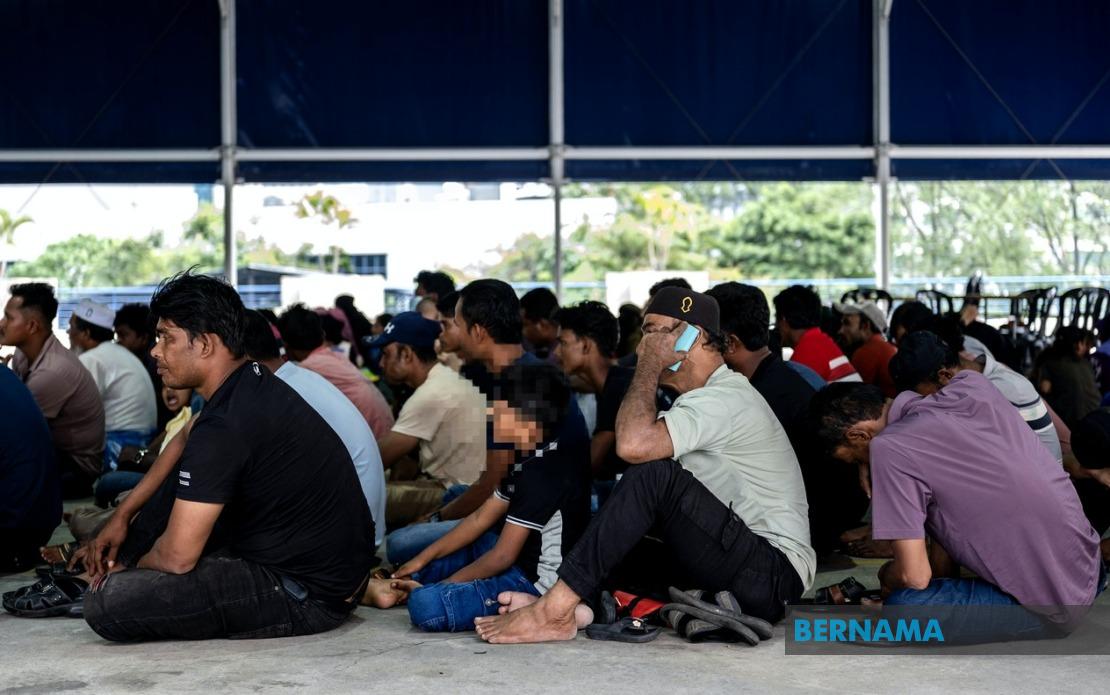
Malaysia is moving toward comprehensive documentation of its refugee population, with Home Minister Datuk Seri Saifuddin Nasution Ismail announcing that preliminary data on Myanmar refugees should be ready by the final quarter of this year. The disclosure came during a press conference in Putrajaya, signalling the government's commitment to a systematic approach to one of Southeast Asia's most pressing humanitarian challenges. The timeline underscores the complexity of managing large displaced populations whilst maintaining security and administrative order.
The refugee registration initiative operates under the Refugee Registration Document, or DPP programme, which the Home Ministry's Immigration Department is implementing in collaboration with relevant stakeholders. This structured data collection effort represents a departure from ad-hoc management practices, establishing a foundation for evidence-based policymaking. The exercise itself demands considerable logistical coordination, requiring immigration officials to reach out to scattered communities, verify identities, and compile biometric information—tasks that are inherently labour-intensive and time-consuming.
Understanding the scale and composition of Malaysia's refugee population has long been a government priority. The DPP programme specifically addresses this gap by gathering accurate, complete and verifiable biometric data alongside identity documentation. Such information is essential not only for humanitarian purposes but also for national security screening, which is why the initiative aligns with National Security Council Directive No. 23 (Revision 2023). By establishing a comprehensive database, Malaysian authorities can distinguish between legitimate refugees fleeing persecution and other migrant populations, enabling more targeted and effective policy responses.
Saifuddin Nasution emphasised that individuals verified as genuine refugees would receive priority consideration for repatriation—a process that falls under the purview of Wisma Putra, Malaysia's Ministry of Foreign Affairs. This division of responsibilities reflects the multi-agency nature of refugee management, where the Home Ministry handles registration and security vetting whilst the Foreign Ministry negotiates with third countries and international organisations to facilitate returns. The commitment to prioritise legitimate refugees for repatriation signals Malaysia's intention to position itself as a transit country rather than a permanent settlement destination, addressing long-standing concerns about refugee burden-sharing within the region.
The data collection initiative faces significant operational challenges. Refugee populations are often dispersed across urban and semi-rural areas, frequently living in informal settlements or relying on informal employment networks. Public awareness campaigns will be necessary to encourage undocumented refugees to come forward voluntarily, a task that requires careful messaging to balance reassurance with security concerns. Many refugees harbour legitimate fears about government registration, fearing deportation or detention, necessitating transparent communication about the programme's humanitarian intent and protective mechanisms.
It is noteworthy that Saifuddin Nasution clarified that the DPP programme encompasses all refugee categories, not exclusively Myanmar nationals. This broader scope is significant given Malaysia's history of hosting displaced populations from across Asia—including Rohingya from Bangladesh, stateless persons, and individuals fleeing political persecution from various nations. A unified registration framework capable of handling diverse refugee populations would represent a substantial administrative achievement, though it also complicates the timeline and resource requirements for data compilation.
The Myanmar context, however, remains particularly urgent. Since the military coup in February 2021, Myanmar has experienced escalating conflict and humanitarian deterioration, driving waves of displacement into neighbouring countries. Thailand and Bangladesh have absorbed the largest numbers, but Malaysia hosts a substantial and growing population of Myanmar nationals seeking refuge. Many fled not only political upheaval but also economic collapse and gang-related violence, making documentation both sensitive and complex. Distinguishing between refugees and economic migrants is a challenge that requires nuanced assessment rather than simple categorisation.
The timeline announced—fourth quarter 2024—provides approximately four to five months for data collection. Whether this proves realistic depends on implementation capacity, public cooperation, and the geographical distribution of refugee populations. The government will need to establish registration centres, deploy sufficient personnel, and manage logistical challenges inherent in reaching dispersed communities. Any shortfall in participation could skew preliminary results, potentially understating the actual refugee population and complicating subsequent policy planning.
For Malaysia's broader refugee policy, this data collection exercise represents a potential inflection point. Comprehensive biometric and identity records could enable more sophisticated targeting of integration support, repatriation assistance, and security screening. Conversely, the same data infrastructure could facilitate surveillance and enforcement that deters refugee registration. The credibility and outcomes of the DPP programme will depend significantly on how the government balances these competing imperatives and whether refugees perceive the process as genuinely protective rather than punitive.
Regionally, Malaysia's approach carries implications beyond its borders. As a major middle-income country hosting substantial refugee populations, its management practices influence refugee policy trends across Southeast Asia. A successful, transparent registration system could serve as a model for neighbouring states struggling with similar challenges. Alternatively, if implementation proves problematic or if registered refugees experience negative consequences, it could discourage future refugee registration and undermine cooperation with international organisations.
The announcement also reflects international pressure on Malaysia regarding refugee treatment. United Nations bodies and human rights organisations have consistently urged Malaysia to strengthen refugee protections and move toward formal asylum mechanisms. Whilst the DPP programme falls short of establishing a formal asylum system—Malaysia is not a signatory to the 1951 Refugee Convention—it represents incremental progress toward more structured and transparent refugee management. For advocacy groups, the data collection exercise offers potential transparency into government refugee statistics, previously opaque and subject to varying estimates.
For Malaysian society, the refugee question remains politically sensitive. Public discourse often conflates refugee, migrant, and security concerns, creating space for both humanitarian advocates and restrictionist politicians. The government's methodical approach through data collection and prioritised repatriation appears calculated to address security concerns whilst acknowledging humanitarian obligations. Whether this balance satisfies stakeholders across the political spectrum remains uncertain, making the fourth-quarter data release a potentially consequential moment for refugee policy debate in Malaysia.

