Coronary artery disease remains a leading health concern across Southeast Asia, and one of the most challenging clinical scenarios cardiologists face is when plaque hardens into severe calcification. Datuk Dr Tamil Selvan Muthusamy, a consultant cardiologist, explains that this condition creates formidable obstacles to conventional treatment approaches. A Malaysian research team led by Dr Tamil Selvan has begun studying an advanced device called the Hertz Contact-IVL System, which represents a significant departure from traditional energy-based methods for managing these complex blockages.
Plaque accumulation in coronary arteries develops gradually as fat, cholesterol, calcium, cellular debris and a clotting protein called fibrin deposit along artery walls. Over extended periods, this material hardens and narrows the blood vessels, potentially cutting off oxygen-rich blood supply to the heart muscle. When arteries become severely restricted or fully blocked, patients face substantial risks including myocardial infarction, heart failure and stroke. The progression from soft to calcified plaque creates entirely different treatment challenges, requiring distinct clinical strategies.
For patients with soft plaque deposits, interventional cardiologists have successfully used balloon angioplasty to compress the material and create adequate space within the vessel. Following balloon expansion, cardiologists typically insert a stent—a small mesh tube—to maintain the newly opened passage and prevent the artery from narrowing again. This approach works reliably when dealing with non-calcified or minimally calcified lesions. However, when calcium content becomes severe, the artery walls develop a rock-like quality that resists conventional balloon pressure, explaining why many patients with advanced calcification have historically required open-heart bypass surgery or experienced poor outcomes from less invasive procedures.
Severe coronary calcification creates multiple technical difficulties that complicate percutaneous coronary intervention procedures. Standard balloon angioplasty alone cannot generate sufficient pressure to crack calcium deposits, and attempting to force advancement through calcified segments risks vessel perforation and other serious complications. Existing treatment options including rotational atherectomy, high-pressure balloon angioplasty and conventional intravascular lithotripsy provide some benefit but remain limited in their effectiveness and have inherent design constraints. These limitations have driven cardiologists worldwide to seek improved technologies that can reliably and safely eliminate calcified blockages while preserving healthy vessel walls.
Conventional intravascular lithotripsy uses external ultrasound generators to produce acoustic waves that fracture calcium deposits within arteries. The technique represents a significant advance over purely mechanical approaches, yet it carries operational restrictions. Energy-based IVL systems typically operate with a fixed number of acoustic pulses—traditionally eight, though newer versions allow twelve—requiring physicians to completely break down calcification within that limited pulse count. Additionally, the catheter design remains relatively bulky, creating delivery challenges when arteries are severely narrowed. Vessel diameter variations, where an artery might narrow from 3.5mm to 2mm along its length, further complicate treatment since one-size-fit-all balloon diameters cannot optimally address these anatomical variations.
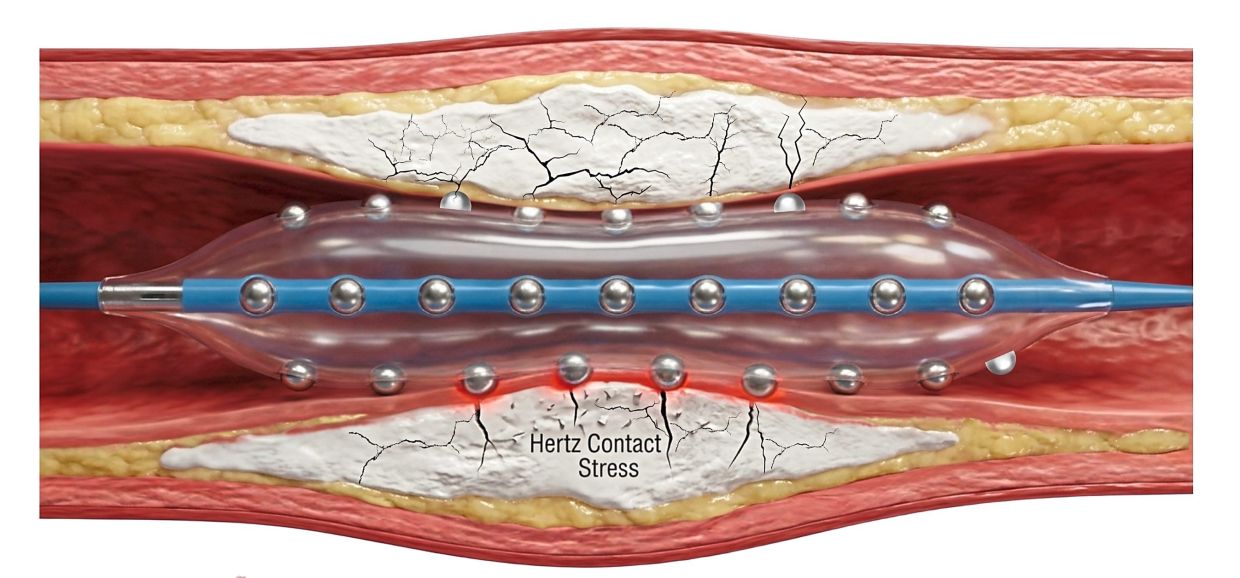
The Hertz Contact-IVL System abandons the external energy source model in favour of a mechanical pressure-amplification approach. Rather than relying on ultrasound generators, this device features a balloon with integrated metallic hemispheres that generate focal pressure amplification when the balloon contacts the hardened plaque. As physicians apply pressure to the balloon, the metallic elements multiply and concentrate that force directly against the calcium deposit, creating deep fissures in the plaque without generating collateral damage to surrounding healthy tissue. This mechanical design eliminates dependence on external generators while offering superior deliverability, allowing a single catheter to treat longer blockages or multiple lesions within the same artery.
Dr Tamil Selvan emphasises that the mechanical lithotripsy approach fundamentally differs from energy-dependent systems. By embedding tiny stainless steel hemispheres within the balloon structure, pressure transmission occurs through direct contact rather than acoustic transmission. This design philosophy enables the catheter to navigate through severely compromised vessel passages more readily, a crucial advantage when dealing with tight stenoses where conventional equipment struggles to advance. The improved manoeuvrability reduces the need for additional support techniques and simplifies the overall intervention procedure. Equally important, the device's ability to handle variable vessel diameters makes it particularly valuable for complex anatomical scenarios that conventional one-size approaches cannot adequately address.
Malaysian research teams, despite having access to cutting-edge medical technologies, often face limited opportunities to conduct large-scale validations of emerging devices within the regional context. The developer of the Hertz Contact-IVL System had conducted only small-scale studies across multiple United States centres, leaving significant gaps in safety and efficacy data. Recognising this knowledge gap, Dr Tamil Selvan and his colleagues decided to expand the evidence base by conducting a larger, locally-focused investigation. This approach aligns with best practices in evidence-based medicine, where treatments are validated across diverse populations and healthcare settings before widespread adoption.
The decision to conduct a comprehensive study in Malaysia reflects several important considerations for Southeast Asian healthcare systems. Local validation ensures that findings are relevant to the regional population, accounting for potential variations in disease presentation, vessel anatomy and patient demographics. Malaysia's advanced cardiac care infrastructure and experienced interventional cardiology teams provide an ideal environment for rigorous device evaluation. Success in this study could position Malaysian institutions as regional leaders in adopting innovative calcification-treatment technologies and potentially establish the country as a training centre for other Southeast Asian cardiologists seeking expertise in complex lesion management.
The clinical implications of improved calcified plaque treatment extend far beyond individual patient outcomes, although those remain paramount. Currently, many patients with severely calcified coronary disease face limited options—accepting high-risk conventional interventions, undergoing open-heart surgery, or managing symptoms medically despite ongoing risk. More effective calcification-management tools could substantially expand interventional cardiology's scope, potentially converting cases previously deemed unsuitable for catheter-based intervention into viable percutaneous procedures. For a region where cardiac disease burden continues rising, improved treatment capabilities translate directly into better accessibility, shorter hospital stays, faster recovery and reduced overall healthcare costs.
The research team's meticulous approach to evaluating the device's safety profile demonstrates appropriate scientific caution. Rather than assuming that small studies conducted elsewhere automatically prove safety and efficacy in other populations, the Malaysian researchers are conducting independent validation. This rigorous methodology protects patients while generating data that Malaysian healthcare providers can confidently reference when considering technology adoption. As the study progresses, findings will likely influence interventional cardiology practice not only in Malaysia but throughout the broader Southeast Asian region, where numerous cardiologists face similar patient populations and disease challenges.
Adoption of the Hertz Contact-IVL System could particularly benefit Southeast Asian healthcare systems managing resource constraints. By converting complex surgical cases into less invasive catheter-based procedures, hospitals can reduce operating theatre demands, intensive care admissions and extended hospitalisation periods. Reduced procedural complexity also decreases complication risks and technical failure rates, ultimately improving patient safety. For patients, less invasive approaches mean shorter recovery times, faster return to normal activities and reduced psychological burden associated with open-heart surgery. These advantages prove particularly valuable in developing healthcare systems where surgical capacity remains limited relative to disease burden.
The broader significance of Malaysian cardiology teams investigating novel interventional technologies reflects the region's growing sophistication in cardiovascular medicine. Rather than remaining passive recipients of technologies developed elsewhere, Southeast Asian physicians increasingly participate in the innovation evaluation and validation process. This engagement strengthens the evidence base for emerging treatments while building local expertise. As the Hertz Contact-IVL System study unfolds, it will contribute valuable data to the international medical literature while potentially establishing Malaysian institutions as important contributors to cardiovascular technology development and evidence generation.

