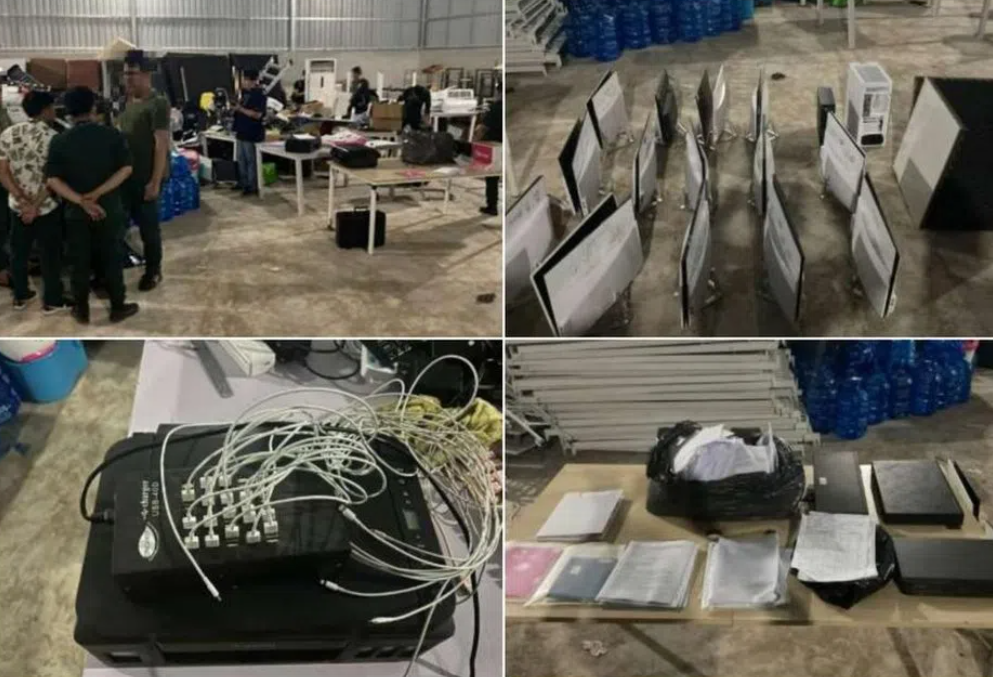
A Malaysian man who lasted just three days working for a sprawling scam operation run from Cambodia has been sentenced to 16 months and two weeks' imprisonment. Yip Chee Ming, 30, pleaded guilty on Friday, June 26, to membership in an organised crime syndicate that systematically targeted Singaporeans through government impersonation fraud. Despite the brevity of his employment and his complete failure to defraud anyone, the court determined his culpability was sufficient to warrant a substantial custodial sentence.
Yip's involvement with the criminal enterprise began innocuously when a friend, known only as Jason, approached him in October 2024 with an employment proposition. Jason had already learned about the fraudulent operation and wanted Yip to join him in what they were told would be lucrative work. The proposal, while vague at first, became concrete when both men were added to a Telegram group by Tang Soon Wah, later identified as a senior leader within the syndicate's hierarchy. To validate the opportunity, Tang offered to fund a trip for the pair to inspect the operation's physical headquarters in Phnom Penh, described as a five-storey building fortified with security personnel at every entrance.
The syndicate that Yip briefly joined represented a substantial criminal infrastructure. Operating from Phnom Penh, the network conducted approximately 528 reported scam cases between September 2024 and September 2025, extracting around S$52.5 million from victims. The operation employed a sophisticated organisational structure, with leadership overseeing operations, a middle tier of supervisors and trainers responsible for managing callers, and specialist units dedicated to laundering the criminal proceeds through cryptocurrency conversion. At least 78 members were identified as part of this criminal apparatus, spanning multiple countries and operational roles.
The trainers within the syndicate prepared their workforce through coaching sessions designed to enhance persuasiveness and authenticity. They distributed scripts that callers would memorise and recite to potential victims, and provided additional coaching on accent modification and communication techniques to mimic legitimate Singaporean banking representatives. This level of preparation reflected a highly organised, profit-driven operation that treated fraud as a commercial enterprise requiring training, standardisation, and quality control—the same mechanisms legitimate businesses employ, but weaponised for criminal purposes.
Yip returned to Malaysia with Jason to deliberate on the job offer, then both flew back to Cambodia on November 21, 2024, to commence their employment. The compensation package offered to Yip was substantial by regional standards: US$1,800 (approximately S$2,333) monthly in cryptocurrency, supplemented by a one per cent commission on the value extracted from each person he successfully defrauded. These terms reflected the syndicate's confidence in its recruitment and training processes, yet Yip would prove to be an exception to the operation's otherwise successful track record.
On November 22, Yip began his assignment, tasked with impersonating a bank officer to deceive Singaporean victims over telephone calls. Armed with the syndicate's prepared script and the training he had received, he made his initial attempts. However, something went fundamentally wrong. Despite adhering precisely to the provided dialogue and following the tactics he had been taught, Yip could not persuade a single victim to fall for the deception. The next day, November 23, he tried again with identical results—another complete failure. After less than 48 hours of actual work, his supervisors concluded that Yip lacked the particular qualities necessary for success in their fraudulent calling operation.
Tang summarily terminated Yip's employment on November 23, 2024, and deleted all evidence of their communications. This swift erasure of digital traces suggested the syndicate's awareness of law enforcement risk and the importance of operational security. Court documents provided no clarity on how Yip subsequently returned to Malaysia, whether through his own arrangements or with assistance from the syndicate. What is notable is that despite his immediate dismissal and his failure to cause any financial harm to victims, Yip remained implicated in the broader criminal conspiracy and would face legal consequences nearly a year later.
Law enforcement action against the syndicate culminated in September 2025 with coordinated arrests spanning multiple jurisdictions. On September 9, 2025, Singaporean police and the Cambodian National Police jointly apprehended 12 individuals identified as syndicate members. The arrested group included Yip and 11 others: nine Singaporean nationals, one other Malaysian, and one Filipino national. The multinational composition of the arrested group underscores the transnational nature of modern scam operations, which recruit facilitators and participants across regional borders to distribute risk and complicate investigation.
Among the Singaporeans arrested were Deon Tan Ke Yuan, Lester Ng Jing Hai, Christy Neo Wei En, Heiqal Lee, Tay Jun Xiang, Ng Wei Kang, Zachary Lee Jia An, Melvin Tan Wenzheng, and Lau Haoxiang, ranging in age from 25 to 39. These arrests suggest that despite Singapore's sophisticated law enforcement capabilities and cybersecurity infrastructure, individuals from within the country were willing participants in operations explicitly targeting their fellow citizens. The involvement of locals in committing fraud against their own society raises questions about recruitment methods, vulnerability factors, and the appeal of rapid financial gain through illicit means.
The government impersonation scam category has emerged as an increasingly significant threat vector in Singapore's fraud landscape. Remarkably, despite overall scam case numbers declining in 2025 compared to previous years, government impersonation fraud cases more than doubled from 1,504 incidents in 2024 to 3,363 cases in 2025. This category has now risen to the fifth most prevalent scam type in the city-state, reflecting how scammers continuously adapt their tactics in response to public awareness campaigns and law enforcement pressure against other fraud methods. The sharp escalation suggests that criminals have identified government impersonation as a particularly effective social engineering vector, possibly because it exploits fear of regulatory authority and creates artificial urgency that bypasses critical evaluation.
The sentencing of Yip demonstrates that Singapore's courts take organised crime membership seriously, regardless of the individual's actual fraudulent output or tenure within the syndicate. Under Singapore law, membership in an organised crime group carries penalties of up to S$100,000 in fines, imprisonment for up to five years, or both. Yip's 16-month sentence, while not at the maximum, reflects the gravity with which the judiciary views participation in syndicates that cause substantial collective harm, even when individual participants contribute minimally. For Malaysian readers and authorities, the case illustrates the regional nature of scam operations and the vulnerability of citizens who are targeted for recruitment into cross-border criminal enterprises.

