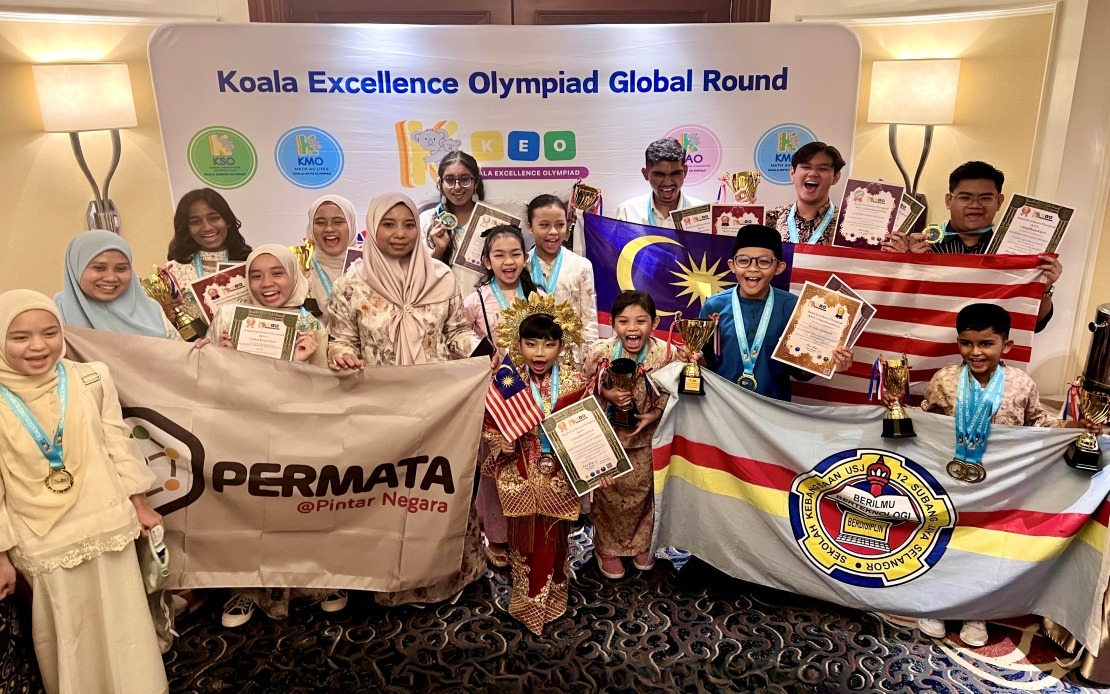
Malaysia has demonstrated its growing strength in international academic competition, with a contingent of 17 students capturing nine overall awards and a total of 22 medals at the Koala Excellence Olympiad (KEO) 2026, which concluded in Macau. The impressive showing reflects both the calibre of talent being developed in Malaysian schools and the systematic approach to nurturing young scholars through institutional programmes. According to Aidah Misran, the Malaysian Young Scientists Organisation (MYSO) coordinator who led the delegation, the team returned home with five gold medals, six silver, and 11 bronze across multiple disciplines.
The competition represents a significant platform for developing critical thinking and innovation among young people across the Asian region and beyond. Organized jointly by KEO and Miss Man International Group with MYSO coordinating efforts in Malaysia, the olympiad brought together participants from various nations to compete in English, Mathematics, Science, and Arts. Unlike traditional examination systems that emphasize memorization, the competition framework developed by Australian educational experts prioritizes real-world problem-solving, creativity, and the application of knowledge to contemporary challenges. This pedagogical approach aligns increasingly with how leading economies prepare their younger generations for a rapidly evolving global marketplace.
The Malaysian delegation comprised students from eight different educational institutions, reflecting a distributed model of excellence across the country rather than concentration in a single premier school. Four students came from Kolej PERMATA@Pintar Negara Universiti Kebangsaan Malaysia (UKM), six from Sekolah Menengah Kebangsaan (SMK) Ungku Aziz, two from Sekolah Sultan Alam Shah, and three from Sekolah Kebangsaan (SK) Convent (2) Bukit Nanas. Additional representation included one student each from SMK Convent Teluk Intan, SK USJ 12, SK Seri Hartamas, and SK Convent Sentul 1. This composition suggests that identification and development of gifted students extends across both government and private institutions, urban and suburban locations, and through both secondary and primary schooling levels.
The standout performer at the competition was Year Six pupil Mukridz Mardzuki from SK Seri Hartamas, who secured the overall Science Olympiad championship in the primary school category. His achievement is particularly noteworthy given that primary school students typically face steeper competition from more mature and academically advanced secondary-level peers. Mukridz's success indicates that foundational science education in Malaysia is producing students capable of competing at the highest international levels while still in their formative academic years. Such early achievement often signals exceptional potential for continued intellectual development and may influence career trajectories toward science-related fields.
Strengths were distributed across multiple disciplines, with Malaysian competitors achieving particular distinction in science education. Beyond Mukridz's primary category championship, Sarah Isabel Maryam Ahmad Suhael from SK Convent (2) Bukit Nanas and Alfie Rizq Danial Azlan from Sekolah Sultan Alam Shah each secured overall runner-up positions in the Science Olympiad for primary and secondary categories respectively. The concentration of science medals suggests that Malaysian schools are effectively cultivating scientific literacy and experimental thinking, competencies increasingly essential as economies transition toward technology and knowledge-intensive sectors. The English language competition also featured strong Malaysian representation, with Ayra 'Adani Muhammad 'Aizat from Kolej PERMATA@Pintar Negara, UKM earning the overall runner-up position, underscoring the importance of linguistic proficiency in international academic contexts.
Third-place awards went to five Malaysian competitors, demonstrating the breadth of competitive achievement across the delegation. Marvyn Zef Mark Philip proved particularly versatile, securing two category third-place finishes in both Science and English, indicating well-rounded academic capability across different knowledge domains. P Prem earned recognition in Science, Muhammad Khairul Mauidz Khairul Azman in Mathematics, and AK Shashini in English. The distribution of medals across multiple schools and students suggests a systematic pipeline for identifying and developing talent rather than isolated pockets of excellence. This structure provides a stronger foundation for sustained international competitiveness in academic competitions over successive years.
The Koala Excellence Olympiad framework itself represents an important evolution in how international educational standards are being established and maintained. By aligning with curriculum standards across multiple countries while emphasizing critical thinking and practical application, the competition creates a more meaningful assessment of student capability than traditional standardized testing. For Malaysian participants, exposure to this competition platform provides experience with international expectations and perspectives on knowledge acquisition. Students return not only with medals but also with expanded networks connecting them to peers from other nations, potentially facilitating future collaboration and exchange opportunities.
From a broader regional perspective, Malaysia's strong performance at KEO 2026 reflects the nation's commitment to developing intellectual capital and maintaining competitive advantage in an increasingly knowledge-based global economy. The success of students from diverse institutional backgrounds—government schools, premier institutions, and private establishments—demonstrates that excellence in academic competition is not confined to elite facilities but rather distributed across the educational system. This inclusive pattern of achievement suggests that Malaysian schools are employing effective methodologies for identifying high-potential students and providing them with appropriate enrichment and support.
The implications for Malaysia's education policy and investment in gifted education are substantial. Success at international competitions generates measurable return on investment in specialized programmes and coaching for academic olympiads. Such achievements also serve as recruitment incentives for talented educators and funding justifications for specialized institutions like Kolej PERMATA@Pintar Negara, which contributed four medallists to the Macau competition. Furthermore, international recognition of Malaysian student achievement enhances the nation's soft power and educational brand, potentially attracting international students and improving Malaysia's positioning within regional education rankings and assessments.

