Malaysia faces a stark public health challenge: sudden cardiac arrest kills without warning, and survival depends entirely on how quickly bystanders can respond. The statistics paint a sobering picture. Current survival rates for out-of-hospital cardiac arrests in Malaysia languish between 0.5 and 8.5 per cent—a figure that stands in sharp contrast to developed nations where trained response teams and accessible equipment can push survival rates above 50 per cent. The core problem is deceptively simple: too few people have access to Automated External Defibrillators (AEDs) when minutes matter most, and too few citizens know how to perform life-saving cardiopulmonary resuscitation (CPR). Every moment of delay in treatment dramatically reduces the odds of walking away from such an event.
Recognising this critical gap in Malaysia's emergency infrastructure, Sunway Medical Centre Velocity (SMCV) has launched an ambitious initiative that extends far beyond simply installing devices. The hospital's approach combines strategic placement of AEDs at high-traffic locations throughout Kuala Lumpur with comprehensive public training programmes designed to transform ordinary citizens into potential lifesavers. This dual strategy represents a fundamental shift in how healthcare institutions approach sudden cardiac arrest—moving from a reactive, hospital-centred model to a proactive, community-based system where minutes of delay are eliminated through preparation and access.
The initiative builds upon SMCV's earlier "Save A Number, Save A Life" campaign, signalling the hospital's sustained commitment to this issue. However, this expansion marks a substantial escalation. SMCV has identified and begun installing AEDs at multiple strategic locations across Kuala Lumpur, including Tun Razak Exchange (TRX), Bukit Bintang, Ampang Park and Muzium Negara MRT stations—transit hubs where large crowds concentrate daily. Commercial landmarks such as Aquaria KLCC, Menara Public Bank, Menara Public Bank 2, and the National Heritage Building at Stadium Merdeka within the Merdeka 118 Precinct have also been equipped. These locations are not chosen randomly; they represent spaces where cardiac emergencies statistically prove more likely to occur, where response times can be minimised, and where trained bystanders are most likely to be present.
The medical rationale underpinning this urgency is straightforward but unforgiving. Dr Wee Tong Ming, SMCV's Medical Director and Consultant Emergency Physician, emphasises that survival rates plummet with each passing minute after cardiac arrest occurs. After eight to ten minutes without CPR intervention, the likelihood of meaningful recovery becomes negligible. This means that in the critical window before emergency services arrive, bystanders who can immediately initiate CPR and deploy an AED represent the only realistic hope for survival. The difference between death and recovery often hinges not on advanced medical technology at a hospital, but on the presence of basic equipment and trained individuals in the community.
Beyond installing the devices themselves, SMCV has invested in user-friendly design and accessibility. Each AED unit is paired with a clearly visible standee to ensure people can spot and access the equipment during moments of panic and confusion. More innovatively, QR code stickers linking to SMCV's emergency guidance webpage will be placed on the standees and in general practitioner clinics throughout Kuala Lumpur. This digital integration means that someone encountering an AED for the first time during an emergency can quickly access video instructions and step-by-step guidance, reducing the barrier to action for those without prior training.
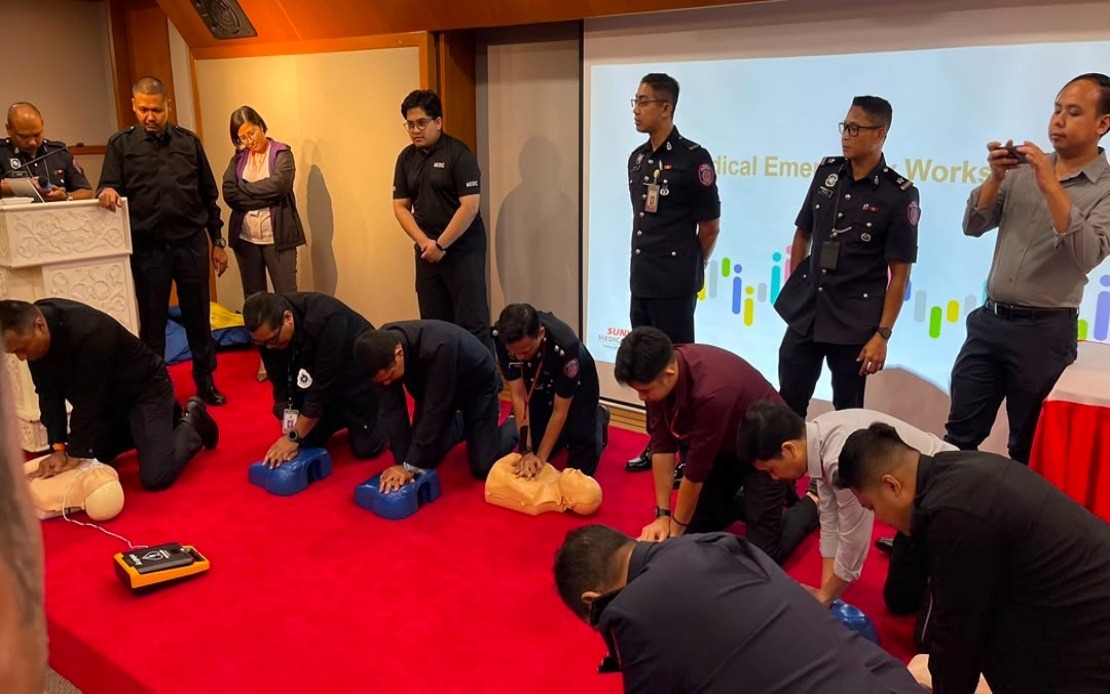
Critically, SMCV recognises that equipment alone saves no lives. Susan Cheow, the hospital's Chief Executive Officer, articulates the institution's philosophy clearly: installing AEDs represents only half the solution. The other half—arguably the more challenging half—involves building public confidence and competence. For this reason, the hospital has implemented on-site training sessions and A&E awareness talks at multiple locations. These sessions cover the fundamentals of emergency response: recognising the symptoms of cardiac arrest, performing CPR with correct technique, and operating an AED safely. The goal is to transform public perception of medical emergencies from paralysing uncertainty into informed, capable action.
For Malaysian readers, this initiative carries particular significance within the regional context. Southeast Asian nations have historically lagged developed countries in emergency preparedness infrastructure, with rural areas especially underserved. Malaysia's urban-rural divide in healthcare access extends to emergency response capabilities. While this SMCV programme focuses on Kuala Lumpur, it potentially establishes a template for expansion to other major cities and regions. If successful, it could demonstrate to other healthcare providers and government agencies that systematic, strategically planned deployment of AEDs combined with public education can meaningfully shift survival outcomes.
The initiative also reflects a broader shift in healthcare philosophy across the region—recognition that health outcomes depend not merely on hospital capacity but on community preparedness. Countries like Singapore and South Korea have invested heavily in AED deployment and public training, with measurable improvements in survival rates. Malaysia's move toward similar systems, led by a private sector institution rather than government mandate, suggests that commercial healthcare providers are stepping into spaces where public health infrastructure has been slow to move. This dynamic raises important questions about sustainability and equity: as private hospitals lead on emergency preparedness, how can Malaysia ensure that these life-saving resources reach all Malaysians, including those in underserved areas and lower-income communities?
Dr Wee's emphasis that "lives are not lost due to lack of help, but because of delays in response and lack of access to life-saving tools" captures the essence of this problem. Malaysia has no shortage of highly trained emergency physicians and well-equipped hospitals. What it lacks is the infrastructure and public readiness that transforms good hospitals into effective tools for saving lives before patients even arrive at those institutions. The window for intervention is measured in minutes, not hours. By that measure, a well-placed AED operated by a trained bystander outweighs any amount of advanced hospital technology.
SMCV's framing of this initiative as part of broader emergency preparedness infrastructure—not merely as a charitable undertaking—suggests sustainability and scalability potential. The hospital positions emergency readiness as something that should be embedded in everyday planning across commercial and public spaces, not treated as an afterthought. This mindset shift, if adopted more broadly across Malaysia's healthcare sector and urban planning agencies, could establish foundations for systematic improvement in survival outcomes from sudden cardiac arrest.
The immediate challenge facing this initiative involves scaling beyond Kuala Lumpur while maintaining training quality and equipment maintenance. AEDs require regular checking, battery replacement, and pad updates. Public training sessions, to be effective, demand consistent, high-quality instruction. SMCV's commitment to both elements suggests institutional seriousness, but questions remain about how Malaysia can sustain such programmes across multiple providers and regions. The hospital's emphasis on partnerships with commercial buildings and corporate premises suggests a model where private sector entities share responsibility for maintenance and training, potentially creating a sustainable, distributed system.
For Malaysians concerned about cardiovascular health—increasingly relevant as the nation's population ages and lifestyle-related cardiac risk factors proliferate—this initiative offers tangible hope. It represents institutional acknowledgement that preventing deaths from sudden cardiac arrest requires not just better treatment, but better preparation. The campaign invites public participation in this preparation, offering training and positioning ordinary citizens as essential members of the emergency response chain. In a healthcare landscape where resources are constrained and demand perpetually exceeds supply, engaging the public as partners in lifesaving makes both practical and ethical sense.
Looking forward, the success of SMCV's programme will likely be measured not just in AEDs installed or training sessions conducted, but in lives saved. This creates accountability and potential for evidence-based improvement. If Malaysia's cardiac arrest survival rates begin moving upward over the next two to three years in areas where SMCV has concentrated efforts, the results will make a compelling case for government investment in similar programmes. Conversely, if implementation falters or training quality proves inconsistent, it will highlight barriers that Malaysia's healthcare system must address. Either way, this initiative pushes Malaysia toward more realistic, community-centred emergency preparedness—a shift that could reshape how the nation responds to sudden health crises across multiple domains.

