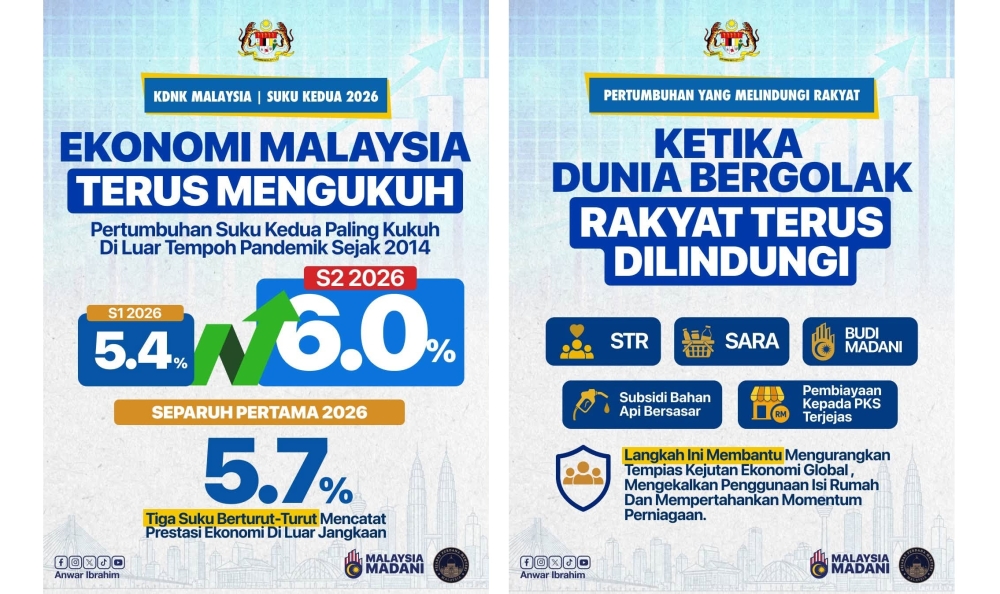
Prime Minister Datuk Seri Anwar Ibrahim has moved to capitalise on Malaysia's economic momentum, publicly endorsing the nation's more robust second quarter growth performance and underscoring the administration's success in shielding domestic consumers from the global inflation surge that has destabilised economies across the developed and developing world. The remarks, delivered on 14 August, signal the government's confidence in its economic management even as regional and international headwinds persist.
The government's ability to sustain expansion beyond market forecasts reflects the structural resilience embedded within Malaysia's diversified economy, comprising manufacturing, services, and agricultural sectors that have proven adaptable to shifting global demand patterns. Q2's outperformance against analyst expectations demonstrates that policymakers' efforts to maintain domestic consumption levels and encourage business investment have yielded tangible results, contrasting with the slower growth trajectories experienced by several neighbouring economies contending with sharper external shocks.
Anwar's emphasis on household protection from inflation carries particular weight for Malaysian voters, many of whom have experienced tangible pressure on living standards over recent years. The government's maintenance of targeted subsidies on essential commodities, alongside efforts to stabilise utility costs and manage fuel pricing, has created a buffer against the purchasing power erosion that has characterised inflation in markets such as Singapore, Australia, and parts of Europe. This cushioning effect, though requiring significant fiscal expenditure, has maintained consumer confidence and supported continued domestic spending that underpins economic activity.
The strategic timing of Anwar's public comments serves broader political purposes beyond mere economic reporting. With general elections potentially on the medium-term horizon, the administration has vested interest in highlighting policy successes that resonate with ordinary Malaysians navigating higher costs for food, housing, and transport. The framing of Q2 growth as evidence of effective governance appeals to voters concerned about economic competence and their personal financial security in coming years.
Malaysia's inflation management contrasts notably with experiences in developed economies where central banks implemented aggressive interest rate increases throughout 2022 and 2023 to combat demand-driven price pressures. By maintaining a more measured approach and utilising supply-side interventions and targeted support, Malaysia has avoided the sharp demand destruction and associated job losses that accompanied tighter monetary stances elsewhere. This difference underscores the distinct economic structures and policy options available to nations with different inflation drivers and institutional arrangements.
However, maintaining this protective shield poses medium-term fiscal challenges that deserve closer scrutiny. Government expenditure on subsidies and support measures has expanded substantially, contributing to public debt levels that approach internationally-cited threshold levels of concern. Sustainability of these measures depends upon continued strong revenue performance from taxation and petroleum-related income, both vulnerable to economic slowdowns or commodity price declines. The government faces difficult choices about whether to gradually phase out supports or seek alternative revenue sources.
Regional context matters significantly for understanding Malaysia's economic positioning. Within ASEAN, the country's growth performance has remained competitive, though Vietnam and Thailand have experienced their own cycles of stronger expansion. Singapore's slower recent growth, driven partly by deliberate policy choices to moderate immigration and investment, has positioned Malaysia as a relatively attractive regional investment destination for manufacturers seeking alternatives to Chinese production bases increasingly affected by geopolitical tensions.
The emerging question involves sustaining growth momentum through anticipated external headwinds. Global interest rate expectations, potential recession risks in Western economies, and ongoing supply chain adjustments create uncertainty for export-dependent Malaysia. While Q2 performance merits celebration, policymakers must contemplate whether momentum can persist should global demand soften materially or if external shocks disrupt the manufacturing sectors concentrated in semiconductor production and electronics assembly.
Internally, Malaysia confronts productivity challenges that inflation-shielding alone cannot resolve. Wage growth must ultimately be justified by enhanced worker productivity and innovation rather than supported indefinitely through subsidies. Long-term competitiveness requires investment in education, technology infrastructure, and research capabilities that position Malaysian industries for higher-value production competing on quality rather than cost alone. Government rhetoric around economic management must eventually translate into transformational structural investments.
For Malaysian households specifically, the government's protective approach has provided welcome respite from the income pressures experienced by populations in countries experiencing double-digit inflation. Middle-class consumers have maintained purchasing capacity for discretionary goods, supporting retail sectors and services that employ significant portions of the workforce. This stabilisation creates space for government to undertake more challenging economic reforms without precipitating social discontent that could destabilise political arrangements.
Looking forward, Anwar's emphasis on economic stewardship positions the government to campaign on competence grounds should elections be called. Public perception of economic management significantly influences voting behaviour, particularly among middle-income voters and urban populations sensitive to cost-of-living metrics. Q2 growth serves as concrete evidence supporting the administration's claims that its policies merit electoral endorsement, though actual living standards improvements must become evident in household finances rather than abstract statistics.

