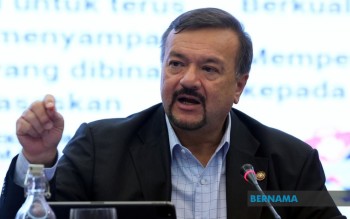
Malaysia's economic trajectory continues to defy global headwinds, with Finance Minister II Datuk Seri Amir Hamzah Azizan reporting a strengthening growth momentum that underscores the country's economic resilience in an increasingly uncertain world. Speaking at the GEAR-uP Progress Report press conference in Putrajaya, he outlined a consistent pattern of expansion that demonstrates the efficacy of government policy frameworks in insulating the nation from international shocks.
The minister laid out a compelling growth narrative spanning multiple fiscal periods. The country achieved 5.2 per cent GDP growth in 2024, maintained that benchmark throughout 2025, and has since accelerated its performance trajectory. The first quarter of the current year yielded 5.4 per cent expansion, while preliminary estimates for the second quarter project 5.8 per cent growth, translating to an average of 5.6 per cent for the year to date. This progressive acceleration reveals an economy gathering momentum rather than losing traction, a particularly noteworthy achievement when set against the turbulent external environment.
The broader context makes Malaysia's performance remarkable. Last year witnessed the intensification of trade conflicts between major economic powers, creating significant headwinds for export-dependent nations throughout the region. This year has introduced fresh challenges through geopolitical instability centred on West Asia, which threatens supply chains and investor confidence globally. Yet Malaysia has navigated these obstacles without experiencing the deceleration that might reasonably be expected under such circumstances, suggesting that domestic policy measures have successfully buffered the economy from these external pressures.
Amir Hamzah attributed this resilience directly to the implementation of the MADANI Economy Framework, which represents the government's comprehensive approach to ensuring inclusive and sustainable economic development. The framework is not merely aspirational rhetoric but has been operationalised through tangible initiatives that are now demonstrating measurable impact on both aggregate economic performance and household welfare. This distinction between policy design and policy execution is crucial—many developing economies articulate sound economic strategies that founder during implementation, yet Malaysia appears to be successfully translating its strategic vision into real-world outcomes.
Central to this execution is the GEAR-uP programme, which the Ministry of Finance has spearheaded since 2024. This initiative represents a deliberate commitment to stimulating domestic direct investment, with government agencies pledging RM120 billion in capital deployment across the 2024-2028 period. Rather than relying exclusively on foreign direct investment, which can be volatile and often generates limited domestic spillover effects, this programme prioritises mobilising domestic capital to build enduring industrial capacity and generate multiplier effects throughout the Malaysian economy.
Government-linked investment companies and government-linked companies play a catalytic role within this framework, functioning as anchor investors and strategic partners that encourage wider participation from the private sector. Their involvement addresses a critical market failure in developing economies—the shortage of patient capital willing to support long-term industrial development projects that mature beyond typical investment horizons. By deploying GLICs and GLCs as catalysts, the government creates pathways for domestic industries to access not only capital but also talent, expertise, and international networks that accelerate their competitive development.
Amir Hamzah articulated a sophisticated understanding of why mere capital injection is insufficient for genuine economic transformation. He emphasised that attracting funds represents only the initial stage; the critical challenge lies in ensuring that deployed capital generates lasting benefits for Malaysian workers and communities. This requires complementary policies encompassing education and skills development, technology transfer mechanisms, and institutional frameworks that facilitate knowledge diffusion throughout the economy. Without such supporting infrastructure, foreign or domestic investment tends to create enclaves of activity with limited integration into the broader economy.
The minister's confidence in Malaysia's trajectory reflects measurable progress rather than mere optimism. The sustained acceleration of quarterly growth rates, combined with the increasingly sophisticated policy architecture driving that performance, suggests the government has moved beyond reactive crisis management into proactive structural transformation. For Malaysian policymakers, the challenge now involves maintaining growth momentum while simultaneously addressing longer-term development challenges, including income inequality, human capital development, and sectoral diversification beyond traditional sources of comparative advantage.
Regional context amplifies the significance of Malaysia's economic performance. As the Southeast Asian region faces mounting uncertainties—from geopolitical tensions to protectionist trade policies—nations that successfully maintain growth while others decelerate gain competitive advantages in attracting investment, retaining talent, and expanding market share. Malaysia's demonstrated resilience positions it favourably within the regional hierarchy, though this advantage can only be sustained through continued policy discipline and institutional effectiveness.
The MADANI Economy agenda represents a distinct Malaysian approach to development that prioritises not merely growth statistics but the qualitative dimensions of economic advancement—specifically, the distribution of prosperity and the structural transformation toward higher-value activities. By anchoring the GEAR-uP programme within this broader framework, the government signals that short-term stimulus is insufficient; instead, policies must address systemic constraints limiting Malaysia's transition to genuine developed-economy status.
Looking forward, Amir Hamzah's assessment that Malaysia is on the right track rests on solid quantitative foundations. The acceleration evident in quarterly growth figures suggests that policy measures implemented over the past eighteen months are yielding results. However, sustaining this momentum requires vigilance against complacency and continued commitment to the structural reforms embedded within the MADANI framework, ensuring that growth translates into tangible improvements in living standards and expanded opportunities for Malaysian citizens across all communities.

