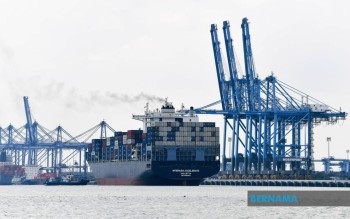
Malaysia's export trajectory for 2026 is looking substantially stronger than previously anticipated, with leading financial institutions revising their forecasts sharply upward in response to robust real-world performance during the first half of the year. RHB Investment Bank Bhd has increased its 2026 export growth projection to 21.7 per cent, a marked improvement from its earlier estimate of 15.3 per cent, reflecting the country's outperformance relative to regional and global benchmarks. This confidence in Malaysia's trade prospects carries significant implications not only for the nation's economic growth but also for employment, currency stability, and the country's competitive standing in Southeast Asia's manufacturing and technology ecosystems.
The impetus behind this optimistic revision stems primarily from Malaysia's impressive export performance in the opening months of 2026, when shipments expanded by 27.5 per cent year-on-year. Such substantial growth signals that the underlying drivers of Malaysia's export competitiveness remain robust and that the country is effectively capturing opportunities within globalisation's current trajectory. The strength evident in the first six months of the year provides a substantial statistical base from which the full-year projection is calculated, lending credibility to analysts' bullish outlook rather than relying on speculative assumptions about future market conditions.
The electrical and electronics sector, long Malaysia's export powerhouse, continues to validate its reputation as an economic anchor. Underpinning the sector's resilience is the global technology upgrade cycle that has been amplified by artificial intelligence investments and related infrastructure buildout. Semiconductor demand, driven by proliferation of AI applications across cloud computing, data centre construction, electric vehicle manufacturing, and industrial automation, has created a sustained tailwind for Malaysian producers and exporters positioned within these supply chains. This convergence of technological trends and Malaysia's manufacturing capabilities creates a compelling narrative for sustained export momentum throughout 2026 and potentially beyond.
The trade surplus tells an equally compelling story about Malaysia's external economic position. The country recorded a surplus of RM83.9 billion during the second quarter of 2026, a dramatic turnaround from the RM15.3 billion surplus achieved in the corresponding quarter of 2025. Such strengthening in the trade account directly enhances the nation's gross domestic product growth calculations and improves the current account position, buffering against currency volatility and external shocks. June 2026 data further substantiated this momentum, with total trade expanding by 44.7 per cent to RM340.9 billion, while the monthly trade surplus surged 64.9 per cent to RM14.9 billion, suggesting the momentum has sustained into the latter part of the year.
MBSB Investment Bank Bhd, offering a slightly more conservative but still notably optimistic assessment, projects 2026 export growth of 18.9 per cent, representing a substantial acceleration from 2025's actual growth rate of 6.6 per cent. MBSB attributes this expansion to the dual engine of technology product demand and commodity-linked growth, particularly in petroleum products and liquefied natural gas sectors. This diversification across both value-added manufactured goods and commodity-based products suggests Malaysia's export base is broadening, reducing dependence on any single sector or market. Such diversification carries strategic significance for long-term economic resilience, as it cushions the economy against sector-specific downturns or technological disruptions.
Import growth, equally important for understanding Malaysia's economic cycle, is also being upgraded by analysts. MBSB now projects 2026 import growth at 13 per cent, up from its previous 6.0 per cent forecast, reflecting strengthened domestic economic activity and capital goods importation associated with export-sector expansion and broader industrial investment. Rising imports alongside rising exports characterises a healthy, growing economy engaged in sophisticated manufacturing and value-chain integration. June's import expansion of 43.9 per cent to RM163.0 billion validates this picture of domestic economic vitality, even as the nation continues to export aggressively.
However, beneath this optimistic surface lie genuine vulnerabilities that sophisticated investors and policymakers cannot afford to ignore. Geopolitical tensions, particularly tensions between major economic powers, threaten to disrupt supply chains and impose additional costs throughout the logistics and manufacturing ecosystem. Malaysia's deeply integrated position within global supply chains, while a source of strength during stable periods, becomes a vulnerability when international tensions rise, potentially forcing companies to reconfigure sourcing, production, or distribution strategies. Energy costs remain another persistent risk factor, with elevated oil prices capable of cascading through transportation, manufacturing, and operational expenses across virtually every export-oriented sector.
Trade policy uncertainty, particularly emanating from the United States, presents perhaps the most acute medium-term risk to Malaysia's export outlook. Potential shifts toward protectionism, heightened tariff regimes, or stricter rules of origin requirements could significantly dampen demand for Malaysian exports or force reorientation of manufacturing and export patterns. Supply chain disruptions, whether from geopolitical sources, natural disasters, or logistical congestion, could interrupt the continuous flow of intermediate goods and finished products that Malaysia's export-dependent economy requires. Weakening global demand, should recession fears materialise or consume-led growth patterns shift, would directly constrain Malaysia's ability to sustain the exceptional growth rates currently projected.
Malaysia's structural advantages in absorbing and responding to external challenges provide meaningful counterweight to these risks. The nation's diversified economic structure, spanning natural resources, manufacturing, services, and increasingly technology sectors, provides natural hedges against sector-specific shocks. Deep integration into regional supply chains, particularly within ASEAN and with China, India, and other Asian economies, creates redundancies and alternative pathways that can sustain trade flows even if some traditional routes face disruption. Government efforts to diversify export markets and expand product offerings, away from historical concentration on certain sectors and destinations, gradually enhance the economy's flexibility and resilience.
Looking forward, Malaysia's 2026 export performance will serve as a critical barometer for Southeast Asian economic health and the resilience of technology-dependent supply chains. The country's ability to sustain growth rates in the 18-22 per cent range, as various analysts project, depends fundamentally on global technological investment cycles continuing to favour semiconductor-intensive products, artificial intelligence infrastructure, and advanced manufacturing. Whether Malaysia can navigate the external risks identified by both RHB IB and MBSB—geopolitical tensions, energy costs, trade policy shifts, and demand volatility—will determine whether current optimistic projections prove conservative or whether downside scenarios ultimately prevail.

