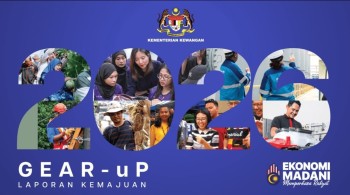
Malaysia's government-linked investment companies have sharply accelerated their domestic capital deployment, channelling RM20.3 billion into the local economy during 2025—nearly three times the RM6.6 billion mobilised in the previous year. This surge in funding represents a crucial phase of the Government-Linked Enterprises Activation and Reform Programme (GEAR-uP), which entered its third year of operation with strengthened momentum extending into the first quarter of 2026. Prime Minister Datuk Seri Anwar Ibrahim, addressing the release of the GEAR-uP Progress Report, emphasised that this capital allocation reflects a departure from traditional passive investment models. Rather than seeking returns divorced from broader economic objectives, the programme channels national wealth toward explicit development targets aligned with Malaysia's transformation agenda.
Launched in 2024 under the stewardship of the Ministry of Finance, GEAR-uP represents an ambitious commitment to unlock RM120 billion over five years, catalysing socioeconomic reforms and accelerating the nation's industrial transition. The programme draws on the combined firepower of six major GLICs: Khazanah Nasional Bhd, the Employees Provident Fund (EPF), Permodalan Nasional Bhd (PNB), Kumpulan Wang Persaraan (Diperbadankan) (KWAP), Lembaga Tabung Angkatan Tentera (LTAT), and Lembaga Tabung Haji (TH). By pooling resources and coordinating deployment across these sovereign and quasi-sovereign entities, Malaysia has constructed a mechanism capable of influencing economic direction at scale while maintaining disciplined investment protocols. The tripling of annual deployment signals both growing confidence in the programme's operational framework and the urgency with which policymakers view the need for structural economic change.
For ordinary Malaysians, the implications extend beyond headline investment figures. Prime Minister Anwar framed GEAR-uP within the broader MADANI Economy framework, which emphasises raising both the economic ceiling and floor—creating opportunity at the top while ensuring prosperity reaches those at the bottom. In an environment marked by persistent global volatility and shifting trade patterns, this strategic approach offers a stabilising mechanism, channelling investment into sectors and enterprises that directly touch household welfare. The government has explicitly repositioned GLICs from entities optimising shareholder returns in isolation toward institutions anchoring Malaysia's socioeconomic resilience during turbulent external conditions.
Concrete infrastructure and employment generation constitute the programme's immediate deliverables. KWAP has backed Google's expansion into Selangor with a substantial data centre investment projected to add 320 megawatts of capacity and create 26,500 jobs through 2026 and 2027. Complementing this initiative, Empyrion Digital is executing a phased buildout in Johor, establishing a dual-track approach to digital infrastructure development across Malaysia's key economic corridors. Simultaneously, Tenaga Nasional Bhd (TNB) is ramping up its grid investment through Regulatory Period 4, scaling from RM12 billion in 2025 toward RM15 billion by 2027 in support of Malaysia's 2050 renewable energy target of 70 per cent installed capacity. These investments represent not merely capital deployment but foundational infrastructure reshaping the nation's energy and digital backbone.
Capital markets development constitutes another strategic pillar. GLIC-managed specialised funds—Dana Impak, Dana Perintis, Dana Pemacu, and Ekuinas—are systematically supporting Malaysian enterprises through the venture-to-growth transition, addressing a critical market gap in growth-stage financing. Khazanah's forthcoming Dana Ciptawan initiative will inject an additional RM200 million specifically targeting Bumiputera enterprises and mid-tier Malaysian firms, deepening the capital supply chain for domestically-rooted champions. Government-linked companies collectively remain on track to generate RM100 billion in additional market value by 2028, while the MY Value Up initiative extends comparable discipline and oversight across Malaysia's 88 largest listed companies. These interventions directly support the Capital Market Masterplan's 2030 target of RM5.8–RM6.3 trillion in market capitalisation, a figure critical for Malaysia's long-term economic competitiveness.
Bumiputera wealth creation—a foundational pillar of Malaysia's social contract—receives explicit programmatic attention. The GEAR-uP framework targets ten Bumiputera company listings over 2026–2027, while the 10 Bumiputera Champions Programme works systematically to scale participant enterprises. Simultaneously, Zakat Wakalah—an Islamic financing instrument channelling charitable funds into productive enterprise—is projected to reach RM100 million by 2026, expanding from RM28 million previously. These measures reflect recognition that inclusive economic growth requires deliberate institutional action ensuring non-Bumiputera-dominated constituencies benefit equitably from Malaysia's development trajectory. Rather than treating Bumiputera advancement and overall economic performance as competing objectives, GEAR-uP posits their fundamental alignment.
Minister of Finance II Datuk Seri Amir Hamzah Azizan articulated a philosophical reorientation underpinning GEAR-uP: capital accumulation divorced from employment generation and wage quality constitutes merely passive wealth concentration. The programme instead measures success through living wages adopted, graduates placed in quality employment, Bumiputera firms scaled to competitive capability, and supply chains deepening local production. In this framing, the RM20.3 billion deployment figure matters primarily as a means to these employment and capability-building ends rather than as an end in itself. Portfolio performance yields an aggregate 8.0 per cent total shareholder return, respectable by investment standards, yet secondary to the programme's real objective: translating capital into sustained, dignified livelihoods accessible to broader Malaysian populations.
Malaysia Airports' five-year, RM11 billion upgrade programme exemplifies infrastructure investments extending GEAR-uP's reach into transportation ecosystems. Kuala Lumpur International Airport's capacity expansion targets accommodating over 100 million passengers, positioning Malaysia's primary gateway for regional connectivity and tourism competitiveness. These large-scale infrastructure commitments, coordinated through the GLIC framework, create multiplier effects throughout construction, hospitality, logistics, and professional services sectors. Rather than allowing major infrastructure decisions to emerge through fragmented commercial considerations, GEAR-uP embeds such projects within coherent national development strategy.
The external environment shapes programme urgency. Malaysia weathered 2023's global turbulence partly through earlier structural reforms, creating buffer capacity against ongoing volatility. GEAR-uP, launched in 2024 with direction firmly settled at inception, represents execution focused and disciplined. The report emphasises that most major initiatives are already in motion, with tangible outcomes approaching accessibility for broader Malaysian populations across 2026–2028. This emphasis on deliverables reflects implicit political accountability: GEAR-uP succeeds only if capital deployment translates into visible improvements in ordinary Malaysians' economic circumstances.
For Southeast Asian observers, Malaysia's GEAR-uP experiment offers instructive dimensions. Few regional economies command comparable pools of patient capital through sovereign wealth and pension funds, nor possess institutional infrastructure coordinating such resources toward explicit development outcomes. The programme exemplifies an alternative to both laissez-faire capital allocation and dirigiste state capitalism, instead establishing framework conditions enabling capital to serve national development priorities while maintaining investment discipline and portfolio performance. Should GEAR-uP successfully translate its ambitious RM120 billion deployment across five years into measurable improvements in employment quality, Bumiputera advancement, and productive infrastructure, it may establish a replicable model for other developing economies seeking to harness state-linked capital for inclusive growth.
The underlying narrative positioning GEAR-uP emphasises constancy amid uncertainty. As global trade reshaping, technological disruption, and geopolitical realignment persist, Malaysia's strategy opts for staying the course with capital deployment, continuous delivery execution, and patience allowing investments to root and flourish. This reflects implicit confidence that Malaysia's fundamentals—institutional capacity, human capital, geographic positioning, and accumulated capital stock—position it advantageously despite external headwinds. Successive year-on-year increases in GLIC deployment, coupled with institutional commitment extending through 2028, signal that policymakers view current conditions as unusually opportune for building enduring economic capability, even if immediate returns remain uncertain.
Looking ahead, GEAR-uP's next three years will prove determinative for the programme's broader credibility. Markets and observers will scrutinise whether deployed capital genuinely generates the employment, skills advancement, and supply-chain deepening officials project, or whether funds merely recycle through existing corporate structures without reaching intended beneficiaries. The explicit invocation of living wages, graduate placement, and supply-chain localisation as success metrics suggests policymakers recognise that capital deployment alone proves insufficient—implementation rigour, governance discipline, and accountability mechanisms become paramount. Prime Minister Anwar's repeated emphasis on the rakyat as the ultimate measure of success acknowledges that GEAR-uP's legitimacy ultimately derives not from financial returns but from visible improvements in Malaysians' economic security, opportunity, and dignity.

