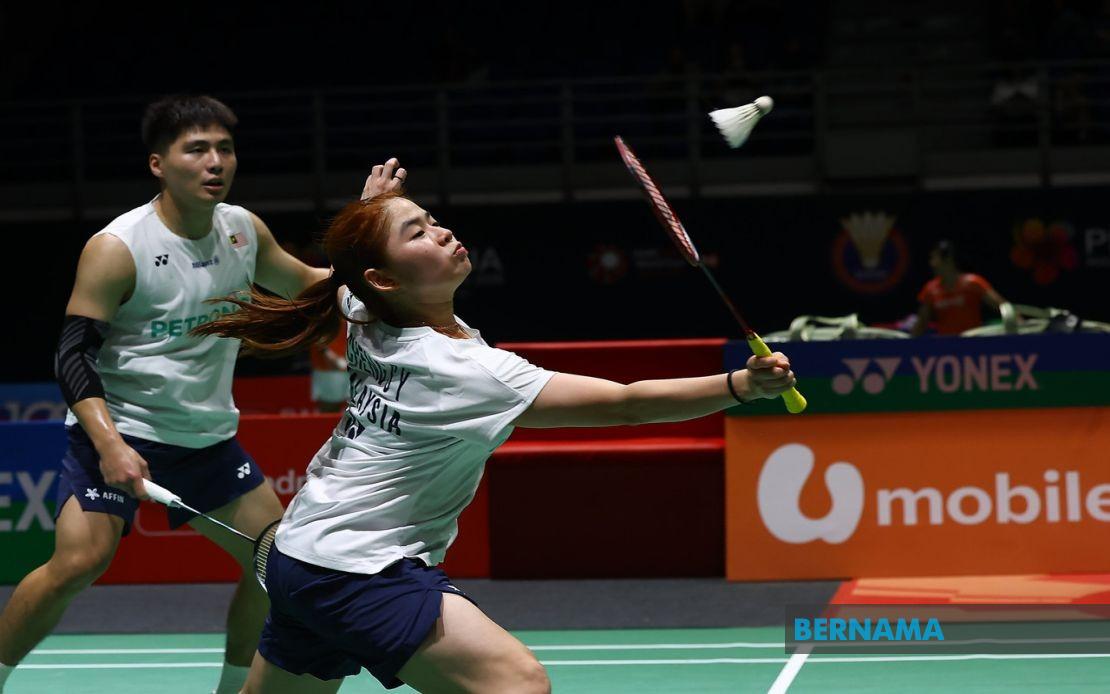
Malaysia's pursuit of silverware at the 2026 Japan Open in Tokyo came to an end on July 18 when the country's final two competing pairs were eliminated in the semi-final rounds, marking the conclusion of what had been an encouraging run for the Malaysian contingent in a tournament that continues to serve as a testing ground for aspiring badminton champions in the region.
The mixed doubles pairing of Jimmy Wong and Cheng Su Yin, competing as unseeded players, saw their impressive giant-killing streak halted by experienced Hong Kong opponents Tang Chun Man and Tse Ying Suet. The Malaysian pair absorbed a 69-minute marathon encounter with considerable composure but ultimately fell short, losing 17-21, 21-18, 21-15. Despite the defeat, the performance demonstrated that Wong and Cheng Su Yin possess the calibre to compete meaningfully against the world's elite mixed doubles combinations, having navigated their way through a demanding draw before encountering Hong Kong's seasoned campaigners in the final four.
The men's doubles combination of Goh Sze Fei and Nur Izzuddin Rumsani faced an even steeper mountain, drawing world number one pair Kim Won Ho and Seo Seung Jae of South Korea in their semi-final matchup. The 58-minute contest unfolded in three sharply contrasting games, with the Malaysian duo struggling to find rhythm early on as they dropped the opening game decisively, 12-21. Rather than capitulating, Goh and Nur Izzuddin staged a spirited recovery, levelling the contest by claiming the second game with an emphatic 21-11 victory and forcing a decisive third game.
However, the South Korean top-seeded partnership proved too formidable in the decider, storming through the final game 21-13 to secure their progression and deny Malaysia a pathway to the final. This result continued an unfavourable historical pattern for the Malaysian pairing, as Goh and Nur Izzuddin have now lost three times in five meetings against the dominant Korean combination. The frequency of these encounters underscores the competitive nature of badminton at the highest level, where repeated matchups against formidable opponents become inevitable as players climb the rankings.
The exits of these two pairs represent the culmination of Malaysia's Japan Open campaign, with both combinations having performed creditably despite falling to superior-ranked opponents in the penultimate stage. The mixed doubles achievement, in particular, highlights the emerging depth within Malaysian badminton's pairing development, as unseeded combinations increasingly demonstrate the ability to navigate tournament structures and trouble established top-ten partnerships. Such performances provide important data points for the Malaysian badminton coaching establishment as they assess player development trajectories heading into the latter stages of Olympic qualification cycles.
For Malaysian badminton observers, the tournament encapsulates both the encouraging progress being made by emerging players and the persistent challenges they face against the region's dominant forces, particularly South Korea and China. The semi-final exits, while disappointing on their surface, should be contextualised within a broader developmental framework where gaining experience against world-class opponents at prestigious tournaments serves as an investment in long-term competitive capacity. The quality of opposition faced by both Malaysian pairs—including unseeded status yet reaching the semi-finals, and contesting close matches against top-ranked players—demonstrates that the national programme continues to produce athletes capable of competing at international level.
The Japan Open holds particular significance within the badminton calendar as a BWF Super 1000 tournament, meaning the competition attracts elite players from across the globe and provides reliable indicators of current form and trajectory. For Malaysian pairs, such tournaments serve dual purposes: they offer immediate opportunities for ranking points and title contention, while simultaneously providing intensive preparation for major championship events later in the season. The performances in Tokyo, though resulting in early eliminations for Malaysia's final representatives, generate valuable intelligence about matchup dynamics and tactical approaches that the coaching staff can incorporate into training programmes.
Looking beyond this particular tournament, the Malaysian badminton federation will likely view these results as part of a longer-term competitive narrative. While the absence of Malaysian pairs in the finals represents a missed opportunity for silverware, the mere fact that the country qualified two pairs for the semi-finals of a prestigious Super 1000 event demonstrates that the national programme maintains competitive relevance. The challenge for Malaysian badminton continues to be bridging the performance gap with regional powerhouses while simultaneously developing depth across multiple pairing combinations to ensure consistent representation at the sport's highest levels throughout the season.

