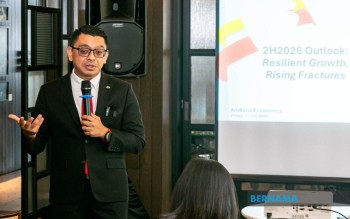
Malaysia's strategic position in global maritime trade is set to deepen as port operators tap into broader supply chain reshuffling driven by geopolitical instability in West Asia, according to analysis from AmBank (M) Bhd chief economist Firdaos Rosli. Despite persistent pressure on logistics expenditure, the country's port sector continues to demonstrate resilience and expansion potential, reinforcing its status as a pivotal transhipment destination along the Strait of Melaka, one of the world's most critical shipping corridors.
The shifting dynamics of international commerce have already started translating into tangible gains for Malaysia's major port facilities. Port Klang and the Port of Tanjung Pelepas (PTP) reported combined container throughputs of 15.14 million and 14.03 million twenty-foot equivalent units (TEUs) respectively during 2025, underscoring the substantial volumes flowing through Malaysian terminals. These figures reflect the cumulative benefit of companies reassessing and diversifying their supply chain networks in response to regional tensions, a trend that looks set to sustain in the medium term.
Early 2026 data provides encouraging signals of sustained momentum. Container volumes at Port Klang expanded by five per cent year-on-year during the first five months of the year, while PTP demonstrated even stronger growth at eight per cent, suggesting that supply chain reorientation towards Malaysia continues to accelerate. This growth trajectory assumes particular significance given the intensely competitive regional port environment, where neighbouring facilities in Singapore, Thailand, and Indonesia are equally vying for increased traffic.
However, maintaining and extending these competitive advantages requires strategic capital investment and infrastructure development, Firdaos cautioned. Port operators cannot simply absorb growing volumes without upgrading facilities, deepening berths, and expanding storage capacity. As emerging markets vie for containerised trade, Malaysia must ensure that its physical infrastructure keeps pace with demand, lest competitors capture market share through superior operational efficiency or newer technological capabilities.
Beyond volume growth, Malaysia is advancing an ambitious agenda to establish itself as a regional hub for sustainable maritime fuels, positioning the nation at the forefront of the shipping industry's environmental transition. The government has unveiled a Green Bunkering Regulatory Roadmap that targets alternative marine fuels such as liquefied natural gas (LNG) and methanol to constitute 40 per cent of maritime fuel consumption by 2050. This long-term commitment reflects both environmental imperatives and commercial opportunity, as global shipping faces increasing regulatory pressure to decarbonise.
Port of Tanjung Pelepas has already commenced LNG and methanol bunkering operations, moving from regulatory framework to operational reality. This positions Malaysia ahead of many regional competitors in offering shipowners the infrastructure necessary to transition towards lower-carbon maritime fuels. As international maritime organisations progressively tighten environmental standards, ports offering green fuel capabilities will attract increasingly valuable customer relationships. Malaysian operators thus have a first-mover advantage that could translate into premium pricing and long-term contract security.
The shipping market itself presents a more complex picture, however. The Baltic Exchange Index (BDI), a barometer of global seaborne freight costs, surged more than 120 per cent year-on-year in February and May before settling at an elevated 64.6 per cent in June. This elevated pricing environment typically dissipates quickly once temporary disruptions resolve, yet shipping costs have remarkably proven resilient and stable, indicating that underlying supply-side pressures persist despite the temporary nature of the West Asia conflict.
This phenomenon carries particular significance for Malaysia's port sector and broader economy. Elevated freight rates increase operational costs for importers and exporters, potentially dampening trade volumes if shippers absorb these expenses or pass them to consumers. The geopolitical tensions in West Asia, while no longer directly disrupting crude oil flows to global markets, continue to impose material costs on maritime transportation by forcing extended transit routes and increased security measures. Malaysian shippers and port operators thus find themselves caught between opportunities arising from supply chain rerouting and headwinds from persistently high transportation costs.
For Malaysian policymakers and port operators, the strategic imperative is clear: leverage the current favourable positioning along the Strait of Melaka to secure market share and investment while simultaneously building the infrastructure and capabilities—particularly around green bunkering—that will sustain competitiveness as global supply chains stabilise and environmental regulations tighten. The window of opportunity presented by geopolitical disruption may not remain indefinitely, making near-term capital deployment essential.
The convergence of supply chain diversification, green energy transition, and elevated freight rates creates both complexity and opportunity for Malaysia's maritime sector. Port operators must balance investments in traditional capacity expansion with commitments to sustainable fuel infrastructure. Simultaneously, they must manage the uncertainty inherent in predicting when freight rates will normalise and supply chain patterns will stabilise. Success requires not merely responding to current market conditions but anticipating and shaping the maritime industry's evolution over the next decade.

