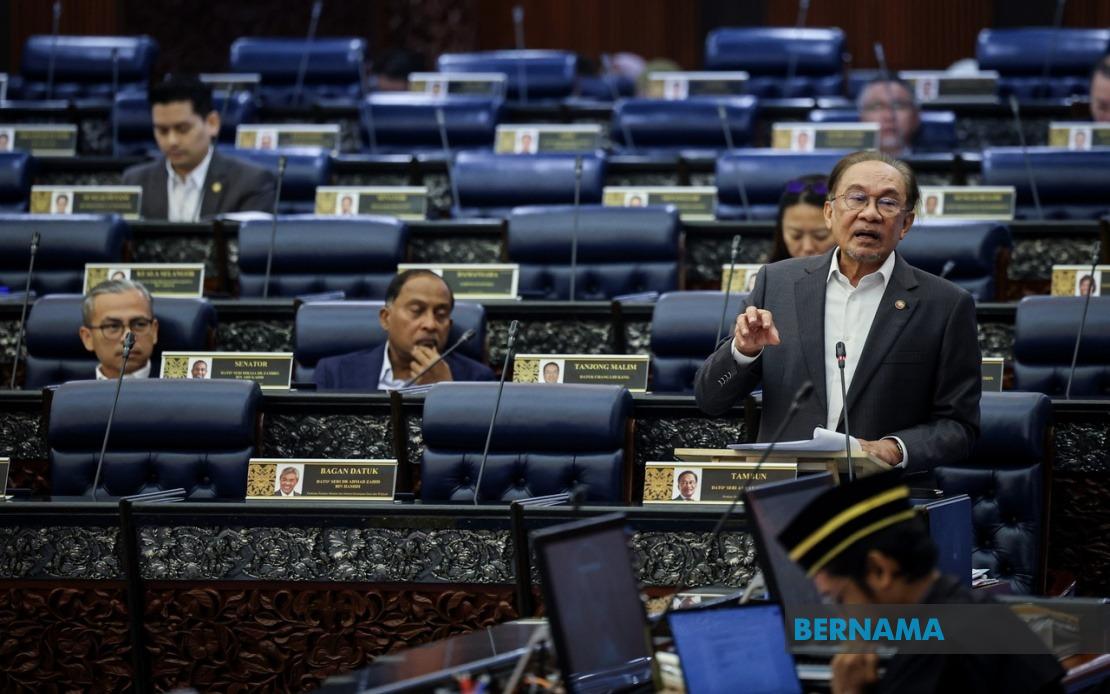
Malaysia's decline in the 2026 World Press Freedom Index—from 88th place last year to 95th—reflects a complex interplay of international assessments and domestic enforcement priorities, according to Prime Minister Datuk Seri Anwar Ibrahim. Speaking during parliamentary Question Time in Kuala Lumpur, Anwar acknowledged that several high-profile actions against media outlets have shaped the country's lower ranking among global press freedom monitors, while simultaneously defending the government's approach as a legitimate exercise of law enforcement rather than censorship.
The Prime Minister identified two specific cases that have drawn international scrutiny. Sin Chew Daily faced action over the publication of an inaccurate illustration of the Jalur Gemilang, while Sinar Harian was subject to enforcement measures regarding publication of the Inspector-General of Police's biography. Anwar emphasised that international media observers, particularly those conducting assessments for the World Press Freedom Index, viewed these interventions as significant violations of press liberty—a perception that directly impacts Malaysia's global standing. The distinction between how Malaysia handles sensitive matters and the international perspective on press norms remains a contentious point, with Anwar noting that other nations may not accord the same level of protection to national symbols.
Crucially, Anwar framed the government's enforcement strategy as narrowly targeted rather than broadly suppressive. The administration distinguishes between three specific categories warranting intervention: matters involving religion, race, and the royal institution—the so-called 3R issues—alongside content posing genuine threats to national security. This framework represents an attempt to reconcile Malaysia's constitutional protections for press freedom with the country's established legal boundaries around religious sensitivities, racial harmony, and institutional respect. The government, according to Anwar, does not penalise media organisations for factual inaccuracies or political criticism standing alone, instead preferring clarification mechanisms such as parliamentary statements over punitive measures.
The Prime Minister's position reflects an ongoing tension within Malaysia's media landscape. While the government has advanced legislative reforms—notably amendments to Section 233 of the Communications and Multimedia Act 1998 that decriminalise satirical remarks directed at political leaders—these changes coexist with frameworks that remain highly protective of certain domains. Anwar specifically highlighted the decriminalisation of satirical content targeting the Prime Minister and other leaders as evidence of the government's commitment to expanding press latitude in political discourse. However, this liberalisation in one area contrasts sharply with the continued restriction of expression relating to the monarchy, religious matters, and racial sensitivity, a duality that international assessors struggle to reconcile with global press freedom standards.
The government's position is further constrained by formal agreements reached through the Conference of Rulers, which maintains oversight of content deemed insulting to the monarchy or capable of inflaming racial or religious tensions. This constitutional arrangement, binding on the executive, reflects Malaysia's unique federal structure and the special constitutional position of the sultans. For press freedom advocates and international monitoring organisations, this institutionalised censorship authority—however legitimate within Malaysia's constitutional framework—represents a structural impediment to unfettered media operations. The tension between respecting established constitutional protections and meeting international press freedom standards has become a defining challenge for the Malaysian government's media policy.
Anwar also directed attention toward dimensions of media regulation beyond direct government action. The removal of online content by social media platforms, frequently based on user complaints rather than government directives, contributes significantly to Malaysia's World Press Freedom Index ranking. The Prime Minister cited his own experience, noting that posts related to Hamas were removed by major social media platforms despite the government's explicit disagreement with those decisions. This phenomenon reveals how Malaysia's press freedom assessment encompasses factors entirely outside governmental control—the enforcement policies of multinational technology companies increasingly shape the information environment that Malaysian citizens access, yet these actions are attributed to Malaysia's regulatory environment rather than platform operators' independent moderation choices.
The role of the Malaysian Communications and Multimedia Commission (MCMC) further complicates this landscape. Anwar clarified that requests issued by the MCMC do not automatically result in content removal, as social media platforms retain final authority over moderation decisions. This distinction—between government requests and platform compliance—rarely receives nuance in international press freedom assessments, which often treat all removal of content relating to Malaysia as a reflection of the nation's regulatory environment. The fragmentation of media authority across government agencies, constitutional bodies, and foreign platform operators creates an accountability gap that international monitors struggle to navigate accurately.
Reporters Without Borders (RSF), the organisation behind the World Press Freedom Index, employs a multidimensional assessment framework that extends far beyond direct government censorship. The index evaluates political environment, legal framework, economic conditions, socio-cultural context, and security considerations. Malaysia's ranking reflects cumulative judgments across these dimensions, meaning that enforcement actions against specific outlets carry outsized weight precisely because other indicators—particularly Malaysia's relative political stability and economic development compared to regional peers—are comparatively positive. The government's legal reforms and stated commitment to press freedom in political discourse compete with headline cases of enforcement, creating a volatile ranking that fluctuates with each high-profile intervention.
For Malaysian stakeholders in media and governance, understanding these dynamics proves essential to navigating the country's evolving regulatory terrain. The government has explicitly signalled that political criticism and factual journalism remain protected activities, even as certain boundaries around religious expression, racial sensitivity, and institutional respect remain non-negotiable within Malaysia's constitutional framework. Foreign technology companies, meanwhile, operate according to global standards that may diverge significantly from Malaysian legal and cultural norms, creating friction points that affect both press freedom and Malaysia's international reputation. The challenge facing policymakers involves developing enforcement approaches that respect constitutionally mandated protections while moderating the reputational costs incurred through actions that international observers perceive as restrictions on press liberty.
Looking forward, Malaysia's press freedom ranking will likely remain volatile and sensitive to enforcement decisions. The government's strategic communication about the rationale for specific interventions—distinguishing between permissible political criticism and impermissible content attacking national symbols or inflaming communal tensions—offers one pathway toward international understanding. Simultaneously, reforms that further extend protection to political speech and satire, as exemplified by the amendments to the Communications and Multimedia Act, signal movement toward international norms. However, the structural tension between Malaysia's constitutional commitments to protect the monarchy and religious sensitivities and international press freedom standards appears likely to persist absent fundamental shifts in either framework.

