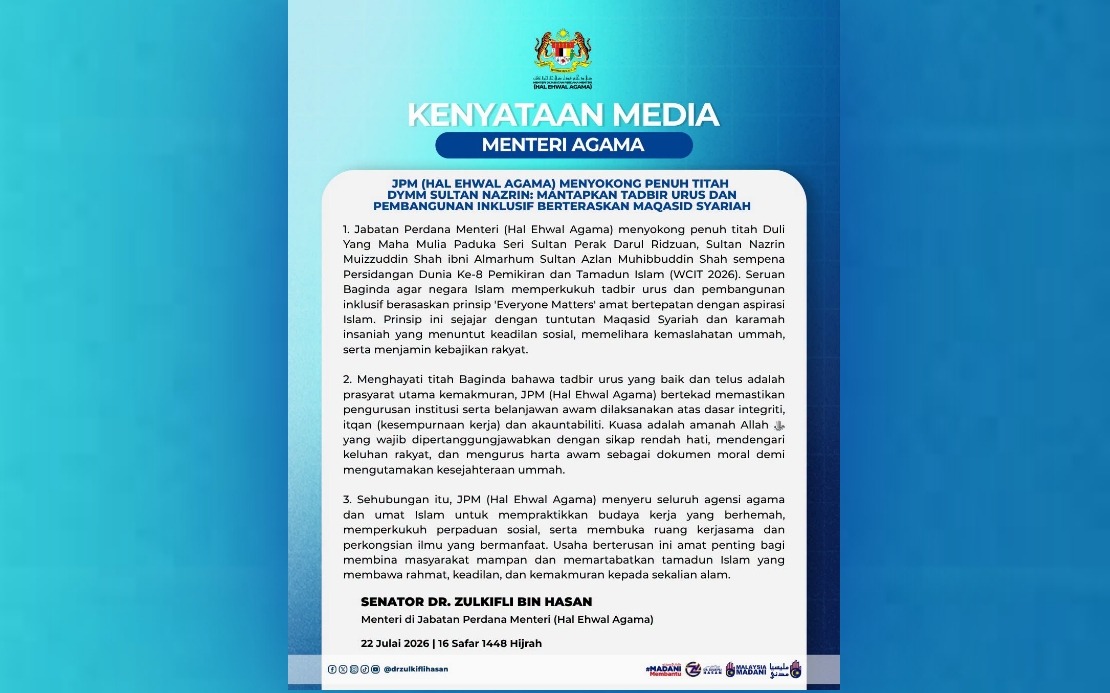
The Prime Minister's Department (Religious Affairs) has committed to overhauling how religious institutions operate in Malaysia, grounding the shift in a vision articulated by Sultan Nazrin Shah at an international Islamic conference. The reorientation centres on three pillars—integrity, accountability, and genuine public welfare—reflecting a broader philosophical move towards governance that treats all citizens as equally valued members of society regardless of their religious affiliation or political background.
Dr Zulkifli Hasan, the Minister in the Prime Minister's Department (Religious Affairs), framed this commitment as an organic extension of Islamic principles rather than a departure from them. Speaking in Putrajaya on July 22, he underscored that the Sultan's advocacy for "Everyone Matters" governance does not conflict with Islamic doctrine; instead, it reinforces core Islamic teachings on social responsibility and human dignity. This framing is significant for Malaysia, where religious governance and secular democratic principles have sometimes appeared to operate in separate spheres. By positioning inclusive governance as doctrinally sound, the minister opened space for religious institutions to modernise without facing accusations of abandoning Islamic values.
Sultan Nazrin Shah made his case for governance reform at the 8th World Conference on Islamic Thought and Civilisation, where he stressed that public administration serving all citizens equally—transcending divisions of ethnicity, belief, and party affiliation—represents authentic national unity and humble leadership. The Perak Sultan's emphasis on listening to citizens before legislating signals a departure from top-down religious governance models that have sometimes marginalised minority viewpoints or public input in policy formation. For Malaysia, a multi-religious nation where religious policies affect citizens of various faiths, this principle carries practical implications beyond symbolism.
The minister anchored the governance framework in two Islamic concepts that carry significant weight in contemporary Islamic jurisprudence. Maqasid Syariah, the objectives of Islamic law centring on protecting faith, life, intellect, wealth, and family, provides theological justification for policies prioritising community welfare over institutional prerogative. Karamah insaniah, or human dignity, emphasises the inherent worth of every person—a concept increasingly invoked by Islamic scholars advocating for rights-based approaches within an Islamic framework. By tethering governance reform to these established principles, Dr Zulkifli positioned institutional change as a return to Islamic fundamentals rather than an external imposition.
The Sultan's broader point about global interdependence carries particular resonance for Southeast Asia's religious leaders and policymakers. He argued that no nation, regardless of economic capacity or resources, can isolate itself from the world system of trade, investment, technological exchange, and knowledge flows. This observation challenges insularity in religious governance and suggests that prosperity depends on engagement rather than separation. For Muslim-majority Malaysia, it implies that effective religious administration must account for international standards of institutional transparency, financial management, and stakeholder consultation rather than treating these as Western impositions incompatible with Islam.
Dr Zulkifli articulated a specific vision of how religious agencies should operationalise these principles in daily practice. He called for governance rooted in itqan—a concept meaning excellence, precision, and integrity in work—alongside formal accountability mechanisms. Critically, he reframed authority itself as a trust from Allah requiring humility and receptiveness to public grievance rather than hierarchical assertion of power. This theological repositioning of authority has implications for how religious administrators, from federal Islamic affairs officials to state-level religious personnel, approach their roles and interact with the communities they serve.
The emphasis on treating public funds as a moral responsibility rather than a discretionary asset addresses longstanding concerns about financial management in some religious institutions. Transparency in how religious departments allocate resources—whether to zakat distribution, mosque maintenance, Islamic education, or administrative overhead—has emerged as an accountability issue in several Malaysian states. By explicitly linking financial stewardship to Islamic principle rather than treating it as a secular compliance burden, the ministry signalled that oversight mechanisms serve religious values rather than contradicting them.
Beyond administrative reform, the minister extended his call to religious agencies and Muslim communities themselves, urging adoption of workplace cultures emphasising courtesy, collaboration, and knowledge-sharing. This cultural dimension recognises that governance quality depends not merely on policy frameworks but on how institutions actually function day-to-day. Religious agencies employing hundreds of people across federal and state levels require internal transformation—shifts in how staff interact, how decisions are made, how information flows—if governance principles are to move from rhetoric to reality. The appeal to Muslims more broadly suggests recognition that religious governance ultimately depends on voluntary participation and buy-in from Muslim communities, not merely bureaucratic restructuring.
The timing of this announcement reflects Malaysia's broader governance trajectory. The country has experienced corruption cases involving religious institutions and personnel, leading to reputational damage and public questioning of religious leadership's moral authority. By proactively articulating a governance framework centred on integrity and public welfare, the Religious Affairs Ministry positioned itself as responsive to these concerns rather than defensive. The alignment with Sultan Nazrin's internationally articulated vision lent weight and legitimacy that a ministry initiative alone might lack.
For neighbouring Southeast Asian countries with substantial Muslim populations—Indonesia, Brunei, Thailand's southern provinces—Malaysia's embrace of inclusive religious governance may serve as a reference point for alternative models. As regional Islamic thought leadership remains contested ground, with various actors promoting different visions of Muslim governance, the Malaysian articulation of "Everyone Matters" as doctrinally sound offers an influential alternative to purely majoritarian or exclusivist frameworks. Whether implementation will match stated commitment remains to be seen, but the public commitment itself represents a notable turning point in how Malaysia's religious establishment frames its institutional purpose.
Moving forward, the substantive test will involve whether religious institutions translate these principles into tangible changes: diversified input in policy-making, transparent budgeting, accountability for misconduct, and genuine service orientation toward all Malaysians. The framework exists; execution will determine whether this represents genuine reform or rhetorical repositioning.

