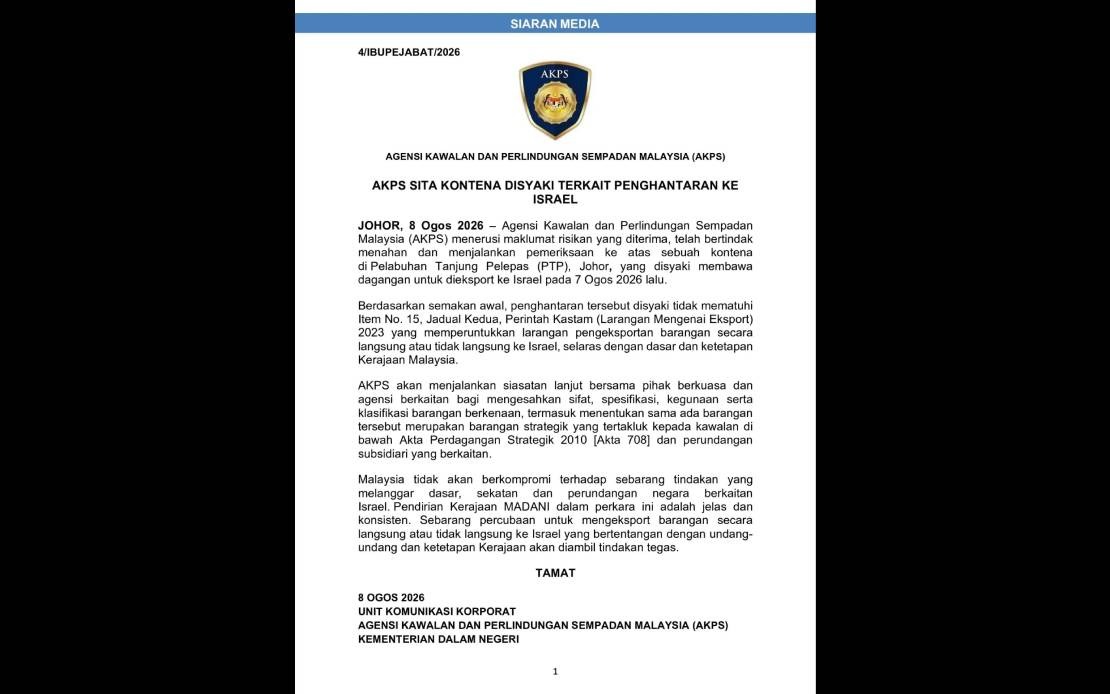
Prime Minister Datuk Seri Anwar Ibrahim has commended the swift intervention by the Malaysian Border Control and Protection Agency (AKPS) in seizing a container suspected of containing strategic materials intended for export to Israel at the Port of Tanjung Pelepas in Johor. The seizure, which occurred on August 7, represents the latest enforcement action in Malaysia's ongoing efforts to prevent the country from becoming a conduit for commerce that could indirectly support Israeli operations affecting Palestinian populations.
In remarks shared on social media, Anwar emphasised that the agency's action underscores Malaysia's determination to maintain strict protocols regarding prohibited trade routes. The interception demonstrates that Malaysian authorities remain vigilant in screening shipments and enforcing compliance with national export policies, particularly those involving sensitive destinations or cargo that might violate existing sanctions frameworks. This enforcement activity serves as a visible reminder to the international shipping and logistics community that Malaysia takes its restrictions seriously and will deploy resources to intercept non-compliant shipments.
The Prime Minister framed the seizure within Malaysia's broader international commitments, specifically referencing the country's obligations as a member of The Hague Group, a multilateral forum addressing non-proliferation and export control concerns. Additionally, Anwar reiterated Malaysia's adherence to a ban implemented in December 2023 that prohibits Israeli-registered vessels and ships carrying Israeli-destined cargo from utilising Malaysian ports. These layered restrictions represent a comprehensive approach designed to prevent Malaysia from becoming implicated in supply chains that support Israeli government activities.
The AKPS confirmed in an official statement that inspectors had detained and examined the container at Tanjung Pelepas, finding it to contain materials suspected of violating Item No. 15 of the Second Schedule under the Customs (Prohibition of Exports) Order 2023. This particular provision explicitly prohibits both direct and indirect exports of goods to Israel, consistent with Malaysian government policy directives. The specificity of the regulation demonstrates the sophistication of Malaysia's export control architecture and the breadth of items and arrangements that fall within the prohibition framework.
From a regional perspective, Malaysia's enforcement activity reflects broader sentiment across Southeast Asia regarding the Palestinian-Israeli conflict, though the intensity and comprehensiveness of Malaysia's restrictions remain distinctive. Neighbouring countries maintain varying positions on trade with Israel, ranging from regulated commerce to normalised bilateral relationships, making Malaysia's stance notably stringent by regional standards. This approach carries implications for Malaysia's positioning within ASEAN and its relationships with countries that maintain fuller diplomatic and commercial engagement with Israel.
The logistics and shipping sectors operating through Malaysian ports face clear compliance obligations. Port authorities and freight forwarders must implement enhanced due diligence procedures to verify final destinations and prevent inadvertent violations. The costs associated with increased screening and the risks of detention create practical incentives for supply chain stakeholders to route Israeli-destined goods through alternative regional hubs, potentially reshaping trade patterns in Southeast Asia. For Malaysian port operators and service providers, these restrictions represent both a compliance burden and a potential competitive disadvantage relative to ports lacking such limitations.
Anwar's public endorsement of the AKPS action signals that export control enforcement remains a priority within the current administration's policy framework. The government has allocated agency resources to maintain an effective inspection regime, suggesting that additional seizures are likely as screening becomes more systematic. This commitment reflects domestic political considerations, as Palestinian solidarity continues to resonate with significant portions of Malaysia's Muslim-majority population, and maintaining visible enforcement helps sustain public confidence in government commitment to the cause.
The December 2023 port ban represented a substantial escalation in Malaysia's restrictions, as it extended prohibitions beyond specific goods to encompass entire vessel categories. By preventing Israeli ships from entering Malaysian waters, the government eliminated logistical advantages that might otherwise have made Malaysian ports attractive for Israeli-related cargo. The container seizure demonstrates that authorities have subsequently developed inspection capabilities to address indirect routing mechanisms, closing potential circumvention pathways where cargo might be transshipped through intermediate carriers.
International trade law specialists note that Malaysia's restrictions, while implemented through domestic customs legislation, exist within a complex global framework where different nations maintain varying levels of restrictions on Israeli trade. Some countries recognise Israeli settlements in occupied territories as illegitimate and restrict related commerce accordingly, while others maintain comprehensive normalised relationships. Malaysia's multi-layered approach—combining vessel bans with goods restrictions and customs enforcement—represents one of the more restrictive positions globally, placing the country alongside nations with more explicitly adversarial relationships toward Israel.
Looking forward, the seizure highlights an ongoing challenge for Malaysian authorities: preventing sophisticated circumvention schemes while maintaining efficient port operations that serve legitimate commerce. Shippers seeking to avoid restrictions may attempt to disguise cargo origins or utilise complex transhipment arrangements, requiring customs officials to develop increasingly sophisticated detection capabilities. The agency's success in this case, assuming proper verification of the seized container's destination, demonstrates operational effectiveness but also suggests that the scale of compliance challenges extends beyond what inspectors can address through random screening alone.
The broader implications extend to Malaysia's international relations and its self-presentation as a nation guided by humanitarian principles and international law commitments. By actively enforcing restrictions rather than merely enacting them symbolically, Malaysia demonstrates consistency between stated values and actual practice—a distinction that carries weight in international diplomacy and soft power considerations. This approach aligns with Malaysia's traditional diplomatic positioning as an advocate for developing nations' interests and rules-based international order, even when such positions generate friction with economically significant trading partners.
For Malaysian policymakers, the seizure represents evidence that existing enforcement mechanisms function adequately, at least for obvious violations. However, the case also underscores that vigilance remains necessary, as violations continue to occur despite established prohibitions. Maintaining political and budgetary support for port inspection operations requires sustaining public awareness of the issue and demonstrating periodic successful enforcement actions, a dynamic that the Prime Minister's public acknowledgement of the seizure serves to reinforce.

