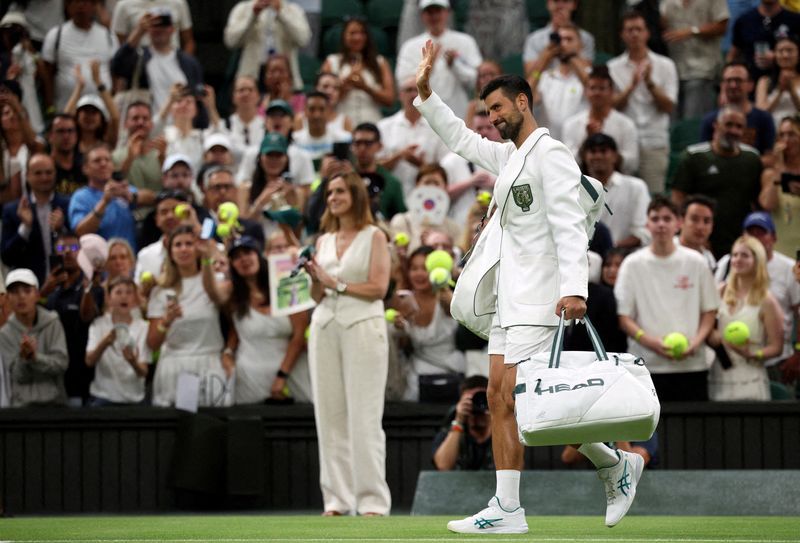
Wimbledon's hallowed grass courts have long been associated with tradition and restraint, yet this year's tournament reveals a surprising shift as male players increasingly leverage fashion as a form of self-expression on one of tennis's grandest stages. Following Naomi Osaka's eye-catching "Kill Bill" kimono entrance, rivals including Novak Djokovic and Taylor Fritz have embraced designer walk-on outfits that blur the line between athletic competition and high-fashion spectacle. The trend reflects a broader cultural moment where athletes, their sponsors, and the sport itself recognise the commercial and cultural value of sartorial storytelling.
Djokovic has made multiple appearances in a personalised Lacoste blazer paired with tailored shorts, establishing himself as a style authority despite his focus on pursuing a 25th Grand Slam title. Fritz, seeded sixth, has turned heads by striding onto Centre Court in a white Hugo Boss jacket, long trousers, and white silk scarf before removing the specially designed trousers—engineered with side zips for swift removal—to reveal his standard match shorts. These calculated presentations represent a deliberate departure from the anonymity that typically characterises male tennis uniforms, especially at Wimbledon, where the all-white requirement has historically constrained creative expression far more than at other major tournaments.
Industry observers view this male-dominated fashion moment as a watershed for professional tennis. Joelle Michaeloff, chief creative officer at Wilson sports brand, emphasises that sponsors and players are weaponising the Wimbledon walk-on as a marketing platform while celebrating tennis heritage. She notes that the relationship between athlete and brand is evolving, with companies like Nike and Hugo Boss seizing opportunities to amplify their association with elite competitors at a moment when global television audiences are most attentive. This strategic coordination between sponsors and players distinguishes the current wave of fashion-forward debuts from ad-hoc styling choices of previous eras.
The stakes attached to elaborate entrances create a peculiar tension for ambitious players: a striking walk-on demands early-round success to avoid the optics of audacious fashion paired with humiliating losses. Fritz himself articulated this concern, recognising that exiting in the opening round whilst wearing a designer suit risks looking ridiculous. Fortunately for him, he has advanced to the third round without dropping a set, allowing his calculated gambit to pay dividends in terms of sponsorship exposure and media coverage. The implicit pressure to perform at a level commensurate with one's wardrobe underscores how fashion has become inseparable from competitive outcomes in modern professional tennis.
Wimbledon's dress code, uniquely mandating all-white attire across the board, presents an intriguing constraint on creativity compared with the French Open or Australian Open, where players deploy far more colour. Yet this very restriction has paradoxically generated some of tennis's most memorable fashion moments, from the revolutionary white bodysuit designed by Ted Tinling in 1985 to Roger Federer's iconic jacket in 2007. The all-white requirement forces designers and athletes to explore texture, cut, fit, and layering rather than relying on chromatic boldness, potentially explaining why contemporary Wimbledon fashion feels more refined and architecturally considered.
Some male players are now actively participating in the design process, demanding input on everything from fabric selection to neckline shape and overall fit. Karen Khachanov, the Russian player who reached the third round, exemplifies this hands-on approach, insisting on discussions with designers about both aesthetic appeal and performance functionality. This evolution signals a generational shift in how male athletes engage with fashion sponsorship: rather than passively wearing what sponsors dictate, contemporary players are claiming agency over their sartorial narratives and ensuring that style choices enhance rather than impede competitive comfort.
Not every fashion experiment succeeds within Wimbledon's regulatory framework. Matteo Berrettini, the Italian former world number six, discovered that the tournament's dress code officials rejected his proposed outfit as insufficiently white, illustrating that even at the highest competitive levels, the All England Club's conservative gatekeepers retain authority over fashion boundaries. This rejection underscores a persistent tension between modern athletic fashion expression and institutional tradition, with Wimbledon ultimately serving as arbiter of acceptable style innovation.
Naomi Osaka's contributions to this broader fashion conversation cannot be overstated. The four-time Grand Slam champion has elevated fashion consciousness at all major tournaments throughout 2024, beginning with a black Kevin Germanier skirt at the French Open before unveiling a layered, iridescent match dress inspired by nighttime Parisian architecture. Her jellyfish-inspired Australian Open entrance and kimono-styled walk-ons at Wimbledon have collectively raised expectations about what athlete fashion can accomplish as storytelling. Eleanor Thomas, collections lead at the All England Lawn Tennis Club and custodian of tennis history's most iconic moments displayed in the on-site museum, has recognised Osaka's contributions as constituting an "iconic moment" worthy of historical preservation.
The deeper historical resonance of contemporary tennis fashion stretches beyond Osaka or Djokovic, reaching back to legends such as Arthur Ashe, whose sartorial choices during the 1960s and 1970s conveyed personality and cultural significance long before modern sponsorship mechanics existed. Michaeloff notes that the momentum and reach of fashion narratives have fundamentally transformed, with social media amplification and global digital distribution enabling walk-on moments to reach audiences numbering in the millions. This technological amplification has democratised fashion visibility whilst simultaneously raising the commercial stakes attached to each appearance.
Women players have historically led the charge in using walk-on outfits as production opportunities, with less institutional resistance to colour and design experimentation. Fritz acknowledged this reality, suggesting that female competitors have established a template for integrating high fashion with competitive tennis that male players are now following. Whether male players will accelerate their fashion engagement or settle into a more restrained approach remains uncertain, though the precedent established by Djokovic and Fritz suggests that designer walk-ons have become a permanent fixture of elite men's tennis.
The commercial implications extend beyond individual sponsorship deals. Wimbledon's institutional brand is itself evolving, transitioning from a bastion of conservative tradition into a platform for contemporary athletic expression. This evolution risks alienating traditionalists whilst simultaneously attracting younger audiences more attuned to fashion and celebrity culture. The tournament's decision to tolerate—and in some cases subtly encourage—fashion experimentation signals that even the most venerable sporting institutions recognise the necessity of adapting to modern consumer expectations around authenticity, personality, and style.
For Malaysian and Southeast Asian sports enthusiasts, this fashion moment offers a window into how elite international sport has transformed beyond purely athletic competition into a multimedia entertainment and lifestyle spectacle. As regional talent develops within professional tennis, understanding these unwritten rules of sponsorship activation, fashion expression, and brand partnership becomes essential knowledge for aspiring athletes and their management teams seeking to navigate the highest levels of professional competition.

