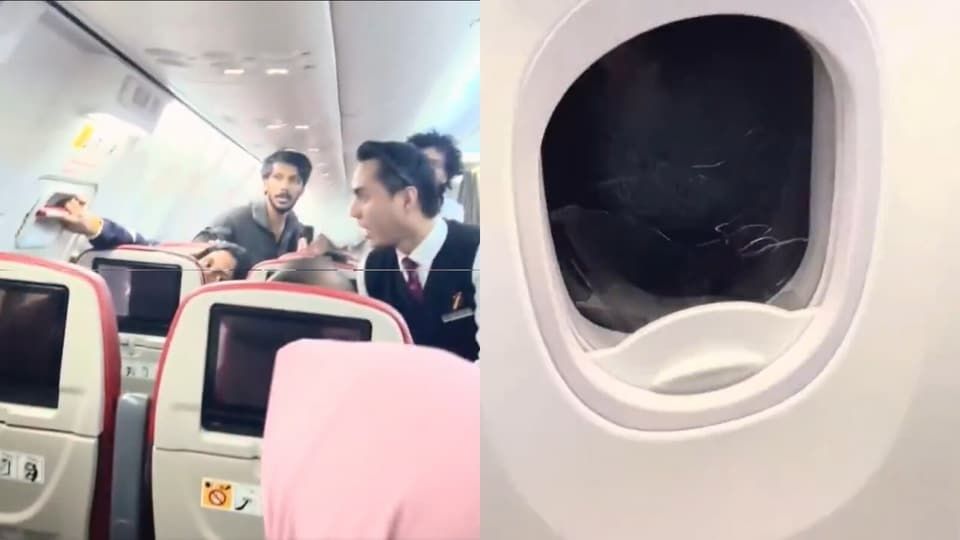
A man has been taken into custody following a harrowing incident aboard a Batik Air flight that left passengers fearing for their safety mid-air. The incident occurred on the evening of Wednesday as Batik Air flight OD231, a Boeing 737, made its journey from Kuala Lumpur to Kochi. According to police records, Jamsheer Athanikkal, 36, a resident of Palakkad who was living in Sreemoolanagaram, engaged in the dangerous behaviour sometime between 9.30pm and 11.05pm whilst the aircraft was airborne over Indian airspace.
The alleged offender targeted the emergency exit situated in the aircraft's emergency row, where he reportedly used his foot to damage the inner window panel and attempted to force the door open. Passengers and cabin crew members were reportedly threatened during the incident, which sent waves of panic through the cabin. The situation might have escalated dangerously had it not been for the quick thinking of fellow passengers and flight attendants who intervened and physically restrained Jamsheer before he could cause further damage or successfully open the exit.
One passenger, Matty Mathew, provided eyewitness testimony through a social media post that illuminated the terrifying nature of the incident. According to Mathew's account, most travellers were asleep during the late-night flight when they were jolted awake by the sound of rushing air filling the cabin. This noise accompanied Jamsheer's attempts to breach the emergency door after he had already damaged the window. However, the aircraft's structural design and the significant cabin pressure difference between the interior and exterior at cruise altitude worked to prevent the door from opening, effectively containing what could have been a catastrophic emergency.
Matthew noted that the combined response from fellow passengers and the Batik Air crew proved instrumental in preventing the situation from deteriorating further. The swift restraint of the individual prevented him from persisting with his actions or potentially attempting other dangerous behaviour. In his account, Mathew expressed both the severity of the scare and relief that all aboard had emerged safely from the ordeal.
When the aircraft landed in Kochi early on Thursday morning, Jamsheer was immediately taken into police custody by Kerala Police officers. The incident prompted Batik Air's Security In-Charge at Kochi to file a formal complaint, triggering a police investigation that has already resulted in charges being filed. Authorities have booked Jamsheer under multiple provisions of Indian law, reflecting the seriousness with which such incidents are treated. The charges include Section 351(3) of the Bharatiya Nyaya Sanhita for criminal intimidation, Section 11A of the Aircraft Act for contravening safety and security protocols, and Section 118(e) of the Kerala Police Act for conduct that endangers public welfare.
This alarming episode comes barely two days after another mid-air emergency involving an Indian airline. Air India flight AI2379, which was carrying passengers from Phuket, Thailand to Delhi, experienced a sudden and unexplained loss of altitude while cruising at normal flight levels on Tuesday. The aircraft was carrying 137 passengers alongside eight crew members when the incident occurred. Despite the alarming nature of the altitude loss, the flight crew managed to stabilise the aircraft, and it proceeded to land safely in Delhi without further incident.
The consequences of the Air India incident extended beyond the frightening experience itself. Following landing, thirteen passengers and four crew members required hospitalisation for medical evaluation and treatment. Air India immediately mobilised its support teams to remain at hospitals, maintaining close contact with those affected and providing both practical and emotional assistance. The airline also contacted the relevant aviation regulators and began cooperating with a formal investigation into the cause of the altitude loss.
According to flight-tracking data, the Air India aircraft involved in the altitude loss incident was a seven-year-old Airbus, suggesting the aircraft itself was relatively modern and should not have presented structural or mechanical issues. The airline has notified the aircraft manufacturer as part of the investigative process, acknowledging the importance of determining whether the issue stemmed from human error, mechanical failure, or some other factor. Air India has publicly stated that passenger and crew safety remains its highest priority and reiterated its commitment to supporting those affected by the incident as investigations proceed.
These two incidents within a span of forty-eight hours have raised concerns about aviation safety in the region and underscore the unpredictable nature of in-flight emergencies. The Kuala Lumpur-Kochi route serves significant traffic between Malaysia and India, connecting major commercial hubs and carrying business travellers and tourists regularly. The Batik Air incident is particularly troubling because it involved deliberate human action rather than mechanical failure, raising questions about passenger screening and in-flight security protocols. Airlines operating regional routes must balance passenger comfort with security measures to prevent such incidents while maintaining operational efficiency.
For Malaysian passengers frequently travelling to South Asia, these incidents serve as reminders of both the inherent risks of air travel and the importance of crew training and passenger discipline during flights. The swift action by Batik Air's crew in containing the situation exemplifies the critical role of well-trained flight attendants in emergency response. The fact that the aircraft's design itself—with its emergency exit doors incapable of opening due to cabin pressure—provided a failsafe mechanism highlights how modern aviation engineering incorporates multiple layers of safety protection.

