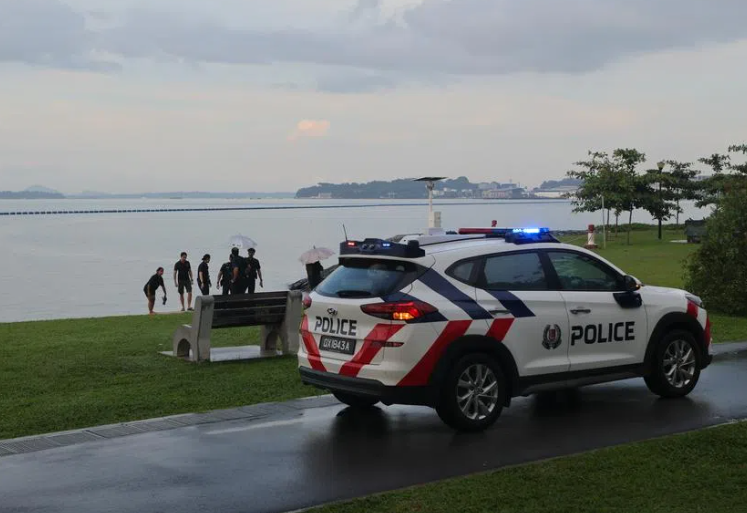
A man in his mid-twenties lost his life on Sunday afternoon after a sudden lightning strike hit the waters off Pasir Ris Beach in Singapore, marking a sobering reminder of the dangers posed by electrical storms in the region. The 24-year-old victim was rendered unconscious by the bolt and subsequently died in hospital, while six others aged between 13 and 54 sustained injuries serious enough to require medical attention. The incident occurred around 4.50pm on July 5 at coordinates near 131 Pasir Ris Road, when the group was engaged in recreational water sports just over 100 metres from shore.
The fatality took place amid what witnesses described as deceptively benign weather conditions. An eyewitness, Muhammad Fairuz, a 40-year-old delivery rider who was fishing nearby, reported that the sky had appeared clear moments before the strike. The sudden nature of the electrical discharge caught the group completely unguarded. Fairuz, positioned on the beach at the time, felt the residual current travel through his fishing rod, indicating the intensity of the electromagnetic energy released into the water. His immediate response was to spring into action alongside another nearby individual, launching kayaks to reach the stricken paddleboarder and bring him back to land.
Authorities responded swiftly to distress calls placed at 4.50pm. The Singapore Civil Defence Force (SCDF) transported five victims, including the unconscious man, to Sengkang General Hospital. Two younger casualties were separately conveyed to KK Women's and Children's Hospital. The unconscious man arrived at the hospital in critical condition and succumbed to his injuries shortly after admission. According to police statements released early on July 6, five of the injured remained conscious during transport and treatment, suggesting varying degrees of electrical trauma across the group.
The recreational activity that turned tragic involved a mixed-age cohort participating in kayaking and paddleboarding. The composition of the group—ranging from teenagers to middle-aged adults—underscores how such natural hazards make no distinction between experience levels or age demographics. Many people undertaking water-based leisure activities in Southeast Asia may not fully appreciate the meteorological risks present in tropical and subtropical zones, where thunderstorm activity can develop and intensify with remarkable speed.
Police investigations into the incident concluded that no criminal element was involved. "Based on preliminary investigations, the police do not suspect foul play," officers stated. "Police investigations are ongoing." This determination was made swiftly, suggesting that the circumstances surrounding the death—a direct lightning strike while in open water—were straightforward and unambiguous. The investigation's continuation likely focuses on procedural documentation and determining whether any safety measures or warnings at the beach could have been enhanced.
Singapore's geographical and meteorological positioning places it within a zone of significant lightning activity. According to data maintained by the Meteorological Service Singapore, the city-state experiences an average of 176 lightning days annually, with a "lightning day" defined as any 24-hour period during which at least one lightning occurrence is detected at the Changi climate station. This frequency, while substantial, often receives insufficient public attention relative to other natural hazards. The tropical monsoon system and maritime location combine to create atmospheric conditions favourable to electrical storm development throughout much of the year.
This tragedy represents neither an isolated anomaly nor an unprecedented event within Singapore's recent history. In May of this year, a worker employed at a fish farming operation perished after sustaining a direct lightning strike at their workplace. In December 2023, three workers required hospitalization after lightning struck near their worksite on December 28. These incidents collectively illustrate a troubling pattern of fatalities and serious injuries stemming from lightning exposure across various occupational and recreational settings. The consistency of such incidents suggests that lightning safety awareness and preventive measures warrant greater emphasis in public education campaigns.
For Malaysian and broader Southeast Asian readers, the implications extend beyond Singapore's borders. The region's shared tropical and subtropical climate generates comparable meteorological conditions and lightning frequencies across neighbouring jurisdictions. Beach-goers, water sports enthusiasts, and outdoor workers throughout Malaysia, Indonesia, and Thailand face analogous risks. However, public awareness campaigns regarding lightning safety remain inconsistent across the region, and many recreational facilities lack adequate warning systems or shelter infrastructure.
The incident at Pasir Ris Beach underscores a critical gap in risk perception. Clear skies do not guarantee electrical storm safety, particularly in equatorial and near-equatorial zones where weather systems can develop with minimal warning. Lightning can strike from clouds that appear distant or from conditions that seem benign to casual observers. The speed with which conditions deteriorate—from apparent safety to fatal danger—occurred within minutes in this case, leaving the recreational group with virtually no opportunity to seek shelter or evacuation.
For water sports operators and beach management authorities throughout Southeast Asia, this fatality raises uncomfortable questions about current safety protocols. Many popular paddleboarding and kayaking venues operate without real-time meteorological monitoring or automated alert systems that could prompt rapid evacuation during dangerous conditions. The investment in such infrastructure, while not eliminating risk entirely, could potentially save lives by providing early warning windows during which participants could return to shore.
The victim's death also highlights the vulnerability of rescue operations in such scenarios. Muhammad Fairuz and his unnamed companion demonstrated commendable bravery in launching kayaks to retrieve the unconscious man, yet their intervention, though well-intentioned and successful in bringing him ashore for emergency medical services, could not reverse the catastrophic physiological damage inflicted by the electrical discharge. Lightning strikes involving water immersion present particularly complex medical challenges, with the combination of electrical trauma and potential drowning creating compound injury patterns that frequently prove fatal despite prompt resuscitation attempts.

