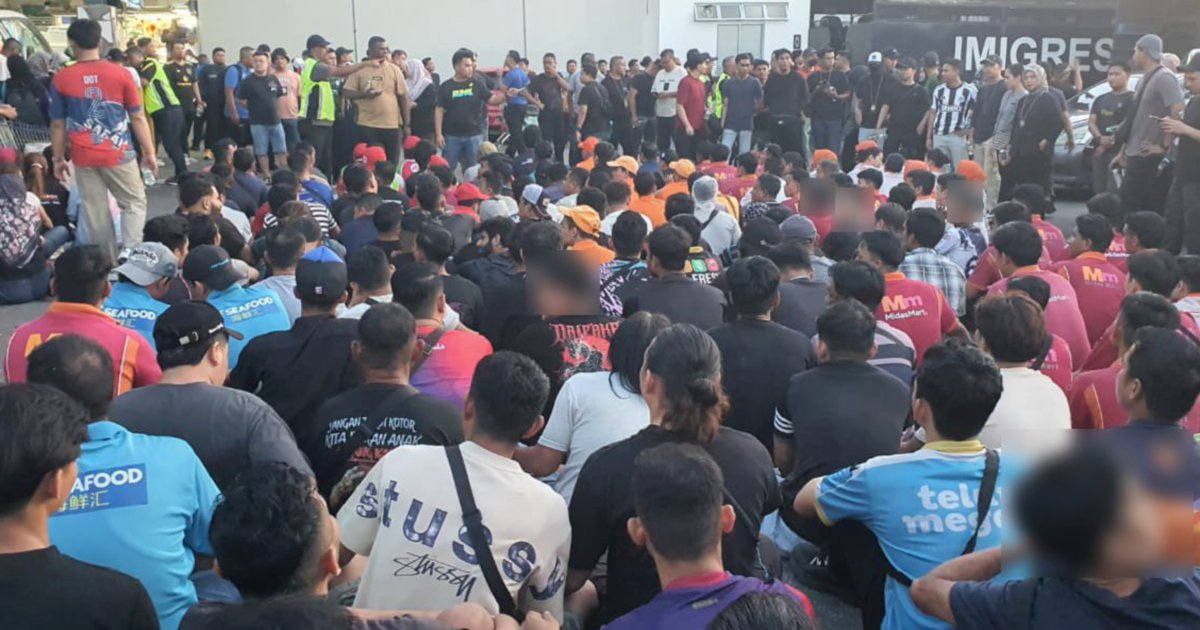
Immigration authorities in Johor Baru have staged a major enforcement operation that has resulted in the detention of 226 migrant workers and exposed an elaborate scheme allowing foreign nationals to work illegally within Malaysia by exploiting passport documentation loopholes. The operation, which revealed how workers cycled through border crossings to obtain routine passport stamps while maintaining unlawful employment arrangements, underscores the persistence of systemic vulnerabilities in Malaysia's immigration control framework despite repeated crackdowns over the past decade.
At the heart of the operation was a surprisingly simple yet effective methodology that operated openly for approximately four years. According to immigration officials, an Indonesian fishmonger employed this technique to sustain his illegal work status—he would travel to a border crossing monthly to have his passport officially stamped by authorities, creating the appearance of legitimate border movements and temporary visits, before returning to employment that violated his entry conditions. The regularity and apparent legitimacy of these stamp renewals made detection difficult, as individual border crossing records appeared compliant when examined in isolation without coordinated cross-checking against employment registries.
This case exemplifies a broader vulnerability affecting Southeast Asian labour markets, where document-centric immigration systems can be circumvented through repeated cycles of exit and re-entry. Malaysia's reliance on entry stamps and visa validity dates as primary indicators of lawful presence creates opportunities for individuals and networks to maintain the technical appearance of compliance while engaging in prohibited employment. The discovery during this Johor operation suggests that such schemes may have operated across multiple sectors and locations beyond what was initially detected, raising questions about the true scope of undocumented employment within the state and potentially throughout the peninsula.
The raid itself was conducted as part of intensified immigration enforcement initiated across Johor, targeting industrial areas, commercial establishments, and labour-intensive sectors where undocumented workers typically concentrate. The detention of 226 individuals represents one of the larger single-operation apprehensions reported in recent months, indicating either a particularly concentrated pocket of irregular migration or the effectiveness of intelligence-led operations focusing on specific employer networks or residential clusters. Immigration authorities have typically emphasized that enforcement prioritizes identifying exploitation networks rather than merely apprehending workers themselves, though practical implementation often results in mass detentions requiring processing and repatriation.
The implications for Malaysia's labour economy remain significant. Sectors reliant on migrant workers—including fishing, agriculture, manufacturing, and domestic service—have historically depended on workforce flexibility that regularized systems often cannot provide at competitive wage levels. The presence of workers maintaining illegal status suggests both demand for undocumented labour and willingness among employers to engage workers lacking proper documentation. The enforcement operation may temporarily disrupt labour supply within affected sectors but is unlikely to address underlying structural factors creating demand for undocumented workers unless accompanied by broader policy adjustments to migrant worker registration and employment frameworks.
For workers engaged through such schemes, the consequences are typically severe. Beyond immediate detention and repatriation costs, individuals lose earnings, face potential blacklisting from future legal employment in Malaysia, and may experience exploitation by employers and smuggling networks. The Indonesian fishmonger's four-year arrangement, while appearing sustainable through regular border processes, ultimately resulted in apprehension, underscoring that such strategies represent temporary accommodation rather than genuine legal status. Southeast Asian migrant workers increasingly operate within networks sharing information about enforcement activities and border vulnerabilities, meaning successful operations like the Johor raid prompt rapid adaptation rather than cessation of irregular migration flows.
The discovery of systematic passport manipulation also raises questions about coordination between Malaysia's immigration service and border enforcement agencies. If authorities at border crossings failed to identify patterns of repeated entries and exits for the same individual, or neglected to cross-reference entry records with employment databases, such gaps represent exploitable weaknesses. Modern immigration systems increasingly employ data analytics and biometric matching to identify suspicious movement patterns, yet implementation across Malaysian ports of entry appears inconsistent. The Johor operation suggests that enhanced information-sharing between border control and employment inspection bodies could prevent similar schemes from sustaining for extended periods.
Regionally, Malaysia's experience mirrors challenges faced by Thailand, Singapore, and Indonesia in managing large migrant workforces while maintaining border integrity. Countries relying on labour migration but seeking to prevent exploitation and tax evasion face constant tension between restrictive policies and practical labour market needs. The regularization of workers operating through schemes like the passport-stamping cycle would require regulatory pathways offering employers reliable access to documented labour at economically viable wages, a structural reform unlikely in the near term despite periodic policy discussions about expanding migrant worker quotas and categories.
The detained workers face standard processing procedures including documentation verification, health screening, and arranged repatriation to their countries of origin, typically Indonesia given the fishmonger's nationality. Malaysian authorities have not disclosed whether specific employers or smuggling networks facilitated the scheme, information that would indicate whether the operation was isolated or part of organized facilitation. Such details often remain unpublished for operational security reasons or during ongoing investigations. Nonetheless, the operation demonstrates that Malaysia's immigration enforcement capacity, while sometimes inconsistent, remains capable of identifying and disrupting established irregular migration patterns when intelligence and resource allocation align effectively.
Moving forward, the incident will likely prompt renewed focus on document verification systems and employer accountability mechanisms, though sustained policy attention remains uncertain given competing political and economic priorities. The structural factors enabling workers to maintain unlawful employment while technically satisfying stamp-based compliance requirements persist absent fundamental reforms to Malaysia's migrant worker frameworks. Until registration systems become more accessible and economically attractive to both employers and workers, irregular migration schemes will continue adapting to detection efforts, with periodic large-scale raids providing temporary disruption rather than systemic resolution.

