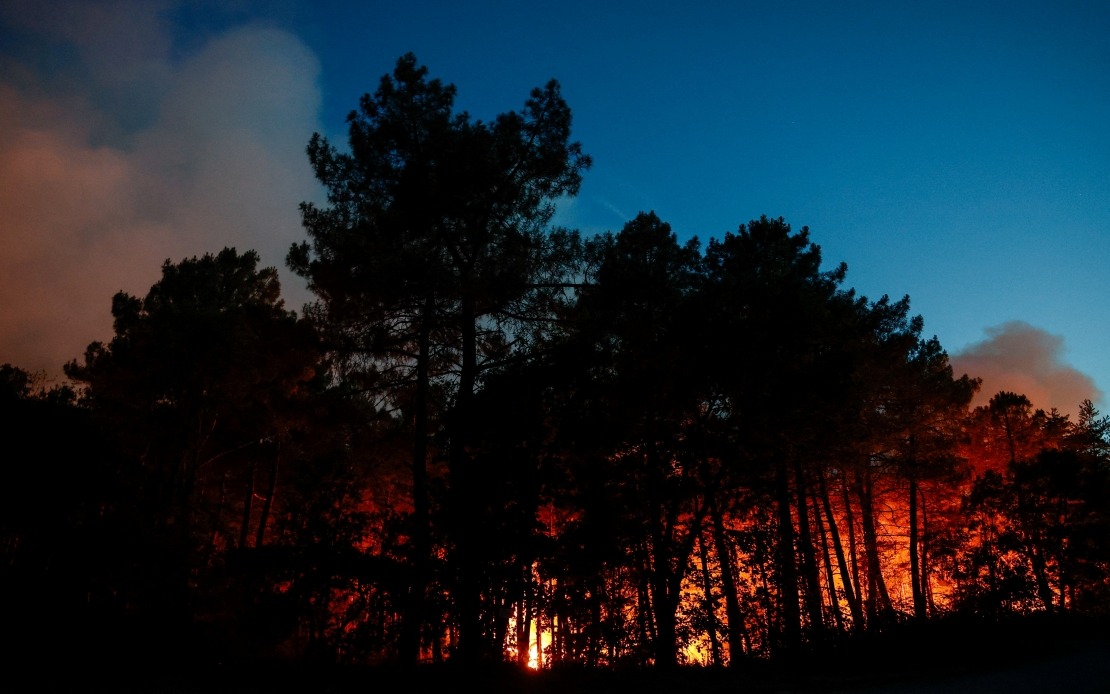
A catastrophic wildfire tore through the renowned Fontainebleau forest region south of Paris on Monday, mobilising approximately 400 firefighters to battle the advancing flames. The incident marked one of the largest woodland fires to strike northern France in recent years, reflecting the heightened fire risks now facing even traditionally cooler European regions during extended heat episodes.
The fire erupted late Sunday evening in proximity to a major motorway corridor, rapidly consuming 800 hectares of densely forested terrain before containment efforts could gain meaningful traction. The speed of the blaze's expansion caught authorities and residents off guard, with emergency services scrambling to deploy available resources and establish evacuation corridors for those in immediate danger.
French Interior Minister Laurent Nuñez travelled to the affected area and publicly raised serious concerns about the fire's origins during Monday's operations. His assessment pointed toward intentional fire-setting, based on a striking geographical pattern: multiple fire outbreaks had ignited within an extremely confined radius of merely 1,000 metres, a distribution pattern inconsistent with natural ignition sources or accidental spread. This observation prompted the gendarmerie to formally initiate a criminal investigation into potential arson charges.
The Fontainebleau forest represents far more than a natural resource to the Paris region. As the location of the historic Château de Fontainebleau, a former royal residence of immense cultural significance, the woodland constitutes one of Western Europe's most substantial continuous forest landscapes. The potential loss of this centuries-old ecosystem carries ramifications extending well beyond immediate fire suppression concerns, encompassing heritage preservation and biodiversity protection across the broader European context.
Local authorities reported the evacuation of more than 1,000 individuals comprising both permanent residents and holidaymakers from adjacent communities. The mayor of Le Vaudoué, a nearby village, provided particularly vivid descriptions of the emergency scenario, characterising the approaching inferno as "a wall of flames" advancing with terrifying velocity toward the settlement's outlying residential zones. Such imagery underscores the terrifying scale and speed at which modern wildfires can envelope populated areas when conditions align unfavourably.
Governing authorities in Paris treated the emergency with maximum seriousness, with government spokeswoman Maud Bregeon declaring the situation "exceptional" in nature. Her statement acknowledged that conflagrations of this magnitude have become uncommon in northern France, signalling a potential shift in fire risk patterns for a region historically considered relatively protected from such disasters. The mobilisation of all obtainable firefighting capacity, including aerial water-bombing operations drawing supplies from the Seine river via the Seine-et-Marne department's coordination, reflected the gravity with which officials approached containment efforts.
The timing of the Fontainebleau incident coincided with broader climatic stress affecting the entire French nation. The country was simultaneously grappling with its third significant heatwave episode of the calendar year, creating dangerously parched conditions across vast territories and elevating ambient temperatures to levels conducive to rapid fire propagation. The national weather service, Météo-France, had positioned 37 departments under its highest-level red heat alert designation at the week's commencement, indicating that the Fontainebleau blaze represented merely one manifestation of systemic wildfire vulnerability spreading across French territory.
For Malaysian and Southeast Asian observers, the Fontainebleau disaster offers instructive lessons regarding climate change implications extending beyond tropical and equatorial regions. Historical assumptions that northern European territories possessed inherent resilience against large-scale wildfires increasingly appear unfounded as temperature patterns shift and drought conditions intensify across previously temperate zones. The incident demonstrates that forest fire management, once considered primarily relevant to Mediterranean and tropical jurisdictions, has emerged as a universal challenge demanding coordinated responses across all climatic zones.
The investigation into potential arson assumes particular importance beyond the immediate French context. Deliberate fire-setting, whether motivated by criminal intent, ideological extremism, or other factors, represents a distinct threat vector that conventional weather-based fire prevention strategies cannot adequately address. The concentration of ignition points within such a restricted geographic area suggested premeditation, raising questions about whether organised actors might exploit heightened fire conditions to cause maximum damage with minimum intervention effort.
The broader pattern of escalating wildfire incidents across Europe, highlighted by concurrent blazes affecting other French regions simultaneously, reflects systemic vulnerabilities in continental firefighting capacity and forest management protocols. As Southeast Asian nations increasingly engage with European counterparts through climate and environmental cooperation frameworks, understanding these emerging challenges becomes strategically relevant. The forestry sectors across ASEAN nations, already managing complex wildfire risks from agricultural burning and deforestation-related practices, may benefit from studying European responses to unprecedented fire scenarios.
The Fontainebleau incident ultimately illustrates a profound transition in environmental risk profiles affecting even developed, well-resourced nations. The combination of climatic stress, potential criminal action, and insufficient historical precedent for effective large-scale response created conditions where extensive woodland and cultural heritage faced genuine threats. As authorities continue investigating the fire's origins and implementing containment strategies, the episode will likely prompt significant reassessment of France's wildfire preparedness frameworks and Europe's collective readiness for intensifying natural disasters.

