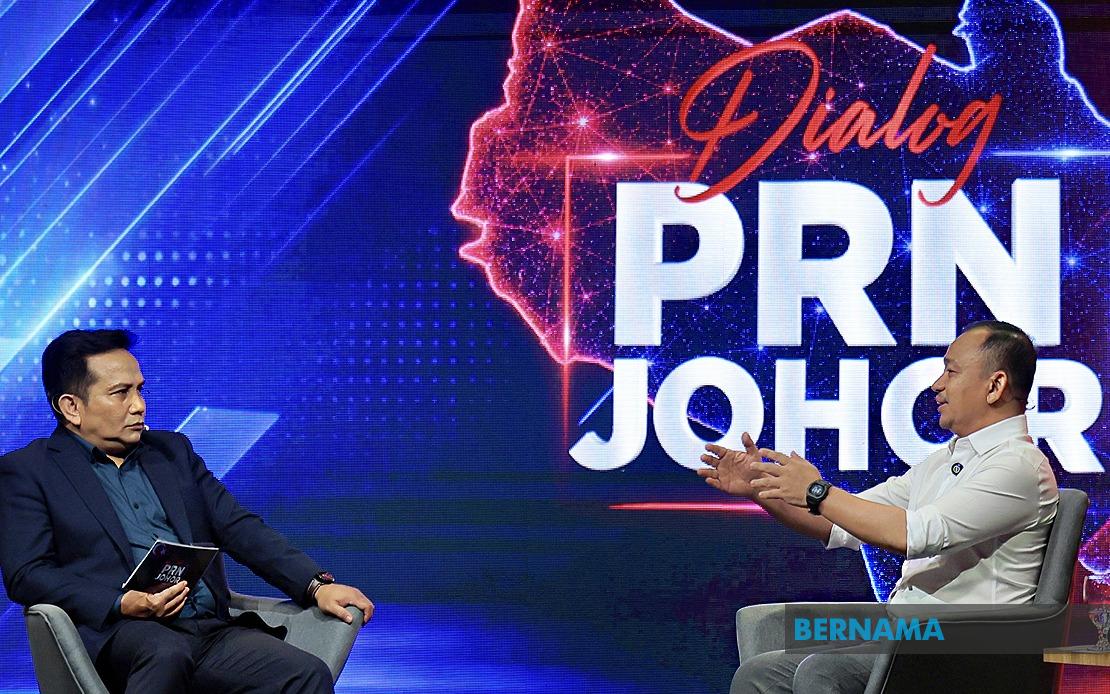
Dr Maszlee Malik, the Pakatan Harapan nominee contesting the Puteri Wangsa state seat in Johor, has expressed optimism that structured political dialogue can catalyse a meaningful shift towards more sophisticated voter behaviour across the country. Speaking in Johor Bahru following a televised dialogue event, the former education minister articulated a vision where Malaysian voters increasingly ground their electoral choices in substantive policy positions rather than tribal affiliations or emotional appeals—a concern that reflects broader anxieties within the political establishment about the quality of democratic discourse in the nation.
The Johor State Election Dialogue, held at the Permata Sari Auditorium under the joint stewardship of RTM, Astro AWANI and Sinar Harian, provided Maszlee with a platform to articulate this philosophy. He characterised such televised encounters as invaluable opportunities for voter education, enabling the electorate to weigh candidates and parties on substantive grounds. His remarks underscore a growing recognition among opposition figures that Malaysia's transition towards genuine democratic maturity depends partly on citizens' willingness to engage with policy arguments and empirical evidence rather than succumbing to personalised or sectarian narratives that have historically dominated electoral contests.
Communications Minister Datuk Fahmi Fadzil's presence at the event signalled government support for this approach to electoral engagement. The participation of both federal and state-level political figures in such forums reflects a strategic consensus that elevating public discourse benefits the democratic process overall, even as the competing parties vigorously campaign for votes. This cross-partisan commitment to dialogue, while modest, contrasts sharply with the polarisation that has characterised recent Malaysian politics and suggests at least rhetorical acknowledgment among leaders that the current trajectory of electoral culture warrants course correction.
Maszlee's emphasis on voter education through reasoned debate carries particular resonance in the Malaysian context, where commercial media ownership concentration, social media echo chambers, and the prevalence of unverified claims have increasingly fragmented the information landscape. By advocating for dialogue anchored in "arguments, facts and evidence," he implicitly acknowledges that voters face unprecedented difficulty in distinguishing credible information from propaganda or misinformation. The challenge of fostering what might be termed "epistemic maturity"—the ability to critically evaluate competing truth claims—has become inseparable from concerns about democratic health in Southeast Asia's largest economy.
The timing of these remarks, delivered with three days remaining in the Johor campaign before the July 11 polling date, demonstrates that Pakatan Harapan viewed the dialogue series as central to its electoral strategy in the state. Rather than relying solely on traditional rallies and door-to-door canvassing, the opposition coalition sought to position itself as the custodian of a more intellectually rigorous political culture. This positioning appeals particularly to urban, educated voters and younger demographics increasingly sceptical of conventional campaign tactics, though its effectiveness in swaying working-class or rural voters remains uncertain.
Maszlee's focus shifted strategically to voter mobilisation dynamics as polling approached. He identified maximising turnout—particularly among voters residing outside their registered constituencies—as a paramount concern for Pakatan Harapan in these final campaign days. This emphasis reflects sophisticated understanding of electoral mathematics: in tight contests, the margin between victory and defeat often hinges on differential turnout rates across demographic and geographic segments. By specifically targeting out-of-town voters and urging their return to their home constituencies, Maszlee articulated a sophisticated ground strategy that extends beyond persuasion to encompass practical logistics.
The relationship between turnout and electoral legitimacy that Maszlee articulated carries implications beyond the immediate Johor contest. His insistence that "high voter turnout is essential to ensure the government formed receives a strong and legitimate mandate" reflects broader democratic theory but also practical political calculation. In Malaysia's context, where accusations of minority rule and illegitimacy have periodically destabilised coalitions, Pakatan Harapan's emphasis on maximalist voter participation serves the dual purpose of potentially expanding their vote share while simultaneously constructing a narrative of genuine popular endorsement should they prevail.
The early voting conducted on the day of the dialogue, with the main election scheduled for four days hence, introduced a compressed timeframe that intensified campaign activity. This compressed calendar meant that dialogue sessions, media appearances, and grassroots mobilisation efforts needed to deliver measurable impact within days rather than weeks. For candidates like Maszlee, the stakes of effective communication became correspondingly higher, as last-minute voter persuasion or mobilisation failures could prove consequential in closely contested seats.
The collaborative approach to organising the dialogue—bringing together the state broadcaster RTM, the commercial channel Astro AWANI, and the vernacular newspaper Sinar Harian—suggested an attempt to reach across Malaysia's fragmented media landscape and ensure that the event reached diverse audience segments. Such inclusive media partnerships, while reflecting pragmatic recognition of audience fragmentation, also raise questions about whether televised political dialogue genuinely shifts voter behaviour or merely preaches to already-converted constituencies. The effectiveness of such forums in reaching persuadable voters versus simply reinforcing existing preferences remains empirically contested.
The participation by Communications Minister Fahmi Fadzil signalled federal government investment in this model of democratic engagement. His presence acknowledged that dialogue-based campaigning had become sufficiently mainstream that absenting himself might send counterproductive signals about the government's commitment to democratic discourse. Yet the minister's attendance also illustrated how senior figures strategically deploy their presence to influence electoral narratives and legitimise particular approaches to campaigning, using their authority to elevate certain forms of political engagement.
Maszlee's articulation of a vision for more mature political culture, grounded in evidence-based decision-making, addresses a genuine frustration among Malaysian civil society, intellectuals, and reform-minded political actors regarding the perceived decline in public discourse quality. The proliferation of social media, the fragmentation of traditional media, and the increasing sophistication of political manipulation techniques have collectively created an environment where fact-based debate becomes progressively harder to sustain. His call for dialogue-based politics represents an attempt to reassert reasoned argument as central to electoral competition, though whether such exhortations can meaningfully counter structural forces driving polarisation remains an open question for Malaysian democracy.

