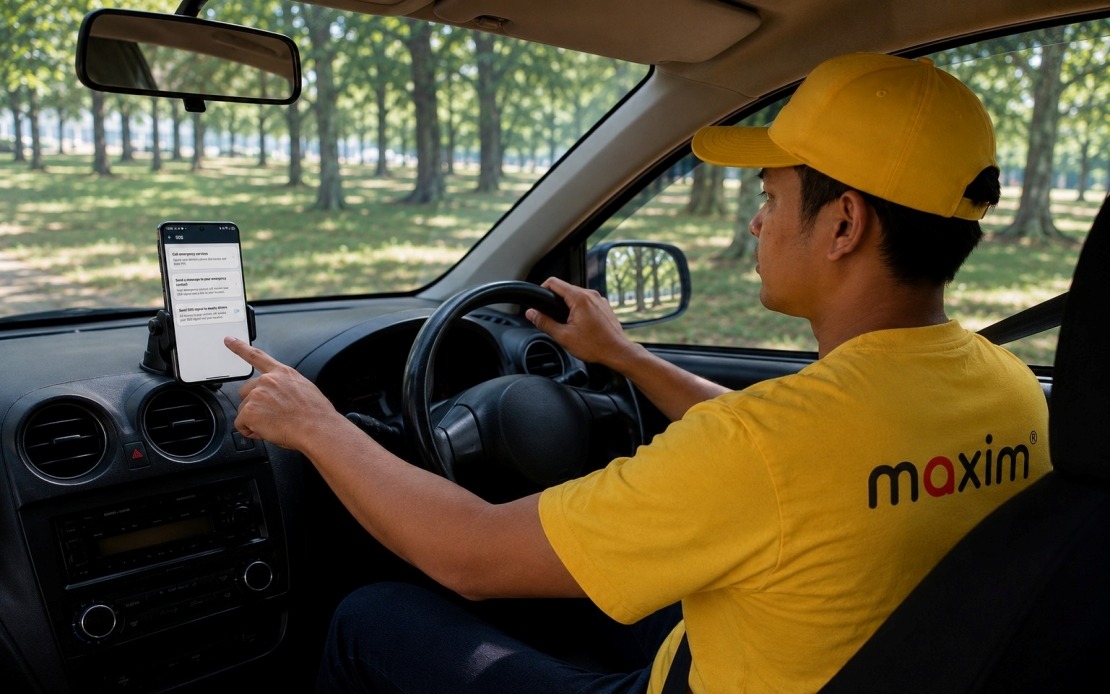
Ride-hailing platform Maxim Malaysia is intensifying its commitment to user safety by rolling out a comprehensive overhaul of its emergency response capabilities. The upgraded system, announced on July 13, represents a significant step forward in how the company addresses passenger and driver security concerns—an increasingly critical issue as digital mobility services become more prevalent across Southeast Asia. The enhancements reflect growing expectations from regulators and users alike that transport platforms must embed protective mechanisms directly into their operations rather than treating safety as a secondary concern.
The centrepiece of the upgrade is a redesigned SOS button that operates with greater speed and reliability than its predecessor. Rather than defaulting to a single response pathway, the new system grants users agency in determining how to summon help. Both passengers and driver-partners can now access the 999 emergency hotline or immediately dispatch alerts to three registered emergency contacts—typically family members or trusted friends. This flexibility acknowledges that different emergency scenarios require different responses. A driver stranded on an isolated highway may benefit more from professional emergency services arriving quickly, whilst a passenger feeling unsafe might prioritise immediate notification to a loved one who can offer emotional support or guidance.
The notification mechanism itself addresses a persistent challenge in Malaysia's digital infrastructure. Alert recipients receive an SMS containing the user's precise GPS location and a live trip-tracking hyperlink, allowing real-time monitoring of the situation. Critically, this system functions even when internet connectivity is unstable—a realistic consideration in Malaysia, where network reliability varies significantly between urban centres and more remote areas. The reliance on SMS rather than data-dependent notifications ensures that geographic disadvantage does not translate into safety disadvantage.
For driver-partners specifically, Maxim has introduced a Driver Alert System that transforms nearby drivers into an informal safety network. When a partner driver experiences an emergency, the platform automatically notifies other Maxim drivers operating within a three-kilometre radius, informing them of the incident type and location. This crowd-sourced assistance model reflects practical realities in ride-hailing: professional emergency responders may take time to reach certain locations, but another driver already on the road can potentially provide immediate help whilst formal authorities respond. The system converts potential competitors into mutual-aid participants, fostering a sense of community responsibility within the driver network.
Mohd Hazwan Musli, Maxim Malaysia's director, articulated the philosophy underlying these improvements in remarkably candid language. He acknowledged that safety represents a fundamental aspect of every transaction on the platform, not merely a compliance checkbox. His statement that users gain the ability to decide who should be informed first—loved ones, professional rescuers, or nearby drivers—reflects a nuanced understanding of emergency psychology. Not all crises are equal, and not all responses are appropriate for all situations. The flexibility to choose rapidly can literally save lives, as those critical seconds determining whether a passenger connects with a trusted person or emergency services may prove decisive.
The platform has also strengthened ancillary safety features addressing different threat vectors. A secured in-app chat function protects against fraud attempts that commonly target ride-hailing users. Internal trip monitoring continuously tracks essential journey data, including continuous GPS mapping that creates an immutable record of every trip. For passengers, the Trip Sharing feature enables immediate transmission of real-time trip links to family or friends upon vehicle boarding—a preventative measure that deters potential harm simply through the knowledge that someone outside the vehicle monitors the journey. These layered protections demonstrate that comprehensive safety requires addressing multiple risk categories simultaneously.
Data security undergirds the entire architecture. All information transmitted through the SOS function, Driver Alert System, and Trip Sharing mechanisms operates under encryption standards aligned with contemporary security protocols. Access remains restricted to authorised security personnel and relevant authorities operating within established procedural frameworks. This structure attempts to balance accessibility for emergency responders against privacy protections for users—a perpetual tension in safety-technology design. Malaysian users should appreciate that local authorities possess legitimate access pathways for emergency situations without subjecting routine user data to broad surveillance.
The timing of these enhancements reflects broader currents within Malaysia's digital economy. As ride-hailing consolidates around established platforms following competitive turbulence in recent years, regulatory scrutiny has intensified. The Ministry of Transport and various state governments have increasingly focused on driver and passenger welfare, creating incentives for platforms to demonstrate concrete safety investments. Maxim's upgrades position the company as a safety-conscious operator, potentially influencing regulatory relationships and user selection decisions. In markets where consumer choice drives platform adoption, visible safety commitments can meaningfully differentiate competing services.
For Malaysian users, the practical implications extend beyond individual transactions. A rider-hailing ecosystem characterised by robust emergency systems reduces broader social friction around women's safety in public transport, a persistent concern that limits mobility options. Driver-partners, who themselves face occupational hazards ranging from accidents to robberies, gain institutional support for managing crises. The Driver Alert System particularly addresses occupational realities: when partners know their peers will mobilise during emergencies, it reinforces psychological safety even as technical systems activate.
The regional significance warrants consideration as well. Southeast Asia's ride-hailing market encompasses varying infrastructure quality, regulatory maturity, and user expectations. Platforms operating across multiple countries must balance standardised global approaches against localised requirements. Maxim's decision to privilege SMS notifications over data-dependent systems reflects contextual understanding of Southeast Asian connectivity realities. Other platforms might replicate this approach, gradually elevating baseline safety standards across the region's mobility services. Technology transfer of this nature—where one platform's innovations become industry standards—can occur organically through competitive imitation.
Implementing these systems successfully depends on sustained investment in backend infrastructure and continuous user education. Maxim must ensure that emergency contacts register and maintain current contact information, that driver-partners understand the alert system mechanics, and that passengers actually activate Trip Sharing. Technical capability means nothing if users remain unaware or hesitant to engage features during actual emergencies. The company's success will ultimately be measured not through feature announcements but through crisis outcomes: how many emergencies resolved more quickly, how many users felt more secure, how many harms prevented.

