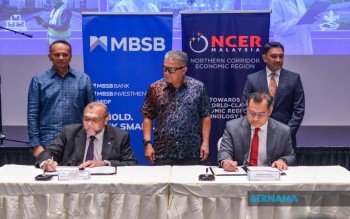
MBSB Bank Bhd and the Northern Corridor Implementation Authority (NCIA) have forged a strategic financing partnership designed to catalyse entrepreneurial growth across the four states comprising Malaysia's Northern Corridor Economic Region (NCER). The collaboration, formalised through a memorandum of understanding signed in Petaling Jaya on July 17, commits up to RM1 billion in dedicated financing facilities to support small and medium enterprises seeking to establish or expand operations in Perlis, Kedah, Penang and Perak.
The partnership reflects a broader policy push to diversify Malaysia's regional economic centres beyond the established Klang Valley and Iskandar corridors. MBSB Bank chairman Datuk Wan Kamaruzaman Wan Ahmad framed the initiative as a crucial mechanism for unlocking dormant entrepreneurial potential in the northern states, arguing that access to affordable capital has historically constrained SME expansion in these regions. By mobilising substantial funding specifically earmarked for northern development, the arrangement aims to level the playing field and encourage businesses to consider relocation or establishment beyond the country's traditional business hubs.
The financing framework carries particular significance for export-oriented enterprises seeking to scale up operations. MBSB Bank group chief executive officer Rafe Haneef disclosed that the initiative specifically targets high-potential companies with international ambitions, leveraging the bank's strategic partnership with Europe's Santander Group. This cross-border banking collaboration creates a direct conduit for participating SMEs to access international markets, extending beyond domestic growth opportunities and positioning the NCER as an export hub with institutional support for overseas expansion.
NCIA chief executive Datuk Mohamad Haris Kader Sultan emphasised that the financing facility aligns with strategic sectoral priorities identified within Malaysia's 13th Malaysia Plan. The NCER has concentrated economic development efforts around six high-value industrial clusters: electrical and electronics manufacturing, advanced manufacturing capabilities, agri-food production, logistics infrastructure, digital economy services, and green technology innovation. By channelling capital toward SMEs operating within these designated sectors, the partnership creates targeted incentives for businesses to specialise in areas where the region possesses comparative advantages and critical mass.
The electrical and electronics sector represents a particularly strategic focus given Penang's historic dominance as Malaysia's semiconductor and technology manufacturing heartland. The dedicated financing facility enables smaller contract manufacturers and component suppliers to invest in automation, quality control systems, and production expansion to compete effectively within supply chains anchored by multinational corporations. Similarly, the agri-food cluster across Kedah and Perak can leverage improved capital access to modernise operations, invest in cold chain infrastructure, and meet international food safety standards that increasingly govern export eligibility.
NCIA functions as the statutory planning and implementation authority responsible for coordinating economic development across the four-state northern zone. The organisation has achieved measurable success in attracting foreign direct investment and facilitating major infrastructure projects, though SME participation in regional growth initiatives has remained constrained by financing gaps. This partnership directly addresses that constraint by establishing a dedicated lending facility with explicit government backing and policy commitment.
The collaboration was formally executed by MBSB Bank group chief commercial banking officer Noor Mohamed Amin and NCIA chief operating officer Hasri A Hassan, signalling institutional commitment at operational levels. The dual signatures underscore that this represents more than a rhetorical commitment but rather a functional framework with defined commercial terms and implementation mechanisms.
The NCER has evolved into one of Malaysia's fastest-expanding economic regions in recent years, demonstrating capacity to attract both domestic and foreign capital when institutional support aligns with sectoral advantages. The region's relatively lower operational costs compared to Selangor and Kuala Lumpur, combined with strategic port facilities in Penang and developing logistics corridors through Perak, create structural attractiveness for manufacturing and trade-based businesses. However, SME sectors frequently lack institutional connectivity to navigate licensing requirements, supply chain integration, and scaling pathways that larger enterprises navigate more easily.
The RM1 billion financing commitment addresses this institutionalisation gap by providing SMEs with capital access conditions explicitly designed for northern development priorities. Participating enterprises gain not merely debt funding but also connection to development authorities, policy frameworks, and peer networks clustered around NCER strategic sectors. This ecosystem dimension often proves as valuable as the capital itself, enabling entrepreneurs to benchmark practices against regional peers and understand regulatory pathways optimised for their sectors.
The arrangement also reflects evolving approaches to regional development policy in Malaysia, moving beyond passive infrastructure provision toward active capital mobilisation for private sector participation. Rather than funding government-controlled enterprises or relying on foreign direct investment alone, the initiative explicitly targets locally-owned SMEs as growth engines. This approach recognises that small businesses, when properly capitalised and connected to larger supply chains, generate employment, retain capital within regional economies, and build indigenous entrepreneurial capacity.
For Malaysian SMEs across other regions, the partnership signals policy appetite for sector-specific financing mechanisms tailored to regional development objectives. Similar arrangements could theoretically be replicated across other economic corridors, suggesting a potential template for addressing capital constraints that persistently hamper SME growth nationwide. The success or shortcomings of this northern initiative will likely inform future coordination between development authorities and financial institutions targeting other underperforming regions.
The broader context involves Malaysia's competitive positioning against regional peers in attracting manufacturing investment as global supply chains diversify away from China and Southeast Asian nations compete for relocation incentives. The NCER financing initiative represents a strategic positioning effort to make the northern zone more attractive to multinational companies considering supply chain shifts, while simultaneously ensuring that local SMEs participate equitably in resulting opportunities rather than experiencing displacement by larger competitors.

