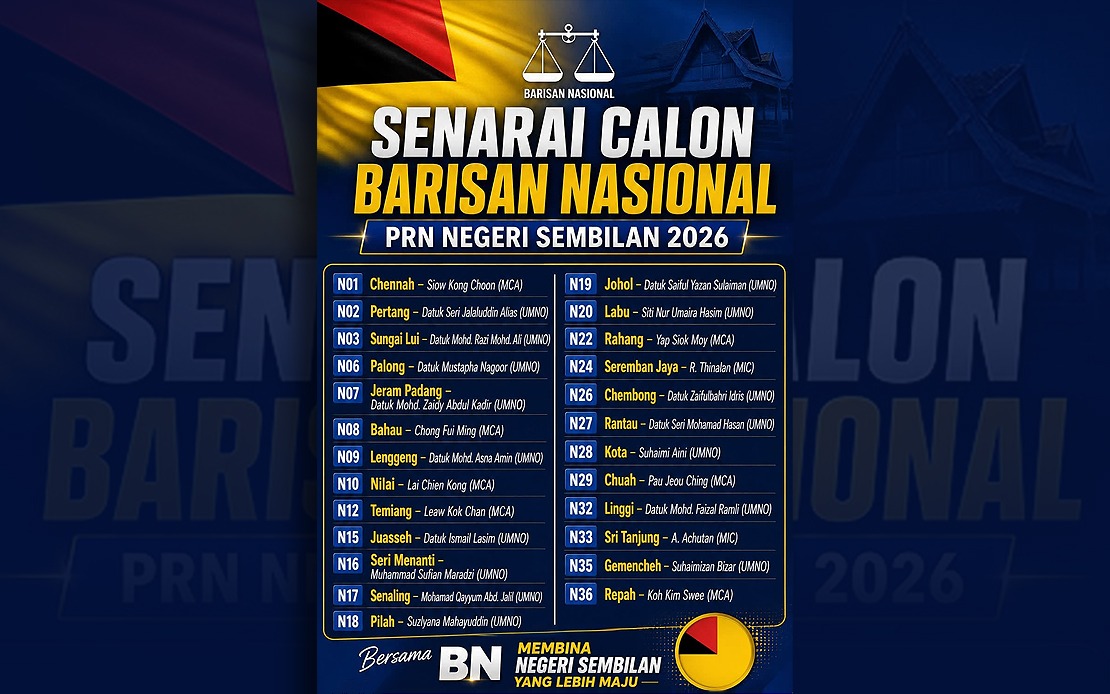
Barisan Nasional's leadership has finalised seat allocations for its component parties ahead of the 16th Negeri Sembilan state election, with the MCA and MIC securing a combined 11 seats in the coalition's campaign strategy. The decision reflects efforts by party leadership to balance representation and electoral viability as the coalition seeks to recover ground lost in the previous election cycle. Datuk Seri Dr Ahmad Zahid Hamidi, who chairs the BN coalition and serves as Deputy Prime Minister, disclosed the distribution during a meeting with prospective candidates in Seremban on July 15.
The seat allocation process followed a careful assessment of electoral prospects across the state's constituencies. Ahmad Zahid explained that the distribution formula considered the realistic chances of victory for candidates fielded in their respective areas, a standard methodology applied across BN's election planning. This approach represents the coalition's attempt to optimise its resources and candidate placement by concentrating efforts on winnable seats while maintaining a presence across the state. The seven seats awarded to MCA and four to MIC underscore the continuing roles these parties play within the broader BN structure, despite both having experienced significant electoral challenges in recent years.
The formal announcement of the complete BN candidate list was scheduled for later that same evening at Stadium Tuanku Abdul Rahman Paroi, marking the culmination of weeks of internal negotiations and vetting. Ahmad Zahid emphasised that all prospective candidates had signed commitments and pledged allegiance to him as BN chairman, a requirement intended to ensure party discipline and coherence during the campaign. This formalisation of candidate commitment is a routine procedure in Malaysian state and federal elections, designed to minimise defections and maintain unity among coalition members during the polling period.
The timeline for the election process has been firmly established by the Election Commission, with nomination day set for July 18. Early voting will take place on July 28, providing an opportunity for civil servants and essential workers to cast their ballots ahead of the main polling day. The election itself will be held on August 1, condensing the entire campaign period into a relatively brief window that will require intensive mobilisation efforts from all contesting parties. This compressed schedule places pressure on campaigners to reach voters efficiently across the state's various districts.
Negeri Sembilan's political landscape has shifted considerably since the 15th state election, which saw Barisan Nasional suffer a significant setback. In that contest, BN secured only 14 seats, while the opposition Pakatan Harapan dominated with 17 seats, and Perikatan Nasional captured five seats. The BN result represented a substantial decline from its historical dominance in the state and signalled growing voter discontent with the coalition during a period of political turbulence in Malaysia. Understanding this electoral context is essential to assessing BN's strategy for the upcoming election, as the coalition attempts to rebuild its support base and regain lost ground.
The current election represents a critical opportunity for BN to demonstrate whether it can reverse the electoral trends that have weakened its position at the state level. The coalition's performance in Negeri Sembilan will carry significance beyond the state itself, as it will provide early indicators of voter sentiment heading into potential federal elections and other state contests. A strong recovery could bolster confidence within the coalition's leadership and demonstrate the effectiveness of recent organisational reforms. Conversely, a continued decline would prompt serious questions about BN's electoral strategy and messaging.
For MCA and MIC specifically, the Negeri Sembilan election represents an important platform to prove their continued relevance within Malaysian politics. Both parties have struggled to maintain membership and electoral support in recent years, facing competition from Malay-focused parties and Chinese-focused opposition alternatives. The eleven seats they will contest in Negeri Sembilan offer an opportunity to reverse negative trends and demonstrate that they retain sufficient grassroots organisation and voter appeal to contribute meaningfully to BN's objectives. Success in this state election could strengthen their bargaining position within the coalition's internal power structures.
The coalition's overall strategy in Negeri Sembilan extends beyond simple seat mathematics. BN's leadership appears focused on presenting a unified front against a fractured opposition, with Pakatan Harapan and Perikatan Nasional potentially competing against each other rather than presenting a consolidated alternative government. The allocation of seats to different coalition components also reflects calculated decisions about which parties and candidates possess the strongest prospects in specific constituencies. Such tactical choices can ultimately determine electoral outcomes in closely contested races.
Regional analysts have observed that Negeri Sembilan elections frequently serve as barometers for broader political shifts affecting the wider Central region of Peninsular Malaysia. The state's relatively compact geography and mixed urban-rural composition make it microcosm of national voting patterns. Results from the August 1 election will therefore interest observers far beyond the state's borders, particularly those monitoring BN's viability as a political force and the stability of Malaysia's coalition politics more generally. The contest will test whether voters reward the coalition's attempts at renewal or continue expressing preferences for change.
The coming weeks will test both the unity of the BN coalition and the effectiveness of its electoral machinery. Campaign activities across Negeri Sembilan's parliamentary constituencies will showcase the messaging and organisational capacities of both the main alliance and its component parties. The participation of MCA and MIC, alongside dominant partner UMNO and other coalition members, will determine whether Barisan Nasional can project an image of inclusive, multi-ethnic governance that appeals to the state's diverse electorate. The August 1 polling day will ultimately reveal whether BN's seat allocation strategy and candidate selection prove sufficient to achieve the electoral recovery the coalition's leadership has targeted.

