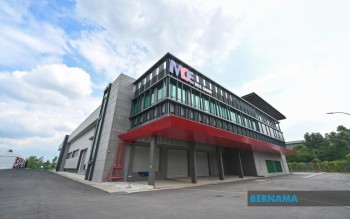
MCE Holdings Bhd has officially inaugurated the MCE Auto Hub, a RM50 million state-of-the-art manufacturing facility located within the UMW High Value Manufacturing Park in Serendah. The launch, officiated by Investment, Trade and Industry Minister Datuk Seri Johari Abdul Ghani, represents a watershed moment for Malaysia's automotive electronics sector and signals renewed confidence in the country's capacity to support advanced manufacturing operations serving global markets.
The new facility spans 5.52 hectares and constitutes the opening phase of MCE Holdings' ambitious long-term capital allocation strategy, which is projected to reach RM200 million over the coming years. This phased approach underscores the company's commitment to methodically expand production infrastructure whilst maintaining quality and engineering standards. The expansion is expected to more than double current production capacity, positioning MCE as a significantly more capable player within the automotive electronics and next-generation mobility solution sectors.
MCE Holdings has established itself as a tier-1 automotive electronics supplier over three decades of continuous operation, having evolved from its initial 1990 contract supplying remote alarms and central locking systems to the domestic market. The company's trajectory demonstrates how Malaysian industrial enterprises can graduate from traditional component manufacturing into increasingly sophisticated domains. Today, MCE serves a geographically diversified customer base spanning Malaysia, the broader ASEAN region, and the United States, supplying complex automotive electronics and mechatronic solutions that meet stringent international standards.
The MCE Auto Hub has been designed from inception as an Industry 4.0-compatible manufacturing platform, incorporating cleanroom production zones and rigorously controlled environments necessary for contemporary automotive electronics. This technological backbone is crucial given the sector's transition toward electrification. The facility accommodates production requirements for both internal combustion engine vehicles and battery electric vehicles, ensuring MCE can service customers across the entire powertrain spectrum during this pivotal industry transition period.
Johari emphasised that the investment reflects confidence in MCE's trajectory and Malaysia's broader industrial prospects. His remarks highlighted the premium placed upon local suppliers' capacity to maintain manufacturing excellence through continuous cultivation of engineering talent, technological innovation, and sophisticated production methodologies. For Malaysia, facing intensifying regional competition from Thailand, Vietnam, and Indonesia across manufacturing sectors, such commitments from established industrial players carry symbolic importance in demonstrating sustained faith in the country's competitive positioning.
MCE group managing director Dr Goh Kar Chun articulated a vision of Malaysian engineering capabilities competing effectively on the international stage. His perspective emphasises that the MCE Auto Hub represents not merely incremental capacity expansion but rather a strategic pivot toward higher-value manufacturing activities. The company's portfolio transformation from traditional automotive components into advanced electronics and mechatronic systems illustrates the broader sectoral shift occurring throughout Malaysian automotive manufacturing, where value capture increasingly depends upon technical sophistication rather than labour cost advantages.
The facility's operational commencement brings MCE's total workforce to 680 employees, including 90 engineers distributed across facilities in Johor Bahru, Port Klang, and Serendah. This engineering concentration represents a deliberate strategy to consolidate technical expertise and accelerate problem-solving capacity across increasingly complex development programmes spanning both conventional and electric vehicle platforms. For Malaysia's engineering talent pool, the expansion creates concrete opportunities for high-skilled employment and capability development within a sector increasingly positioned as strategically significant for the nation's economic future.
The MCE Auto Hub's establishment carries implications extending beyond single-company operations. MCE management characterised the investment as strengthening broader localisation efforts within Malaysia's automotive ecosystem, creating pathways for Malaysian semiconductor firms, electrical and electronics manufacturers, and component suppliers to participate in designing and manufacturing advanced automotive technologies domestically. This ecosystem perspective aligns with government strategies emphasising value-chain integration and indigenous technological capability development rather than assembly-only operations.
Dr Goh articulated a collaborative vision wherein Malaysia's automotive future emerges through strengthened coordination between vehicle manufacturers, tier-1 suppliers, semiconductor enterprises, and electronics companies. This stakeholder integration model differs materially from compartmentalised industrial development, instead positing that competitive advantage emerges from ecosystem coherence and knowledge circulation across supply networks. For Malaysia, successfully executing such integration could establish the country as a genuine advanced manufacturing destination rather than merely a low-cost assembly location.
The investment arrives during a critical juncture in Malaysia's automotive sector development. Global automotive electrification accelerates rapidly, reshaping competitive dynamics and requiring suppliers to master battery management systems, power electronics, and integrated vehicle control architectures. MCE's RM200 million commitment suggests confidence that Malaysian industrial capabilities can participate meaningfully in this transition. However, sustained competitive positioning requires continuous technological upgrading, talent retention, and strategic partnerships with international technology leaders, challenges that extend considerably beyond individual facility investments.
The MCE Auto Hub will function as the group's primary manufacturing and engineering headquarters, consolidating design and development functions alongside production operations. This integrated arrangement facilitates rapid iteration between engineering teams and manufacturing personnel, accelerating problem-solving and enabling responsive customisation for diverse customer requirements across Malaysian, ASEAN, and international markets. For the broader Malaysian industrial ecosystem, MCE's evolution toward integrated design-manufacturing operations demonstrates a viable pathway for local suppliers to capture greater value whilst strengthening overall automotive competitiveness.
Government officials present at the launch, including Malaysia Automotive, Robotics and IoT Institute leadership and the Malaysian Investment Development Authority, underscored official support for such capital commitments. Policy alignment across multiple agencies suggests coordinated government effort to position automotive electronics as a priority sector. However, sustained sector growth requires complementary investments in education, digital infrastructure, research partnerships with academic institutions, and regulatory frameworks encouraging technology adoption and foreign partnership formation.
The MCE Auto Hub's opening carries strategic significance stretching beyond immediate economic metrics. As established Malaysian industrial enterprises invest substantially in advanced manufacturing capabilities, such decisions signal to international investors and technology partners that Malaysia remains committed to competing within high-value manufacturing sectors despite regional alternatives. The facility's success in executing complex automotive electronics manufacturing at scale will significantly influence both MCE's trajectory and perceptions regarding Malaysia's broader advanced manufacturing potential.

