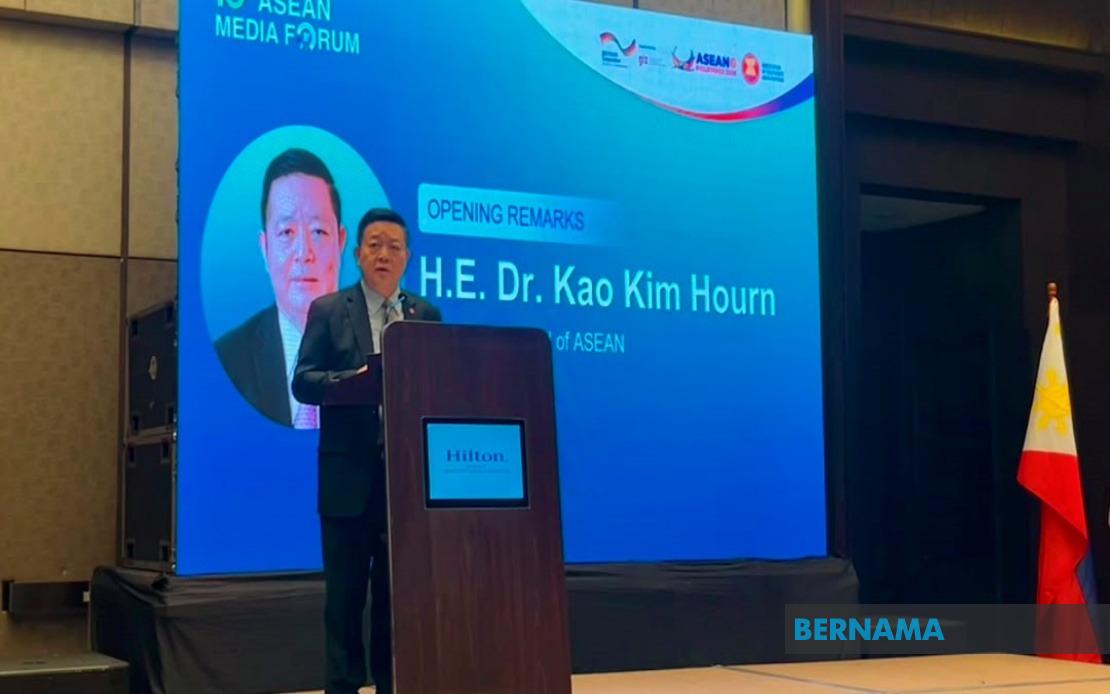
The journey towards ASEAN Community Vision 2045 will succeed or falter partly on the ability of journalists across the region to explain complex policy decisions to ordinary citizens and build a genuine sense of shared regional purpose. This conviction underpinned remarks by ASEAN Secretary-General Dr Kao Kim Hourn at the 10th ASEAN Media Forum in Manila on Wednesday, as he positioned professional journalism not merely as a chronicler of Southeast Asian affairs but as an essential architect of regional cohesion and understanding.
The timing of Kao's intervention reflects a deepening recognition within ASEAN leadership that the bloc's ambitious long-term agenda cannot be achieved through policy documents and diplomatic statements alone. As the ten member states navigate divergent national interests, competing geopolitical pressures, and the practical challenges of economic integration, the media becomes a vital conduit for translating ASEAN's strategic priorities into narratives that resonate with citizens across the region. Without this translation layer, the Vision 2045 framework risks remaining a distant institutional exercise rather than a lived reality shaping Southeast Asian futures.
The information landscape through which ASEAN must now communicate with its peoples has transformed radically over the past decade, creating both unprecedented opportunities and acute dangers. Digital platforms and social media have democratised news distribution while simultaneously creating vast uncontrolled spaces where false narratives, manipulated content and coordinated disinformation campaigns flourish with minimal friction. Generative artificial intelligence has amplified these dynamics further, enabling the creation of synthetic media and deepfakes that can deceive even sophisticated audiences. For a region as vast and linguistically diverse as ASEAN, where traditional media infrastructure remains unevenly developed across member states, these dynamics pose particular challenges to the maintenance of an informed regional public sphere.
Dr Kao acknowledged that generative AI does offer tangible benefits to newsrooms struggling with resource constraints. Multilingual reporting, real-time news production, and improved operational efficiency become feasible at lower cost through AI assistance. Yet these productivity gains come laden with risks that Malaysian and regional journalists must navigate carefully. Questions of editorial accountability blur when algorithms participate in news gathering and story selection. The authenticity of reported information becomes harder to verify. Copyright protection dissolves in systems trained on unlicensed content. The distinction between journalism and synthetic content marketing grows dangerously thin. Each of these developments corrodes the foundation upon which public trust in media institutions rests, and that trust, once fractured, rebuilds with extraordinary difficulty and time.
The Secretary-General's emphasis on credibility as journalism's most valuable yet fragile asset carries particular weight for Malaysia and Southeast Asia. Across the region, recent years have witnessed declining trust in traditional news institutions, partly attributable to legitimate concerns about editorial independence and partly driven by orchestrated campaigns to discredit mainstream journalism. In this context, Malaysian editors and publishers face a professional imperative to demonstrate that verification, contextualisation and ethical standards remain non-negotiable commitments rather than optional refinements. The alternative is a regional information ecosystem where citizens increasingly retreat into ideologically sealed information bubbles, making consensus on shared challenges—from economic policy to climate response—progressively more elusive.
The Philippines' role as ASEAN Chair during this period adds institutional weight to the forum's agenda. Undersecretary Leo M. Herrera-Lim explicitly framed journalism as integral to all three pillars of Vision 2045: political-security architecture, economic cooperation, and socio-cultural development. This formulation reflects an understanding that media engagement cannot be compartmentalised. When ASEAN negotiates maritime security frameworks or coordinates responses to transnational challenges, journalists translate these decisions for publics who must ultimately support or at minimum accept these policies. When regional trade agreements are concluded, media outlets explain implications for workers and consumers. When ASEAN addresses education and cultural exchange, journalists shape understanding of regional identity and shared interests. Media, in this framework, functions as the connective tissue binding institutional decisions to social legitimacy.
The current geopolitical environment gives added urgency to this agenda. ASEAN faces intensifying great-power competition, with major economies competing for influence across Southeast Asia. In such circumstances, the ability to maintain credible regional media capable of offering independent analysis becomes a matter of strategic importance. If journalists across ASEAN are perceived as compromised or untrustworthy, the space for autonomous regional voice contracts. Conversely, strengthened professional journalism reinforces ASEAN's capacity to articulate positions that reflect the region's interests rather than merely echoing external powers' preferences. For Malaysian journalists and media organisations, this carries implications for editorial independence and the protection of professional standards against both market pressures and political influence.
The ASEAN Media Forum itself, now in its tenth iteration since inaugural convening in 2017 to mark ASEAN's golden jubilee, has evolved into a substantive platform for regional media dialogue. The forum brings together journalists, media executives, and policymakers in structured exchanges that go beyond ceremonial acknowledgments to engage with substantive challenges facing the profession. This year's iteration, supported by the German government through GIZ, continues that tradition while confronting digital transformation issues that barely existed in 2017. The longevity and growth of the forum suggests that ASEAN's media fraternity recognises the necessity for coordinated thinking about shared professional challenges that transcend national boundaries.
For Malaysian media practitioners attending or engaging with outcomes from the forum, the principal takeaway concerns the necessity of investing in professional journalism precisely when technological and economic pressures push towards shortcuts and cost-cutting. The credibility assets that Malaysian news organisations have built over decades remain valuable but increasingly contestable. Misinformation spreads faster than correction. Audiences increasingly encounter news through algorithms designed to maximise engagement rather than inform comprehensively. In this environment, distinguishing professionally-produced journalism from noise requires sustained commitment to verification, contextualisation and ethical practice—the very qualities that Kao Kim Hourn identified as essential to ASEAN's long-term cohesion.
The broader implication extends beyond individual newsroom decisions. At a regional level, ASEAN's ability to speak with coherent voice about its interests, values and priorities depends substantially on whether journalists across the bloc maintain sufficient professional standards and independence to report on regional developments with credibility. This does not require uniformity of editorial voice or outlook. Rather, it requires journalism grounded in factual accuracy, contextual understanding, and commitment to serving public comprehension rather than narrow institutional interests. As ASEAN advances towards 2045, this professional foundation becomes not merely desirable but essential to the bloc's capacity to shape its own future.

