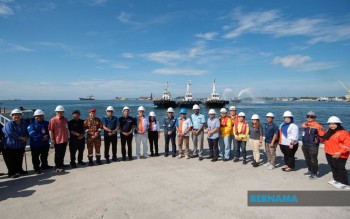
Megah Port Management Sdn Bhd formally initiated its marine services division at Labuan Port today, capitalizing on a significant capital deployment of RM23 million to acquire four purpose-built tugboats. The move represents a substantial operational expansion for the port operator and signals its commitment to raising service standards across one of Malaysia's strategic maritime hubs. The tugboat fleet was officially unveiled at Dermaga Merdeka Jetty in a ceremony that underscored the company's investment in maritime infrastructure and port safety capabilities.
Datuk Seri Patrick Tiong, the managing director of Megah Port Management, positioned the tugboat acquisition as a cornerstone investment aligned with the company's contractual obligations under a recently finalized Operation, Facility and Management Continuation Agreement with the Labuan Port Authority. He emphasized that the decision to procure these vessels reflected not merely a business undertaking but a fundamental commitment to enhancing the safety and reliability profile of all maritime traffic moving through Labuan Port. The acquisition demonstrates how port operators in Malaysia are increasingly investing in proprietary marine assets to meet evolving regulatory expectations and maintain competitive service delivery.
The four tugboats will serve multiple operational functions critical to modern port management. They will facilitate vessel entry and exit procedures, assist in berthing and unberthing maneuvers, and provide crucial support during challenging weather or strong current conditions that periodically affect Labuan waters. Beyond routine towage operations, these vessels extend tugboat assistance to ships encountering mechanical difficulties or loss of propulsion—situations that without prompt intervention could escalate into maritime incidents affecting other port users and creating environmental risks. This comprehensive service approach reflects industry best practices adopted by leading Southeast Asian port operators.
Particular emphasis was placed on the tugboats' emergency response capabilities, a dimension increasingly prioritized by port authorities across the region. The vessels can be rapidly deployed to support firefighting operations, relocate vessels away from hazardous zones, and provide coordinated assistance to maritime enforcement and security agencies responding to critical incidents. The ability to mount such responses swiftly and effectively represents a significant enhancement to Labuan Port's overall risk management framework. An emergency response demonstration showcased these firefighting and incident response capabilities, illustrating the tangible safety improvements the new fleet delivers.
Labuan Port's operational footprint encompasses several strategically important terminals and specialized facilities beyond conventional cargo infrastructure. The marine services mandate extends across the DG Terminal handling dangerous goods, the Petronas Chemicals Methanol Labuan Terminal serving petrochemical operations, the Asian Supply Base Fuel Terminal supporting offshore industries, and the Shell Timur Terminal. This diverse terminal landscape necessitates sophisticated tugboat coordination and highly trained marine personnel capable of managing the distinct safety protocols and operational requirements each facility imposes. The breadth of this responsibility underscores why Megah Port Management deemed a dedicated marine services division operationally essential.
The launching event reflected broader maritime governance frameworks increasingly evident across Malaysian and regional ports. Tiong acknowledged the necessity of close operational coordination with the Malaysian Maritime Enforcement Agency, the Marine Police Force, and other enforcement bodies to ensure compliance with maritime legislation and international safety standards. This collaborative approach signals a shift toward integrated port governance models where private operators work within clearly defined regulatory parameters and maintain transparent relationships with government maritime authorities. Such coordination mechanisms are particularly important in Labuan, a federal territory with distinct regulatory arrangements and significant offshore petroleum and financial sector operations.
The investment decision reveals how Megah Port Management approaches its operational mandate as more than basic containerization or general cargo handling. By taking direct ownership of marine assets rather than contracting these services externally, the company assumes responsibility for equipment maintenance standards, crew training protocols, and service response times. This vertical integration of marine services represents a confidence statement regarding the port's commercial trajectory and indicates management's belief that Labuan Port's traffic volumes and operational complexity justify in-house maritime capabilities. Such decisions typically reflect positive market assessments among port operators.
From a Malaysian maritime policy perspective, the Labuan Port marine services expansion contributes to broader national objectives of strengthening regional port competitiveness and enhancing maritime safety standards. Labuan's strategic location along major East-West shipping corridors and its role as a bunkering and offshore services hub position it as an important node within Malaysia's maritime infrastructure network. Investments in modern marine services support these functions and enhance the territory's attractiveness to international shipping lines and offshore industry stakeholders. The RM23 million tugboat investment therefore carries implications extending beyond Labuan itself.
Datuk Seri Patrick Tiong articulated Megah Port Management's operational philosophy as one emphasizing professional service delivery, legal compliance, and continuous improvement through engagement with regulatory authorities and stakeholder feedback. This posture suggests the company views its Labuan Port mandate as a long-term operational commitment requiring sustained investment and refinement rather than extractive short-term profit maximization. Such approaches tend to build stakeholder confidence and support among government agencies and industry participants—relationships essential for port operators seeking to expand service offerings or secure contract extensions. The public articulation of these principles carries competitive signaling value within Malaysia's port sector.
The timing of the marine services launch follows the execution of the Operation, Facility and Management Continuation Agreement, indicating that Megah Port Management moved swiftly to operationalize its contractual obligations and deploy capital toward service enhancement. This implementation timeline suggests confidence in the broader Labuan Port operating environment and commercial prospects. Port operators typically scale capital investments incrementally in response to traffic growth and service demand; the immediate commitment of RM23 million signals management's assessment that sufficient market fundamentals exist to justify this outlay. Such decisions carry implications for Labuan's attractiveness as a logistics and maritime services destination.
Looking forward, the marine services division establishes an operational foundation upon which Megah Port Management can layer additional service enhancements. Modern tugboat fleets increasingly incorporate advanced navigation technology, environmental monitoring systems, and specialized capabilities addressing emerging maritime challenges. The initial four-vessel deployment potentially represents a baseline configuration that could expand as port traffic grows. The willingness to establish dedicated marine services divisions distinguishes progressive port operators from those offering minimal value-added services, a competitive distinction increasingly important in Southeast Asia's contested port markets where multiple facilities compete for limited container and vessel traffic.
The launch also reflected Megah Port Management's cultivation of governmental and stakeholder relationships through formal recognition of the Ministry of Transport, the Labuan Port Authority, maritime enforcement agencies, and industry participants. This public acknowledgment of institutional relationships and collaborative approaches builds social capital essential for navigating regulatory environments and securing support for future operational or expansion initiatives. The formal ceremony format, complete with emergency demonstration components, provided media platforms for communicating the port's service capabilities to shipping lines, offshore operators, and potential clients—audiences whose vessel and facility utilization decisions fundamentally drive port revenues and operational throughput.

