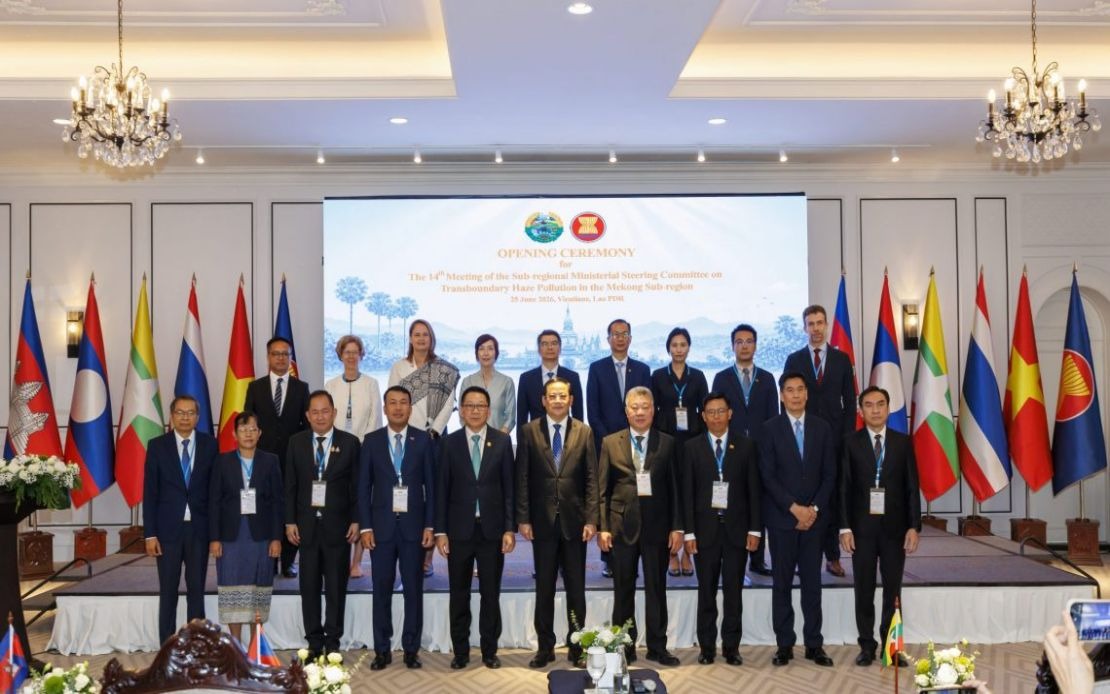
Policymakers across Southeast Asia's Mekong region are bracing for a critical period ahead, as soaring temperatures and the looming El Niño phenomenon create ideal conditions for widespread forest and peatland fires. The convergence of climate pressures has prompted regional governments to strengthen their cross-border mechanisms, recognizing that air pollution from one nation's burning forests inevitably drifts across boundaries to affect millions in neighboring countries. The urgency was underscored at a major regional gathering in Vientiane on June 25, where environment and agriculture ministers from across the Greater Mekong Subregion convened to coordinate defenses against what has become one of the subregion's most persistent transboundary challenges.
The warning signals are mounting on multiple fronts. Hotspot counts — a key indicator of potential fire activity — have already climbed by approximately eight percent in the December 2025 to May 2026 period compared to the previous year, signaling a trajectory toward more frequent ignition events. This statistical uptick carries profound implications for a region where forest fires have historically triggered cascading crises affecting public health, agricultural productivity, and economic stability across multiple nations simultaneously. The data suggests that despite previous commitments and infrastructure investments, the underlying vulnerability of the Mekong landscape to fire ignition remains stubbornly high.
Lao Prime Minister Sonexay Siphandone articulated the stakes bluntly during the 14th Meeting of the Sub-Regional Ministerial Steering Committee on Transboundary Haze Pollution. He characterized forest fires and transboundary air pollution as existential threats to the subregion's ecological and economic fabric, noting that these phenomena have already inflicted measurable losses in biodiversity while simultaneously damaging public health and imposing substantial economic costs across the Greater Mekong Subregion. His remarks reflected a growing acknowledgment that transboundary haze is no longer merely an environmental nuisance but a multidimensional crisis demanding urgent, coordinated intervention at the highest political levels.
The meteorological picture is particularly unsettling. While the monsoon season has theoretically arrived across much of the Mekong region, rainfall patterns have proven erratic and insufficient in critical areas, leaving vegetation dry and primed for combustion. Major urban centers from Bangkok to Ho Chi Minh City are experiencing temperatures and heat stress far exceeding normal seasonal expectations, with weather scientists attributing these anomalies to the compounding effects of climate change and El Niño oscillation patterns. The Lao Ministry of Agriculture and Environment has issued projections suggesting that certain areas could experience temperatures between 35 and 38 degrees Celsius, accompanied by irregular precipitation, extended dry periods, and declining water availability — a combination virtually guaranteed to elevate fire risk across forested landscapes.
Scientists monitoring atmospheric conditions have flagged a particularly troubling possibility: the emergence of a Super El Niño event during the current year. Such intensified oceanic warming patterns would amplify the heat and drying effects already stressing the region, potentially creating near-perfect conditions for rapid, uncontrollable fire spread. The cascading consequences extend far beyond immediate smoke exposure; prolonged drought conditions threaten irrigation availability, water supply systems, and hydroelectric generation across nations heavily dependent on river systems. Agricultural and livestock sectors face potential devastation from heat stress and water scarcity, with ripple effects throughout food security networks across the region.
The haze itself represents a direct public health emergency. When fires rage across national boundaries, particularly in Indonesia and Myanmar where vast peatland deposits can burn for months, smoke plumes drift across international borders, exposing populations in Thailand, Laos, Cambodia, and Vietnam to hazardous air quality. Children, elderly persons, and those with respiratory conditions face amplified health risks, and hospital admissions typically spike during haze episodes. Beyond acute health impacts, transboundary pollution imposes chronic burdens on healthcare systems and productivity losses as workers and students grapple with reduced air quality.
Economically, the calculations are sobering. Previous haze episodes have disrupted tourism, reduced agricultural yields, increased healthcare expenditures, and forced industrial operations to curtail output. Airlines have cancelled flights, visibility-dependent industries have suffered, and export-oriented agricultural sectors have absorbed significant losses. For a region where many nations operate with relatively thin fiscal margins, these shocks represent genuine macro-economic threats that can derail development trajectories and exacerbate poverty dynamics.
The governmental response articulated at the Vientiane meeting reflects recognition that unilateral national approaches prove insufficient. ASEAN member states formally pledged to implement measures targeting hotspot reduction and transboundary haze control specifically during the high-risk dry seasons. This commitment signals intention to move beyond ad-hoc crisis response toward systematic prevention frameworks. However, translating pledges into effective on-the-ground implementation remains a persistent challenge, requiring sustained funding, technical capacity, and political will across nations with varying resource availability and institutional capabilities.
Cross-border coordination mechanisms face inherent structural difficulties. Fire prevention and suppression require real-time information sharing, harmonized enforcement approaches, and joint resource deployment across multiple jurisdictions with different administrative systems and priorities. Peatland management — critical for fire prevention since peat burns with particular intensity and duration — demands long-term land-use planning that often conflicts with agricultural expansion and economic development pressures. Additionally, agricultural and slash-and-burn practices that contribute significantly to fire initiation are deeply embedded in rural livelihoods across the region, making behavioral change exceptionally complex.
For Malaysia and Singapore, which have historically experienced severe haze impacts during Mekong region fire episodes, the intensifying threat carries particular relevance. Previous transboundary haze events have degraded air quality in Peninsular Malaysia and the island city-state to hazardous levels, prompting school closures, health warnings, and industrial disruptions. The strengthening of regional coordination mechanisms therefore represents a direct interest alignment, as improved fire management and transboundary pollution controls in neighboring countries provide tangible protective benefits for Malaysian populations and economic interests.
The challenge ahead demands that governments move beyond rhetorical commitments toward sustained institutional development, adequate resource allocation, and regional trust-building that enables genuine operational cooperation. Early warning systems must be strengthened to provide decision-makers with sufficient lead time for preventive measures. Ground-level fire prevention and suppression capabilities require investment in personnel training, equipment, and cross-border operational protocols. Land management practices must evolve to reduce fire vulnerability while respecting livelihood imperatives affecting rural populations dependent on current agricultural systems.
The convergence of El Niño pressures, rising temperatures, and inadequate rainfall patterns during what should be the monsoon season suggests that the coming months will test these coordination frameworks severely. Success in reducing transboundary haze will require not merely political pledges but demonstrated capacity for sustained, multifaceted intervention spanning prevention, preparedness, and response dimensions. The alternative — allowing fire and haze episodes to continue unabated — carries costs that extend far beyond affected nations' borders, ultimately imposing shared regional burdens that no single nation can effectively manage in isolation.

