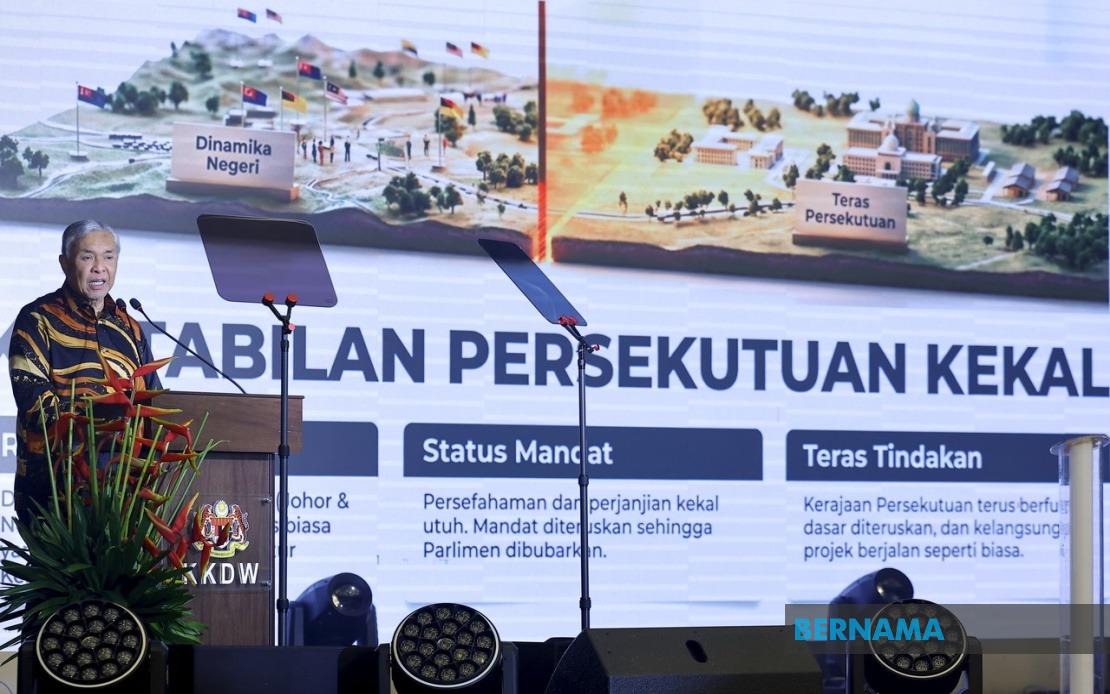
Barisan Nasional in Melaka is pursuing an ambitious defensive strategy ahead of the state's next election, with the coalition determined to retain every one of its 21 existing seats. BN chairman Datuk Seri Dr Ahmad Zahid Hamidi revealed the objective after being briefed by the Melaka Chief Minister Datuk Seri Ab Rauf Yusoh, who doubles as state BN chairman. The announcement underscores the coalition's confidence in maintaining its grip on the southern state, though it also reflects the intensifying electoral competition that characterises Malaysian politics at the state level.
The 16th Melaka state election represents a critical test for the long-dominant coalition, which has governed the state across multiple electoral cycles. Ab Rauf Yusoh's determination to capture all available seats signals that BN views Melaka as firmly within its electoral base, despite the fragmentation and realignment that have characterised Malaysian politics since 2018. This all-or-nothing posture differs markedly from the kind of seat-sharing arrangements that have become commonplace in other states, where coalition partners negotiate carefully to balance competing interests and geographical strengths.
However, Ahmad Zahid's comments also hint at flexibility within BN's strategy. While the Melaka leadership has articulated its maximalist goal, the national BN hierarchy remains willing to explore understanding with other political parties, subject to central approval. This nuance is significant for understanding how Malaysia's dominant coalition operates—state-level ambitions must ultimately defer to decisions made at the apex of party structure. The careful language employed by Ahmad Zahid reflects the delicate balance BN must strike between projecting strength and maintaining the alliance relationships that have sustained its political dominance.
The possibility of negotiations with other parties suggests that BN recognises the evolving nature of Malaysian electoral politics. In recent years, various coalitions have experimented with cooperation beyond traditional BN structures, particularly in pursuit of more competitive configurations against Pakatan Harapan and other opposition groupings. For Melaka specifically, any such arrangement would need to account for the distinct demographic and political characteristics of different constituencies, where local factors often prove decisive.
Melaka's electoral significance extends beyond the state itself. As a relatively compact polity with a substantial urban population and significant rural constituencies, the state serves as a bellwether for broader trends in Malaysian politics. Results here frequently presage outcomes in other peninsular states and can influence the trajectory of national politics. A decisive BN performance would bolster the coalition's narrative of recovery and consolidation following losses in 2018, while any unexpected setbacks could embolden opposition forces and complicate narratives about BN's trajectory.
The timing of this announcement is strategically important. By publicly committing to defending all 21 seats, the Melaka leadership establishes a clear mandate that shapes internal party dynamics and voter expectations. It also sends a signal to the broader electorate about BN's confidence and organisational capacity. In Malaysian political culture, such statements carry weight beyond their literal content, functioning as indicators of party morale and perceived viability.
For opposition coalitions, Melaka will likely emerge as a crucial battleground. Pakatan Harapan and other groupings will scrutinise which constituencies represent genuine opportunities for advancement. The state's three major urban centres attract younger, more volatile electorates, while rural areas tend to favour establishment politics. This mix makes Melaka contested terrain where neither side can take victory for granted, despite BN's current structural advantages.
The reference to central BN leadership's ultimate decision-making authority highlights how Malaysian political coalitions function hierarchically. Individual state chapters, however confident, cannot unilaterally determine electoral strategy without considering national party imperatives and relationship obligations. This centralisation serves to ensure coherence but sometimes creates friction when local preferences diverge from national calculations. In Melaka's case, the chief minister's assertiveness appears to enjoy backing from senior BN figures, at least based on Ahmad Zahid's framing.
Regionally, Melaka's positioning matters for broader Southeast Asian political dynamics. Malaysia's sophisticated party system and federal structure provide lessons for neighbouring democracies grappling with coalition politics and electoral competition. The way BN manages its Melaka campaign could influence how other regional parties approach similar challenges. The coalition's capacity to maintain or expand its support base while simultaneously adapting to new political realities will be closely observed across the region.
Looking forward, the actual conduct of this election will test whether BN's confident projections translate into electoral success. Campaign dynamics, unexpected scandals, local grievances, and voter sentiment will ultimately determine outcomes. The coalition's declared intention to sweep all 21 seats provides clear benchmarks against which performance will be measured. This transparency, while politically bold, also creates vulnerabilities should results disappoint. Nonetheless, BN's willingness to articulate such ambitions reflects confidence rooted in years of electoral dominance and established machinery across the state.

