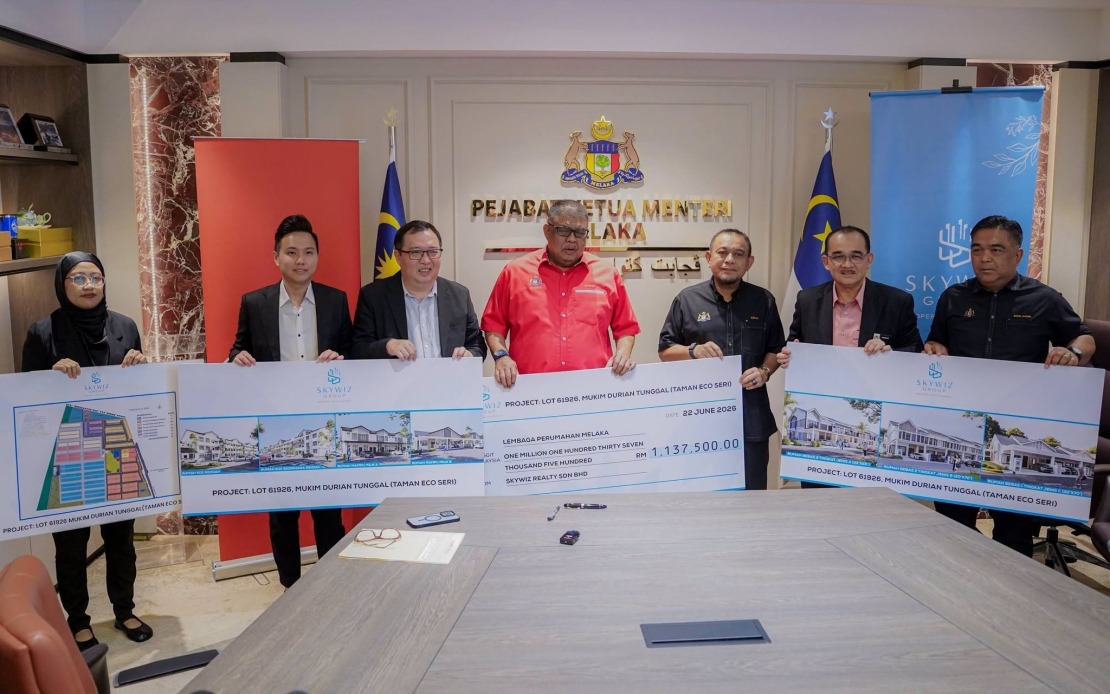
Melaka's Chief Minister Datuk Seri Ab Rauf Yusoh has mounted a fresh push to reshape the state's residential property landscape, advocating for lift installations to become standard features in multi-storey construction projects. Speaking after witnessing the signing of an Affordable Housing Development Agreement between the Melaka Housing Board (LPM) and developer Skywiz Reality Sdn Bhd, Ab Rauf framed lift access not as a luxury amenity but as a functional necessity that builders have overlooked at considerable cost to their bottom lines and to vulnerable demographics within the buying public.
The Chief Minister's intervention addresses a tangible problem within Melaka's property sector. Properties across Kota Laksamana, Banda Hilir, and Melaka Raya—prime residential zones—have languished on the market, with mounting evidence suggesting that the absence of lift facilities ranks among the principal barriers deterring purchases. For elderly residents, families with mobility constraints, and buyers concerned about long-term accessibility, multi-storey units without elevators present a significant practical hurdle. Ab Rauf's diagnosis reflects observations from stakeholders within the state's development community and signals an intention to eliminate this structural impediment to sales velocity and market absorption.
The state government is now preparing to introduce formal regulatory machinery to enforce lift requirements across new shoplots and three-storey residential properties. This policy shift represents a move away from voluntary industry practice toward mandatory specification standards. Such interventions are common in developed property markets, where accessibility codes have become embedded in building regulations for decades. Melaka's adoption of this approach indicates growing alignment with accessibility-first urban planning principles that are gaining traction across Southeast Asia, particularly as ageing demographics reshape demand patterns in residential real estate.
The Skywiz Reality development announced during the signing ceremony exemplifies the scale of affordable housing activity now underway in Melaka. The project encompasses 903 housing units across a 26.56-hectare site in Mukim Durian Tunggal, Alor Gajah, with construction scheduled to unfold over three years. The breakdown reflects deliberate social housing strategy: 453 units will fall into the affordable category, comprising 61 low-cost houses, 54 low-medium cost units, 200 Type A affordable homes, and 138 Type B affordable homes. The remaining 450 units are designated for open-market sale, a structure that allows developers to cross-subsidize affordable inventory through profit-generating market-rate sales.
This development narrative fits within Melaka's broader housing ambitions. The state government has targeted construction of more than 38,440 affordable homes to expand homeownership among residents across income bands. To date, the state has completed 23,514 units, positioning it roughly 61 percent of the way toward its stated goal. These figures underscore sustained momentum in affordable housing delivery, a priority area under the Melaka Sayang Rakyat (MeSRa) initiative that frames property ownership as foundational to family stability, community cohesion, and inclusive regional development.
For investors and the broader development sector, the Skywiz project is projected to generate RM2.38 million in returns for the Melaka Housing Board, with construction obligations beginning within 90 days of Form B issuance by the Hang Tuah Jaya Municipal Council (MPHTJ). This timeline and revenue structure illustrate how public-private partnerships in Melaka's affordable housing space function as mutually beneficial arrangements, allowing private developers to access large land parcels and assured absorption, while public entities secure revenue streams and policy leverage over quality, scheduling, and affordability thresholds.
Ab Rauf's emphasis on lift requirements carries particular significance for elderly residents and those with mobility challenges. Malaysia's population is ageing, a demographic trajectory replicated across Southeast Asia. Properties designed without regard to accessibility effectively exclude growing cohorts of potential residents, constraining addressable market size. By normalizing lift installation across multi-storey residential projects, Melaka addresses not merely current demand but future housing suitability, reducing the risk that buildings completed today will functionally obsolete within two decades as household composition shifts toward greater numbers of senior residents.
The unsold inventory problem that prompted this intervention reflects a mismatch between developer assumptions and buyer preferences. Historically, property builders in some Malaysian states have treated lifts as discretionary upgrades, cost items that compress margins and can be eliminated when competitive pressure intensifies. Market feedback from Kota Laksamana, Banda Hilir, and Melaka Raya suggests this calculus has backfired, with units remaining vacant and capital trapped in illiquid inventory. By making lift provision mandatory, the state government essentially corrects a coordination failure in the development market, aligning builder incentives with buyer requirements and reducing time-to-sale friction.
The policy framework being developed will require careful calibration. Lift installation adds capital expenditure to development costs, a burden that may be partially absorbed through higher unit prices, passed to buyers as affordability trade-offs, or absorbed by developer margins. For low-cost and low-medium-cost segments, where affordability targets constrain pricing flexibility, the mandatory upgrade could compress returns sufficiently to dampen participation by smaller developers or require state subsidy mechanisms. Ab Rauf's commitment to monitoring implementation through the Melaka Housing Board suggests the state is prepared to engage actively with operational challenges as the policy rolls out.
Regional implications warrant consideration. Accessibility-first building standards are advancing unevenly across Southeast Asia, with some jurisdictions adopting comprehensive codes while others rely on voluntary guidelines. Melaka's regulatory move may establish a reference point for other Malaysian states navigating similar pressures from ageing populations and market feedback regarding design preferences. Moreover, if the policy successfully clears unsold inventory and accelerates absorption rates, empirical performance data could persuade neighboring regions to adopt comparable requirements, creating incremental standardization across the region's property development landscape.
The announcement also reflects broader evolution in how state governments approach real estate market governance. Rather than limiting intervention to zoning or taxation, Melaka is now prescribing design specifications intended to correct market inefficiencies and align supply with demographic realities. This active role in shaping the physical characteristics of new construction represents expansion of the state's policy toolkit and a shift away from hands-off regulatory approaches that have generated persistent housing quality and suitability challenges across multiple Malaysian jurisdictions. As Melaka implements its lift requirement framework and evaluates outcomes, other states will likely monitor results with careful attention to replicability within their own regulatory environments.

