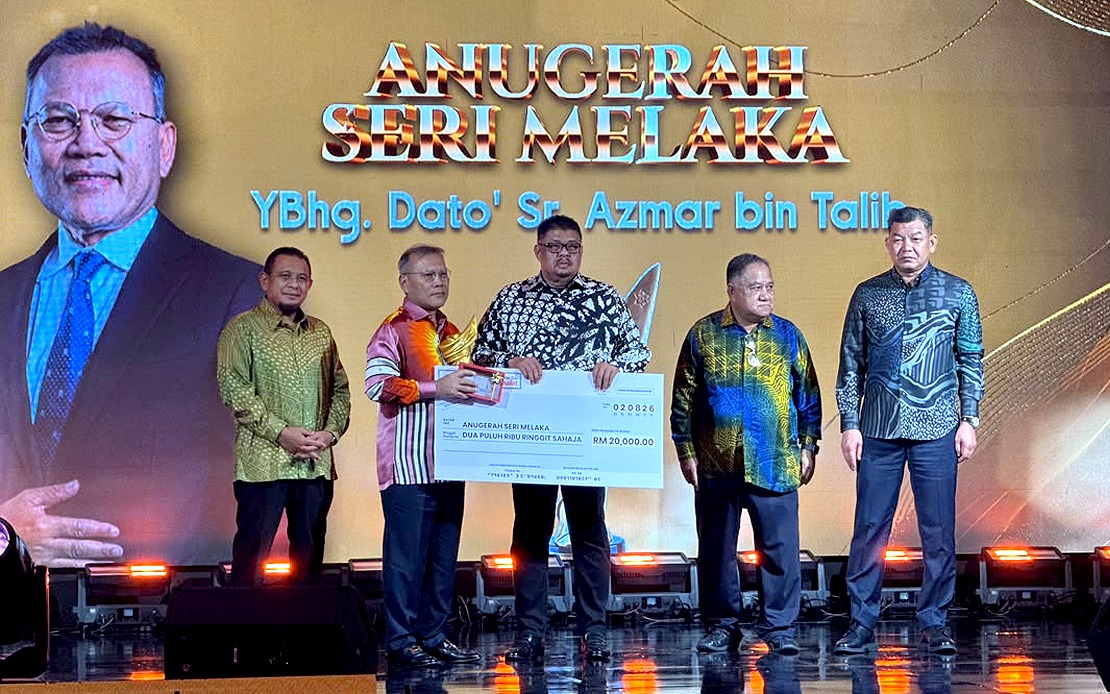
Melaka's Chief Minister Datuk Seri Ab Rauf Yusoh has appealed to the state's most accomplished individuals—spanning business, sports, arts and public service—to transition from personal success into active mentorship roles within the state administration. Speaking at the Anugerah Seri Melaka (ASM) awards ceremony on August 2 at the Melaka International Trade Centre in Ayer Keroh, Ab Rauf positioned high-achieving Melakans as essential partners in the state's developmental agenda, particularly in nurturing emerging talent.
The Chief Minister framed this partnership concept around the Melaka Sayang Rakyat (MeSRa) initiative, which seeks to transform individual accomplishments into collective state assets. Rather than allowing success stories to remain as personal achievements, the programme aims to document and publicise these narratives as inspiration for a broader population. This approach reflects a growing recognition among state governments across Malaysia that talent retention and knowledge transfer require deliberate institutional mechanisms. By elevating successful individuals into advisory or mentorship roles, Melaka is attempting to create a culture where expertise becomes a shared resource rather than remaining concentrated among a select few.
The ASM awards programme itself demonstrates the breadth of Melaka's talent across multiple sectors. The awards recognised excellence across four distinct categories: Public Service, Corporate, Sports, and Arts and Culture. The fact that the awards attracted more than 200 nominations suggests substantial depth in the state's professional ecosystem, spanning from entrepreneurs to athletes to civil servants to creative professionals. This diversity of achievement across different spheres indicates that Melaka's development strategy need not be narrowly focused but can draw on multiple sources of expertise and innovation.
Among the inaugural recipients were several figures of considerable standing. Datuk Azmar Talib, chief executive officer of TRX City Sdn Bhd, claimed the Corporate category award, recognising his role in major development initiatives. National badminton player Aaron Chia received the Sports category honour, representing Malaysia's continued excellence in this discipline. The Arts and Culture award went to performing arts director Lokman Abd Ghani, while the Public Service category recognised Datuk Zamri Misman, director-general of the Legal Affairs Division at the Prime Minister's Department. Additionally, Dr Saiful Anuar Singar, an international medical science researcher, received the Special Category award.
The financial structure of the awards underscores the state government's commitment to recognising achievement. The principal ASM award recipient received RM20,000 in cash along with a trophy, whilst winners in each of the four main categories received RM10,000 and trophies. While these sums are relatively modest by corporate standards, they serve as public validation and, more importantly, as catalysts for the kind of engagement Ab Rauf is seeking. The financial component signals that recognition is substantive rather than merely ceremonial.
Ab Rauf's vision extends beyond symbolic recognition, however. He explicitly called on recipients to deploy their accumulated experience, professional networks and technical expertise toward creating fresh opportunities for younger Melakans. This represents an understanding that state competitiveness increasingly depends on knowledge ecosystems rather than individual brilliance alone. By encouraging successful individuals to actively mentor, advise and create pathways for emerging talent, Melaka is attempting to build institutional capacity that transcends any single leader or administrator.
The emphasis on creating pathways for the younger generation carries particular relevance for Malaysian states facing demographic and economic transitions. Many young professionals migrate to Kuala Lumpur, Singapore or overseas in search of opportunity, creating a brain-drain that erodes state-level capacity. By creating mentorship structures and leveraging successful individuals' networks, Melaka is tackling this challenge at its root—making the state itself an attractive ecosystem for ambitious young people rather than simply accepting outmigration as inevitable.
The narrative that Ab Rauf presented at the ceremony emphasises a philosophy of cumulative advantage: the success of one Melakan should facilitate pathways for others, creating what he described as a source of strength for the state and future generations. This intergenerational framing acknowledges that sustainable development requires institutions that outlast individual actors. If successful professionals commit to mentoring and network-sharing, the benefits compound over time, creating durable competitive advantage.
For Malaysian policymakers more broadly, Melaka's approach offers a template worthy of consideration. Many states struggle with the mechanics of converting achievement into institutional capacity. Rather than relying solely on government bureaucrats to identify and nurture talent, the ASM model taps into the private knowledge and networks of successful individuals who understand their sectors intimately. This reduces the informational burden on government while simultaneously engaging the private sector in state development.
The success of this initiative will ultimately depend on whether award recipients translate recognition into concrete mentorship activities. Merely celebrating achievement does not automatically generate spillover benefits for younger generations. The state government will need to create structures—formal mentorship programmes, networking events, funding mechanisms—that facilitate knowledge transfer. Without such infrastructure, the ASM awards risk becoming primarily ceremonial rather than transformative.
Looking forward, Melaka's initiative reflects a broader regional trend toward leveraging diaspora networks and local talent as development assets. Southeast Asian states increasingly recognise that their most valuable resources are not always visible on balance sheets or development statistics, but rather embedded in the skills, relationships and accumulated experience of successful nationals. By institutionalising recognition and partnership with such individuals, states create feedback loops where success breeds further opportunity, potentially shifting migration dynamics and competitive positioning in an increasingly knowledge-driven regional economy.

