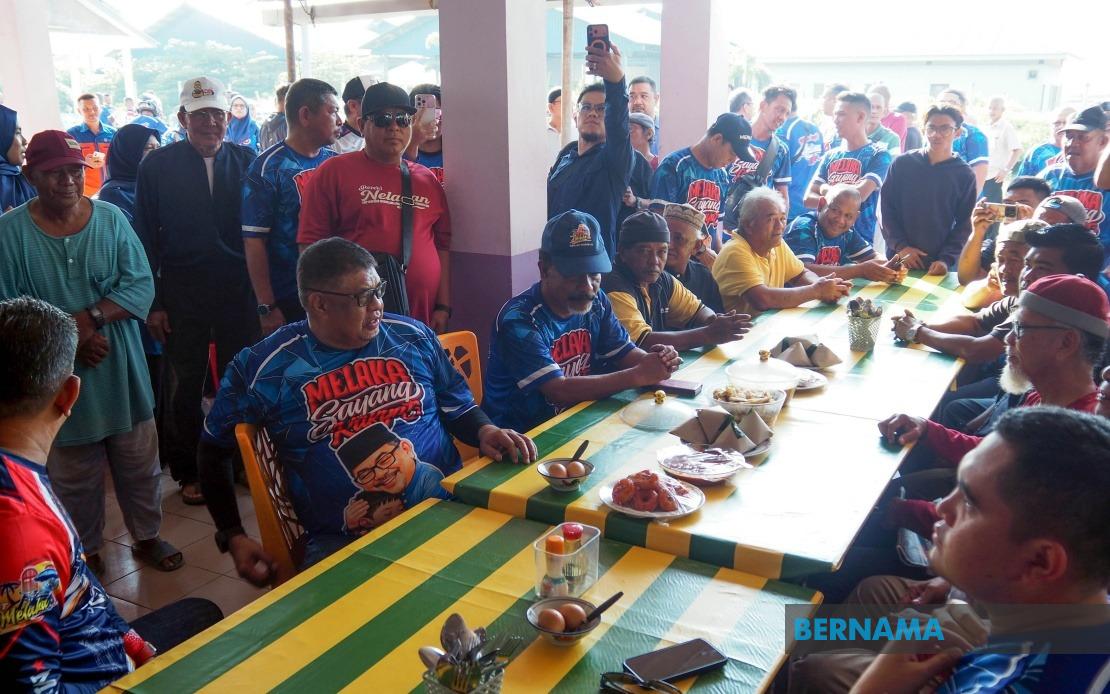
The Melaka government has rolled out a comprehensive support initiative targeting the state's fishing community, combining occupational insurance protection with modern fishing technology as part of efforts to elevate living standards among maritime workers. Chief Minister Datuk Seri Ab Rauf Yusoh unveiled the scheme during the fifth instalment of his grassroots engagement tour, "Jelajah Ketua Menteri Sayang Rakyat," held at Kuala Sempang Jetty in the Merlimau state constituency. The two-pronged approach—extending Social Security Organisation (PERKESO) coverage to all registered fishermen while equipping them with fish-finding equipment—reflects a deliberate strategy to address both workplace vulnerability and operational efficiency within a traditionally labour-intensive sector.
The Chief Minister emphasised that the initiative emerged from direct consultation with fishing communities rather than decisions made remotely from government offices. By taking the executive council members into the field, the administration sought to identify genuine hardships and craft targeted responses. This hands-on governance model has become increasingly common among Malaysian state leaders attempting to demonstrate accessibility and responsiveness to constituent concerns. For Melaka's fishing populations, many of whom operate with minimal safety nets and limited access to modern tools, such direct engagement signals governmental attention to their precarious economic position.
The immediate material support distributed during the Kuala Sempang event included cash assistance totalling RM21,400 channelled through the "Bantuan Jaring Nelayan" scheme, with 107 registered fishermen each receiving RM200. This direct cash transfer, while modest in individual terms, provides liquidity for equipment maintenance or family expenses during lean catch periods. The government simultaneously distributed 360 kilogrammes of fish valued at RM3,600 to the local public, averaging 1.5 kilogrammes per recipient—a symbolic gesture acknowledging the sector's contribution to food security whilst distributing surplus catch.
The provision of fish finders represents the more strategically significant component of the initiative. These electronic navigation devices, which typically retail between RM1,000 and RM2,000 privately, fundamentally alter fishing methodology by identifying fish concentrations rather than relying on experiential guesswork. For veteran fisherman Amirul Shah Fuad Shah, 35, who has worked Melaka's waters for two decades, the technology promises tangible productivity gains. By enabling fishermen to locate schools of fish with precision, fish finders reduce wasted fuel, nets, and labour hours spent casting in unproductive areas—efficiency gains particularly critical when operating margins remain razor-thin and fuel costs volatile.
The introduction of such technology into traditional fishing operations mirrors broader Southeast Asian trends toward modernisation within artisanal sectors. While industrial-scale fishing in the region has long utilised sophisticated sonar and GPS systems, small-scale fishermen—who dominate employment figures across Malaysia—have largely been excluded from technological advancement. Melaka's initiative, if successfully implemented across its registered fishing population, could serve as a model for other Malaysian states grappling with productivity stagnation in maritime communities. The technology transfer also carries implications for resource management; more efficient fishing may paradoxically support sustainability efforts by reducing fuel consumption and bycatch associated with blind net-casting.
The PERKESO coverage component addresses a critical vulnerability in Malaysia's fishing sector. Occupational hazards at sea—encompassing drowning, equipment injuries, and weather-related incidents—exact a substantial toll on fishing communities, yet many small-scale operators lack formal employment status that would automatically trigger social insurance coverage. By extending PERKESO benefits to all registered fishermen, Melaka removes a bureaucratic barrier to protection and acknowledges the genuine occupational risks inherent in maritime work. This coverage provides medical benefits, temporary disability allowances, and survivor benefits, addressing a gap that has historically forced fishing families into poverty following accidents or fatalities.
Kampung Sempang Fishermen's Association chairman Md Khalil Md Jadi, 67, contextualised the PERKESO extension as symbolic recognition of a community often relegated to policy peripheries. For elderly fishermen particularly—many of whom entered the profession decades ago without formal qualifications or alternative employment pathways—the security framework offers dignified protection acknowledging their lifetime contributions. The demographic profile of Malaysia's fishing communities, skewed toward older workers with limited educational mobility, means such protective measures carry disproportionate significance compared to younger or more educated populations.
The modernisation angle highlighted by Md Khalil reflects broader regional tensions between preserving traditional livelihoods and enabling technological transition. Rather than positioning fish finders as threats to traditional knowledge, the framing emphasises complementarity—technology enhancing rather than replacing experiential skill. This narrative proves particularly important in Southeast Asian contexts where maritime cultures carry deep historical and identity significance. By framing technological adoption as state-enabled progress rather than external disruption, Melaka's government avoids resistance grounded in cultural preservation concerns.
Implementation challenges remain unaddressed in the announcements. Fish finder distribution mechanisms—whether government provides devices directly or subsidises private purchases—warrant clarification. Training requirements for operators unfamiliar with electronic navigation systems present another practical consideration. PERKESO coverage extension requires administrative coordination to update registration databases and ensure contribution payment mechanisms function smoothly across a dispersed, often informal workforce. These operational details typically determine whether well-intentioned initiatives achieve lasting impact or dissipate through bureaucratic friction.
The initiative also reflects political calculations within Melaka's competitive electoral landscape. Fishing communities, concentrated geographically in coastal constituencies, constitute a meaningful voting bloc. Direct assistance announcements during grassroots tours generate goodwill and create visual narratives of government responsiveness—critical for legitimacy maintenance among populations sometimes feeling marginalised by urban-centric development priorities. The timing of announcements during constituency-specific engagement tours suggests coordination with electoral calendars, a pattern evident across Malaysian states regardless of ruling coalition composition.
For regional observers monitoring Malaysian state-level economic development, Melaka's approach to fishing sector modernisation carries broader implications. As climate change pressures traditional fishing grounds and regional competition intensifies, Southeast Asian fishing communities face structural transformation. State-led technology distribution combined with social protection represents one policy pathway—distinct from either laissez-faire approaches or heavy-handed sector restructuring. Whether such initiatives meaningfully improve fishing household incomes over medium terms remains uncertain, but the combination of immediate material support with longer-term productivity enhancement reflects at least sophisticated policy thinking about sectoral challenges.
The fishing community's receptiveness to these initiatives, expressed through association leadership endorsements, suggests genuine demand for such support measures. However, community praise during government events carries inherent constraints—public criticism risks damaging relationships with resource-controlling bureaucracies. Meaningful assessment of initiative effectiveness would require independent tracking of household income changes, fish finder adoption rates, and actual PERKESO claims processing over subsequent months. Such monitoring typically receives limited attention unless subsequent electoral cycles make performance measurement politically salient.

