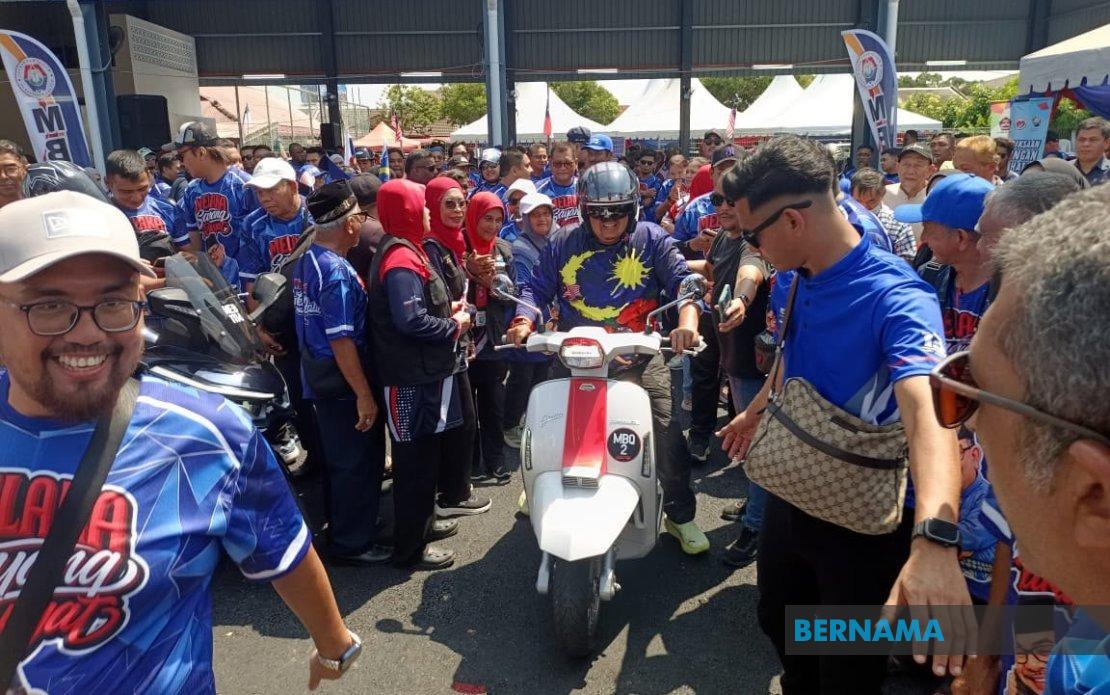
Melaka Chief Minister Datuk Seri Ab Rauf Yusoh has pushed back against perceptions that the state's high-profile constituency tours function primarily as election machinery, instead characterizing them as the latest chapter in a sustained commitment to address public grievances at the local level. Speaking after the tenth instalment of the 'Jelajah Ketua Menteri Sayang Rakyat' programme in Pengkalan Batu on August 4, Ab Rauf stressed that such engagement represents institutional policy rather than seasonal campaigning.
The initiative traces its roots to the 'Wakil Rakyat Untuk Rakyat' (WRUR) framework launched two years prior, well before the current political cycle gathered momentum. This timeline matters strategically in a Malaysian context where opposition figures frequently accuse ruling coalitions of manufacturing grassroots visibility during pre-election periods. By anchoring the current tour to earlier programming, the Melaka administration seeks to demonstrate that constituent outreach forms part of permanent governance architecture, not ad-hoc voter engagement.
According to Ab Rauf, the structured approach enables state officials to triage complaints more efficiently, preventing minor grievances from festering within bureaucratic channels. The Chief Minister highlighted that issues identified through WRUR and its companion programme 'Hari Exco Bersama Rakyat' (HEBAT) receive prioritized attention during these tours, creating a feedback loop where citizen concerns identified in one phase receive concrete follow-up in subsequent phases. This contrasts with more traditional town-hall models where public forums generate commitments without systematic tracking.
In Pengkalan Batu specifically, eight previously unresolved matters received closure, demonstrating the programme's utility in clearing backlogs. Among the notable achievements was facilitation of land acquisition for a Muslim cemetery, complicated by the property's Chinese ownership. The transaction proceeded at a fifty per cent discount from market valuation, a gesture the Chief Minister noted carried symbolic weight beyond mere commercial value. Such cross-community transactions remain politically sensitive in Malaysia, where property disputes occasionally invoke religious or ethnic dimensions, making successful resolution a minor diplomatic achievement.
Infrastructural improvements complemented the intangible gains. Five dwellings identified as structurally unsound received repair funding through state channels, while a separate residence valued at RM100,000 transferred to a beneficiary family under the 'Baiti Jannati' initiative, implemented in partnership with national utility Tenaga Nasional Berhad (TNB). Additionally, the Melaka Historic City Council (MBMB) completed an open-air community hall within the constituency, providing amenities previously unavailable to residents. These material outcomes give the touring programme tangible deliverables beyond rhetoric.
The Chief Minister's emphasis on direct official engagement reflects broader governance philosophy across Southeast Asian administrations, where centralized decision-making increasingly incorporates feedback mechanisms designed to bypass intermediary structures. In Malaysia's federal system, where state governments retain substantial autonomy over local development, such tours allow chief ministers to demonstrate responsiveness without awaiting approval from federal counterparts. This proves especially valuable for Melaka, a state of modest economic scale where gubernatorial visibility carries outsized political returns.
The WRUR initiative itself has now completed twenty-five iterations statewide, with only five of Melaka's state constituencies remaining uncovered under the systematic visitation schedule. This near-comprehensive coverage across electoral boundaries suggests genuine institutional commitment rather than targeted focus on politically marginal areas where governing coalitions might expect competitive contests. Comprehensive rather than selective coverage also reduces opposition claims that the administration selectively ignores certain constituencies.
Ab Rauf's framing also addresses a latent tension within Malaysian politics: the expectation that elected representatives remain continuously accessible while also managing routine governance. The touring model allocates dedicated time for constituent interaction within official calendars, preventing officials from claiming they lack capacity for grievance resolution. This matters in a political culture where perceived aloofness from ordinary citizens represents a vulnerability exploited readily by rival parties.
The presence of other officials at the Pengkalan Batu event—including Science, Technology, Innovation and Digital Communications Committee chairman Datuk Fairul Nizam Roslan and Pengkalan Batu assemblyman Datuk Kalsom Noordin—reflects the multi-tier approach to issue resolution. Rather than positioning the Chief Minister as sole arbiter, the administration distributes responsibility across relevant state-level functionaries and district-level elected representatives. This distribution also reduces pressure on the chief ministerial office while signalling to constituencies that their elected representatives retain meaningful authority over local concerns.
For Malaysian readers, the Melaka model offers a template for understanding how state governments operationalize constituent responsiveness amid competing demands. Unlike federal systems where central authority maintains distance from local grievances, state-level chief ministers can position themselves as accessible problem-solvers willing to intervene directly in individual cases. This proximity generates political capital that national-level politicians find difficult to replicate.
Looking forward, the initiative's near-completion across all constituencies positions the administration to claim systematic coverage while creating templates for future cycles. The explicit denial that these tours represent campaign activities—made with the emphasis that the original initiative predates any electoral considerations—suggests awareness that Malaysian voters increasingly skepticize official visits that coincide suspiciously with electoral calendars. By establishing institutional precedent, Ab Rauf creates conditions under which future tours face less suspicion regarding motivations.
The programme ultimately reflects how contemporary Southeast Asian governance incorporates localized grievance mechanisms within centralized authority structures. Rather than entirely displacing bureaucratic channels, the touring approach supplements existing complaint procedures with higher-level official access. For constituencies like Pengkalan Batu, such access translates into resolved disputes and completed infrastructure that might otherwise languish within standard administrative queues. Whether this model proves sustainable as electoral pressures intensify remains an open question for Malaysian political observers.

