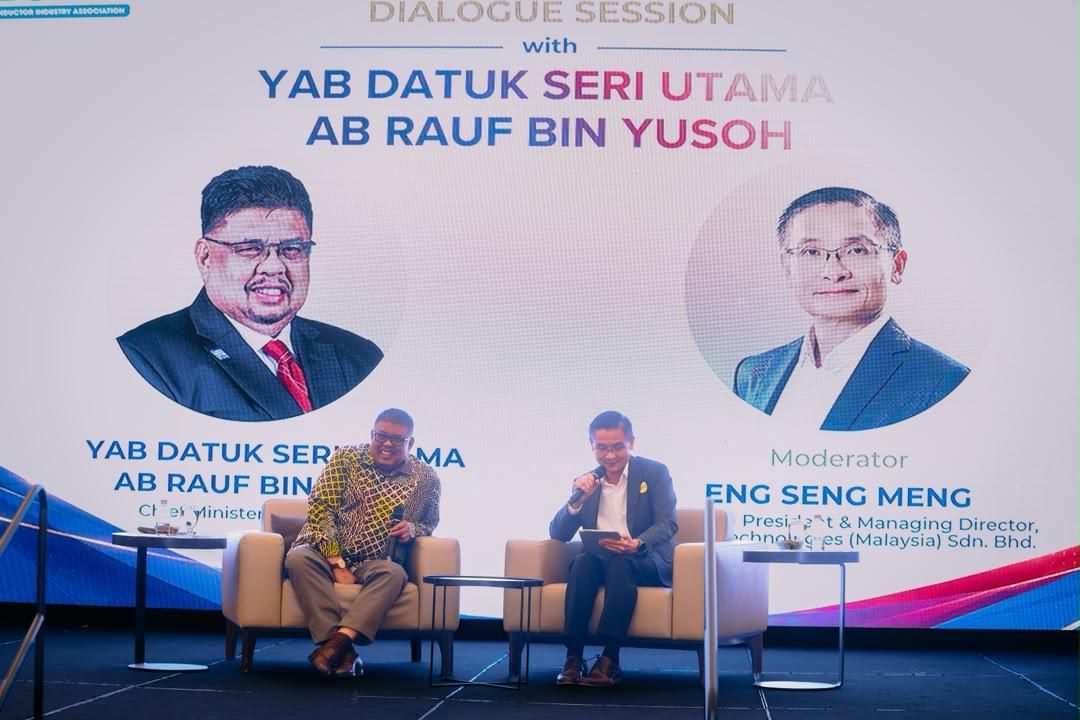
Melaka has transformed itself into a semiconductor manufacturing powerhouse with an industry valued at RM17.6 billion, according to Chief Minister Datuk Seri Ab Rauf Yusoh, who outlined how the state has evolved from a modest operation in the 1970s to a global technology hub. Speaking during a dialogue with semiconductor industry leaders at a Melaka hotel on July 16, Ab Rauf traced the sector's remarkable journey, noting that what began as a handful of workers has crystallized into a world-class manufacturing ecosystem driving substantial economic value and employment across the state.
The semiconductor industry took root in Melaka during the early 1970s when an international company made the pivotal decision to establish operations in the state. The venture initially operated from an unconventional location — the Umno building on Jalan Hang Tuah — before relocating to Batu Berendam following the creation of Melaka's first Free Industrial Zone in 1976. This establishment of dedicated industrial infrastructure proved instrumental in catalyzing subsequent investment waves, as multinational corporations recognized the state's potential for electronics manufacturing and began consolidating their regional operations within its borders.
Today, manufacturing accounts for 36.1 percent of Melaka's economic output, with over 400 manufacturing companies spanning 18 industrial sectors. The semiconductor and electrical and electronics (E&E) segment represents the crown jewel of this diversified manufacturing base, drawing on more than five decades of accumulated expertise and operational know-how. Beyond the direct employment provided by major manufacturers, the industry has generated a sprawling ecosystem of local suppliers, small and medium enterprises, and ancillary service providers whose prosperity remains intertwined with the health of the broader semiconductor sector.
Ab Rauf attributed Melaka's sustained competitive advantage to three interconnected strengths that continue attracting global investors. First, the state's geographic positioning between Kuala Lumpur, Johor, and Singapore provides unparalleled accessibility to major consumer markets, while its proximity to key port facilities and international airports facilitates efficient supply chain management. Operating costs remain substantially lower than in comparable Asian manufacturing hubs, while the state maintains 2,600 hectares of available industrial land that offers companies flexibility for expansion as market demand fluctuates and technology requirements evolve.
The availability of skilled labor constitutes the second pillar supporting Melaka's appeal. The state has positioned itself as a Technical and Vocational Education and Training hub, operating 61 institutions that produce industry-ready graduates through curricula increasingly calibrated to semiconductor manufacturers' evolving requirements. This systematic approach to talent development ensures companies can access workers possessing the technical competencies necessary for advanced manufacturing operations, reducing the lag time between recruitment and productive contribution to operations.
Melaka's third competitive strength rests upon demonstrated track record in retaining multinational investors from diverse geographic origins. Companies headquartered in the United States, Germany, China, Japan, and other industrial economies have sustained and expanded their Melaka operations continuously for over fifty years, a pattern reflecting the stability and business-friendly environment the state government has cultivated. The confidence reposed by these corporations in Melaka's long-term viability underscores the state's credibility as a destination for capital-intensive, technology-sensitive manufacturing investment.
The magnitude of recent investment inflows underscore this investor confidence. Melaka recorded RM14.68 billion in investments across 312 projects during 2025, representing the highest investment value the state has achieved in 22 years. This figure signals renewed momentum in capital allocation toward Melaka's manufacturing sector, despite competitive pressures from other potential locations across Southeast Asia and the broader Asian region. The concentration of such investment within a single year suggests that companies are accelerating their facility expansions and capacity additions in anticipation of sustained semiconductor demand growth.
However, Ab Rauf cautioned that Melaka faces a critical juncture, as investment decisions made in the current period will fundamentally shape global technology supply chains for the next two decades. The semiconductor industry exhibits distinctive characteristics wherein location decisions prove extraordinarily difficult to reverse, as manufacturers invest heavily in facility construction, workforce training, and local supply chain development. Companies evaluating new sites or expansion opportunities will prioritize jurisdictions demonstrating not merely competitive costs but also faster regulatory approval processes, superior technological capabilities, and heightened certainty regarding long-term operational stability.
The Chief Minister warned that complacency poses an existential threat to Melaka's position. Should the state fail to maintain competitive advantage through continuous improvement and rapid responsiveness to investor requirements, global companies may reallocate anticipated expansion projects to alternative locations offering superior speed-to-market, enhanced technical infrastructure, or stronger governmental commitment. Beyond the direct loss of new manufacturing facilities, such reorientation would jeopardize supporting industries, professional services, and thousands of high-skilled employment opportunities that have developed around Melaka's semiconductor base. Local small and medium enterprises integrated into semiconductor supply chains would face particular vulnerability, potentially losing access to multinational procurement networks developed over decades.
To address these challenges and capitalize on emerging opportunities, Melaka has developed the Semiconductor Strategy 2035, a comprehensive roadmap designed to secure additional high-value investments while strengthening indigenous technological capabilities. The strategy reflects recognition that Melaka must evolve beyond its historical role as a low-cost assembly location toward higher-value semiconductor fabrication, design services, and advanced manufacturing processes. This upgrading of industrial capabilities requires sustained investment in research and development facilities, acquisition of cutting-edge manufacturing equipment, and systematic development of design engineering expertise.
Beyond strategic planning documents and infrastructure provision, Ab Rauf emphasized the state government's commitment to operational partnership with investors. Officials pledge to expedite permit approvals, resolve operational impediments, and provide sustained support spanning the entire project lifecycle from initial conception through implementation and ongoing operations. This commitment to responsive governance reflects understanding that multinational manufacturers increasingly base location decisions not solely upon static factors such as labor costs or land availability, but equally upon the quality of government-business relationships and the efficiency of administrative processes.
Ab Rauf synthesized these elements into a comprehensive value proposition that Melaka extends to prospective semiconductor manufacturers. The package encompasses strategic connectivity enabling efficient access to regional markets, competitive operational costs that enhance profitability, workforce quality reflecting decades of skill development investment, an established industrial ecosystem providing specialized suppliers and supporting services, and government commitment to facilitating long-term investment through responsive administration. Collectively, these attributes position Melaka as a defensible location for semiconductor manufacturing in an increasingly competitive regional landscape where companies enjoy expanded choice regarding facility locations and can readily shift investment to jurisdictions offering superior combinations of cost, capability, and operational ease.

