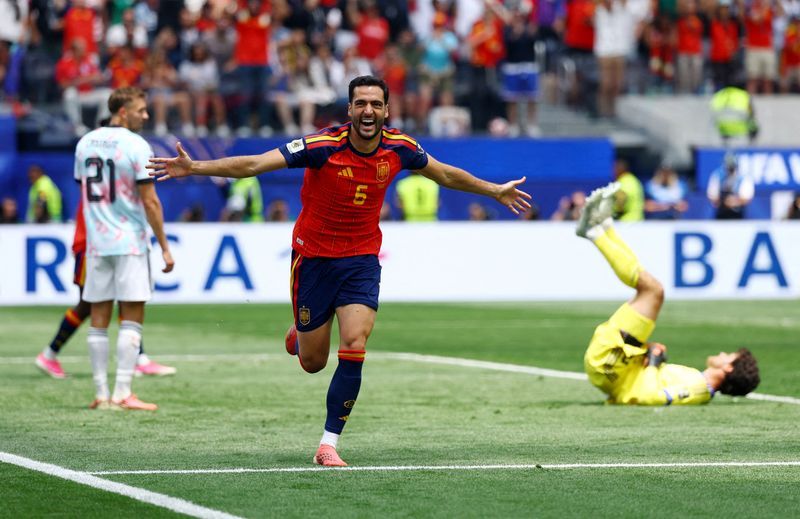
Spain advanced to the World Cup semifinals with a hard-fought 2-1 victory over Belgium in a quarterfinal clash at Los Angeles Stadium on Friday, with substitute Mikel Merino delivering the decisive blow in the 88th minute. The winning goal came after Pau Cubarsi's low drive forced Belgium's backup goalkeeper Senne Lammens to spill the ball, presenting Merino with an easy finish in front of a largely pro-Spain crowd sweltering in oppressive heat at the California venue. The result sets up a fascinating semifinal matchup between Spain and tournament favorites France in Dallas on Tuesday, where a spot in the final awaits the victor.
Spain's path to the semifinals marks only the second time the European champions have reached this stage at the World Cup, the previous occasion being their triumphant 2010 campaign when they claimed the tournament title. Their only other appearance in the latter stages came in 1950, when the competition featured a group-stage format for the final round rather than knockout matches. This resurrection into the upper echelon of World Cup contenders reflects the tactical evolution and player development under coach Luis de la Fuente, whose strategic decisions proved crucial in this quarterfinal encounter.
The first half unfolded as an even contest between two teams intent on dictating play through possession and positional pressure. Spain seized the initiative through Fabian Ruiz in the 30th minute, with the Paris Saint-Germain midfielder capitalizing on a fortunate rebound after Belgium goalkeeper Thibaut Courtois made a diving save. Ruiz's finish, which threaded between defender Timothy Castagne's legs, validated de la Fuente's bold selection to start the midfielder ahead of Pedri, a decision that raised eyebrows in the lead-up to the fixture. The Barcelona playmaker subsequently entered the match early in the second period as Spain's tactical template shifted.
Belgium responded with impressive character just eleven minutes later through Charles De Ketelaere, whose perfectly-timed run allowed him to direct Castagne's cross past Spain goalkeeper Unai Simon. This goal represented a significant milestone for the Spanish defense, which had remained impenetrable throughout the tournament until this moment. The equalizer reinvigorated Belgium's challenge and brought competitive equilibrium to the encounter as both sides pressed for advantage through the remainder of the first half in stifling atmospheric conditions that tested the fitness and concentration of every player on the field.
The Red Devils carried substantial injury burdens into this quarterfinal, constraints that progressively hampered their ability to maintain intensity as the match progressed. Belgium captain Youri Tielemans was withdrawn from the starting lineup mere moments before kickoff after suffering a warm-up injury, with Hans Vanaken drafted in as a replacement. More significantly, the absence of midfielder Amadou Onana, who sustained an anterior cruciate ligament tear during the team's round-of-sixteen victory over the United States, deprived Belgium of crucial midfield stability and ball-winning capability. These personnel losses accumulated as the match wore on, with Spain gradually assuming dominance in the second period.
Spain emerged from the halftime interval with renewed purpose and systematic approach to dismantling Belgium's increasingly fragile defensive structure. The Spanish team's superiority in possession and territorial control became increasingly pronounced as the second half unfolded, with Belgium forced into a reactive posture that prevented them from mounting meaningful attacking threats. Belgium's backup goalkeeper Lammens, thrust into action to replace the injured Courtois, made a critical error in judgment when confronted with Cubarsi's low strike, failing to secure the ball cleanly and instead allowing it to bounce loose in the six-yard box.
Merino, introduced from the bench after 86 minutes of play, punished Belgium's momentary lapse with clinical finishing that sent the assembled Spanish supporters into jubilation. The substitute's intervention exemplified Spain's tactical flexibility and the quality embedded within their squad depth. His goal not only secured three crucial points but delivered psychological momentum heading into the semifinal confrontation with France, a team that enters the competition as the preferred choice among bookmakers and analysts. The victory underscores Spain's capacity to navigate high-pressure knockout competition through intelligent play and decisive finishing when opportunities materialize.
The quarterfinal drew significant international attention, evidenced by the presence of celebrity figures among the sold-out crowd. Musicians Courtney Love and Noel Gallagher, American actor Brad Pitt, and Spanish actors Penélope Cruz and Javier Bardem witnessed the encounter, reflecting the cultural prominence of World Cup football across continents and demographics. Such attendance patterns demonstrate the tournament's status as a global entertainment phenomenon that transcends traditional sports audiences and captures the imagination of popular culture.
Spain's advancement carries important implications for Southeast Asian football enthusiasts and analysts observing how European football powers approach World Cup competition. The Spanish approach emphasizes positional superiority, patient build-up play, and exploitation of momentary defensive vulnerabilities rather than reliance on dramatic individual moments. This philosophy has proven sufficiently durable to withstand challenges from experienced opponents managing injury challenges and tactical adversity. The upcoming semifinal against France will provide further insight into whether Spain's measured, technically-proficient approach can overcome the speed and unpredictability that characterize contemporary World Cup football at its highest level.

