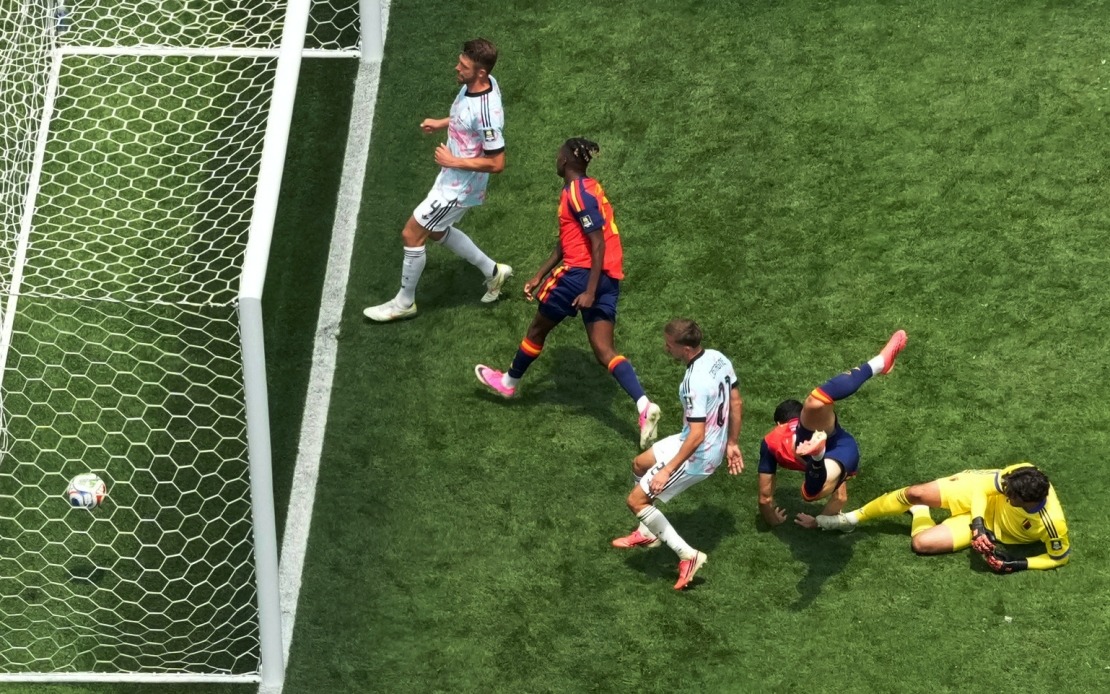
Spain's campaign to reclaim World Cup glory reached a crucial milestone on Friday when substitute midfielder Mikel Merino sealed a 2-1 quarter-final victory over Belgium at Los Angeles Stadium in California. The decisive strike sent La Roja into the semi-finals for the first time since their triumphant 2010 campaign, marking a 16-year absence from football's championship stage. Merino's impact off the bench once again proved decisive, having already delivered the winning goal in Spain's round-of-16 encounter against Portugal, establishing himself as a key tactical weapon for head coach Luis de la Fuente in critical moments.
Spain entered the contest as the dominant force, establishing their intent from the opening stages with sustained possession and purposeful attacking play. The Spanish midfield controlled the tempo throughout the first half, creating numerous opportunities that reflected their superior technical quality and cohesive movement. Young sensation Lamine Yamal, just 18 years old and already emerging as one of the tournament's breakthrough performers, nearly gave his side an early lead in the 21st minute when his curled effort narrowly missed the left post, a warning shot that signalled Spain's attacking ambitions.
The deadlock was broken moments into the second quarter when midfielder Fabian Ruiz capitalised on a defensive lapse to open the scoring. Belgian goalkeeper Thibaut Courtois, the 34-year-old veteran, had made an outstanding save to thwart Dani Olmo's initial attempt, but he could not prevent Ruiz's opportunistic finish as the midfielder pounced on the loose ball. The goal appeared to have settled the contest in Spain's favour, and Courtois was required to make another crucial intervention minutes later, diving acrobatically to his right to deny Yamal's dangerous free-kick that had been destined for the bottom corner.
Belgium's defensive vulnerabilities were exposed in the 41st minute when full-back Timothy Castagne delivered a precisely weighted cross from the right flank that found forward Charles De Ketelaere completely unmarked in the penalty area. The Belgian attacker's powerful downward header gave goalkeeper Unai Simon no opportunity to react, restoring parity and demonstrating that despite Spain's superiority, the European side remained fragile at the back. The goal represented Belgium's first concession of the tournament, suggesting that Rudi Garcia's defensive setup, which had proven effective until this point, contained tactical weaknesses when exposed to sustained Spanish pressure.
The second half unfolded as a battle of defensive organisation against attacking persistence. Belgium emerged with renewed vigour and came agonisingly close to taking the lead approximately ten minutes into the resumed action, with full-back Maxim De Cuyper's effort striking the side netting. Courtois continued his masterclass of goalkeeping, producing back-to-back saves within rapid succession to first deny Yamal and subsequently Mikel Oyarzabal, preserving Belgium's slender hopes. His commanding display appeared to have weathered Spain's most determined assault until a moment of misfortune altered the trajectory of the contest entirely.
Courtois's withdrawal through injury in the 71st minute brought Manchester United goalkeeper Senne Lammens into the fray, and the substitution proved immediately consequential. In the 88th minute, centre-back Pau Cubarsi unleashed a long-range effort that Lammens fumbled, the ball slipping through his hands and presenting the quickest-thinking player on the pitch with an unmissable opportunity. Merino, having positioned himself perfectly, reacted with the instinctive sharpness that defines elite finishers, stabbing the ball home with clinical precision to secure Spain's passage into the semi-finals. The goal encapsulated the fine margins that decide knockout tournaments, where individual mistakes at crucial junctures can determine the trajectory of entire campaigns.
Spain's progression sets up a compelling semi-final showdown against France in Dallas Stadium on July 15. The French side, two-time champions and one of the tournament's most accomplished teams, secured their own semi-final berth by dispatching Morocco 2-0 on Thursday, establishing themselves as formidable opposition. The encounter promises to be a strategic chess match between two nations renowned for their technical sophistication and tactical intelligence, with significant implications for the tournament's ultimate outcome.
The FIFA World Cup 2026 represents a watershed moment for international football, expanding the competitive field from the traditional 32-team format to an unprecedented 48-nation competition. This expansion reflects both the growing globalisation of football and the desire to increase representation across continents, though it fundamentally alters the dynamics of tournament structure and qualification pathways. The enlarged format has been anticipated as potentially democratising the competition, offering smaller footballing nations genuine opportunities for meaningful participation and progression.
The tournament, jointly hosted by Canada, Mexico, and the United States, continues until July 19, with the semi-finals and final representing the culmination of weeks of intense competition. Spain's progression demonstrates that despite the competitive depth across multiple nations, pedigree and experience remain significant advantages in knockout football. For Malaysian and Southeast Asian observers, Spain's advancement offers lessons in how established footballing traditions, coupled with evolving tactical approaches and individual quality, can sustain competitiveness across international competitions.

