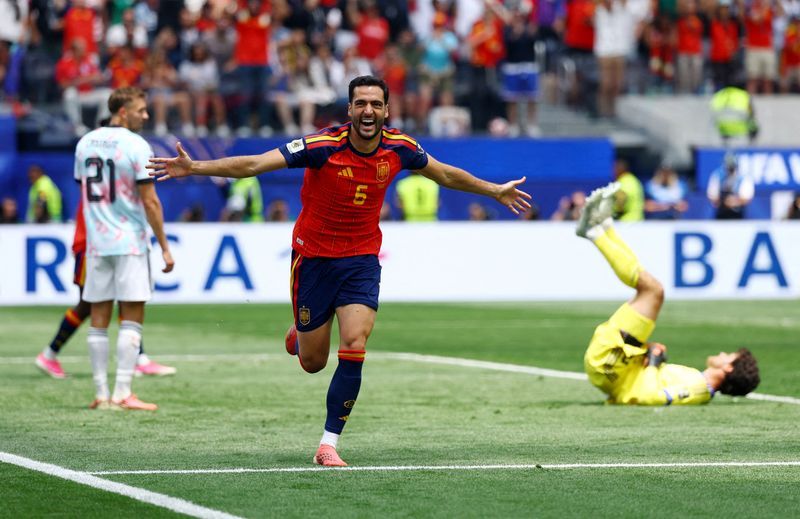
Spain secured their passage to the World Cup semi-finals on Friday with a pulsating 2-1 triumph over Belgium at Los Angeles Stadium, with substitute Mikel Merino delivering the decisive blow late in the match. The result represents a significant milestone for the European champions, who will now pursue their first World Cup title since 2010 when they next face tournament favourites France in Dallas on Tuesday. The victory came at considerable cost to the Belgian outfit, who laboured under the burden of multiple injury absences that fundamentally weakened their competitive capacity.
The match unfolded in dramatically different phases, with Spain establishing early dominance through a ruthless attacking display. Fabian Ruiz opened the scoring in the 30th minute, capitalising on a loose moment following an excellent diving save by Thibaut Courtois. The Paris Saint-Germain midfielder's finish was clinical, threading the ball between Timothy Castagne's legs to give Spain the advantage. This goal vindicated Spanish coach Luis de la Fuente's tactical selection to start Ruiz ahead of Pedri, a decision that raised eyebrows among observers but ultimately proved prescient.
Belgium's response was swift and well-executed, drawing level through Charles De Ketelaere's perfectly-timed header from Castagne's cross just 11 minutes later. The goal marked the first time Spain had conceded in the tournament, suggesting that Belgium possessed sufficient attacking quality to trouble even the most resolute defences. The equaliser injected new energy into the match, and the two sides entered halftime locked at 1-1 in the oppressive heat of southern California, with momentum appearing genuinely balanced.
The second half witnessed a marked shift in territorial control, as Spain emerged with renewed intensity and purpose. The Spanish midfield increasingly dominated possession, while the teenage sensation Lamine Yamal proved a constant menace on the flank, his youthful explosiveness creating problems that Belgium's ageing defensive infrastructure struggled to contain. De la Fuente's tactical adjustments, including the introduction of fresh attacking impetus, began to bear fruit as Spain gradually suffocated their opponents' capacity to generate counter-attacking opportunities.
Merino's decisive intervention came in the 88th minute, just two minutes after his introduction as a substitute. Belgian backup goalkeeper Senne Lammens, thrust into an unfamiliar and high-pressure scenario following Courtois's earlier departure through injury, failed to secure a low strike from Pau Cubarsi cleanly. The ball squirted from the keeper's grasp, allowing Merino to pounce and fire past the helpless Lammens. The moment epitomised the often marginal differences that separate tournament progression from elimination at football's highest level, and the sold-out crowd predominantly supporting Spain unleashed a roar of celebration at the crucial breakthrough.
Merino's achievement carries particular historical significance, as he became the first player ever to score match-winning goals in two different World Cup knockout fixtures while operating as a substitute. His previous such contribution came in Spain's round-of-16 dispatch of Portugal, suggesting a pattern of crucial interventions when matches demand decisive action. The midfielder himself acknowledged this pattern with considerable maturity, dismissing the notion of coincidence and attributing his success to thorough preparation and tactical readiness. His observation that "things tend to happen again" when entering matches well-prepared encapsulates the mentality required at elite tournament level.
Belgium's defeat represented a disappointing conclusion to a campaign undermined by personnel challenges from the outset. Captain Youri Tielemans suffered a warm-up injury immediately before kickoff, necessitating his replacement by Hans Vanaken. More significantly, midfielder Amadou Onana remained absent following a serious anterior cruciate ligament tear sustained during their round-of-16 victory over the United States. These absences fundamentally compromised Belgium's midfield resilience, a critical vulnerability when confronting the Spanish possession game. Veterans Kevin De Bruyne and Romelu Lukaku laboured in their search for alternative approaches, their undoubted quality unable to compensate entirely for the structural deficiencies imposed by Belgium's injury list.
Spain's progression signals their emergence as genuine World Cup contenders, a status that assumes heightened significance given their absence from the semi-finals since 2010. That previous appearance culminated in global triumph, establishing a benchmark of excellence that the current generation seemingly possesses the talent and tactical coherence to approach. The confrontation with France in Dallas assumes the character of a contest between two continental powerhouses, each possessing considerable tournament pedigree and contemporary quality. De la Fuente's confidence in matching France's competitive threat appeared appropriately calibrated, his assertion that the favourites will experience equivalent trepidation reflecting the genuine competitive balance between the two sides.
For Malaysian and Southeast Asian observers, Spain's trajectory demonstrates the value of sustained investment in youth development alongside experienced leadership. The emergence of Yamal as a transformative 18-year-old force mirrors patterns in Asian football where young talent increasingly impacts senior competitions. Spain's methodical possession-based approach also highlights tactical systems that reward technical excellence and midfield control, offering strategic lessons for regional federations pursuing long-term competitive advancement. The contrast between Spain's controlled progression and Belgium's injury-undermined struggle illustrates additionally how squad depth and robust injury management protocols fundamentally influence tournament outcomes, considerations particularly relevant for regional confederations developing high-performance infrastructure.

