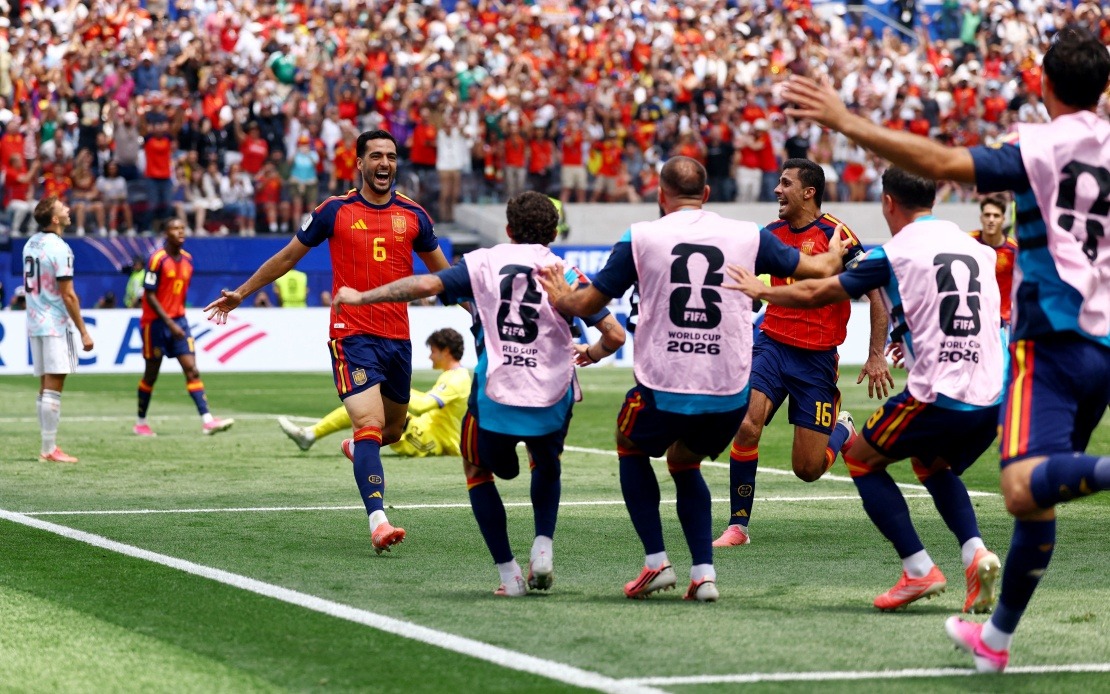
Spain has booked its place in the World Cup semi-finals after a hard-fought 2-1 triumph over Belgium in Los Angeles County on Friday, setting up a tantalising encounter with France near Dallas on Tuesday. The victory maintains the momentum of the European champions, who will now face the tournament's other heavyweight contenders in a rematch of their Euro 2024 semi-final triumph. Merino's decisive contribution—his second crucial substitute appearance in consecutive knockout rounds—proved decisive once more as Spain showed their resilience and tactical flexibility in navigating the competition.
The Spanish side had taken the lead through Fabián Ruiz's composed finish in the 30th minute, establishing early control that suggested a straightforward path to victory. However, Belgium demonstrated their own quality when Charles De Ketelaere struck to level proceedings, a significant moment that ended Spain's goalkeeper Unai Simón's remarkable record of not conceding for 649 consecutive World Cup minutes spanning two tournament campaigns. The Belgian equaliser represented a watershed moment in the match, transforming what appeared to be a one-sided affair into a genuine contest requiring Spain's attacking reinforcements.
Spain's ability to import fresh energy through their substitutes became the decisive factor in overcoming Belgian resistance. The introduction of Nico Williams alongside Merino shifted the momentum decisively in the closing stages, with the Arsenal midfielder capitalising on a critical error from Belgium's backup goalkeeper. Senne Lammens, thrust into an unexpected situation after Manchester United's Thibaut Courtois suffered an injury on 71 minutes, spilled a long-range effort from Pau Cubarsi before Merino finished clinically into the roof of the net. The goal exemplified Spain's clinical finishing when opportunities presented themselves, a characteristic that has defined their tournament performance thus far.
Belgium's pursuit of the semi-finals proved undermined by a combination of misfortune and tactical setbacks before kick-off. Captain Youri Tielemans was forced to withdraw during the warm-up with an apparent hamstring concern, depriving the side of one of their most influential midfield operators. This absence compounded the existing loss of Amadou Onana, whose knee ligament damage ruled him out of earlier rounds. These personnel gaps created vulnerabilities that Spain's attacking players systematically exploited, particularly after the game opened up in the latter stages. The injuries effectively neutralised Belgium's capacity to dominate the midfield battle, leaving them vulnerable to Spain's patient buildup play and penetrative passing movements.
The emergence of Courtois as another casualty during the match further compromised Belgium's structural stability. The loss of the experienced custodian forced manager's to introduce Lammens, a goalkeeper far less accustomed to World Cup pressure and decision-making at this rarefied level. While Lammens demonstrated courage in attempting to maintain Belgium's defensive shape, the decisive error on 88 minutes illustrated the fine margins between progressing and elimination at this stage of the tournament. Spain capitalised with the ruthlessness expected of genuine champions, converting the opportunity without mercy.
France enters the semi-final as formidable opponents, having reached the final four despite being considered among the tournament favourites. The 1998 and 2018 World Cup winners, who finished as runners-up to Argentina four years ago, will approach the matchup with realistic respect for Spain's quality and contemporary form. However, the French squad possesses sufficient star power and tournament experience to believe they can topple the European champions in what promises to be an absorbing contest. Both sides have demonstrated the ability to navigate difficult moments—Spain through tactical adjustment and substitute brilliance, France through sheer quality and resilience when under pressure.
The semi-final rematch of Euro 2024 carries additional significance given Spain's comprehensive victory in that earlier encounter. Unai Simón's record-breaking goalkeeping display, now extending further, remains a cornerstone of Spain's tournament progress. His ability to maintain focus and distribute the ball with precision has provided the foundation upon which Spain's attacking players build their combinations. The defensive stability provided by this performance, despite conceding one goal, suggests Spain remains capable of frustrating even France's most creative attacking movements.
For Malaysia and Southeast Asian followers of international football, Spain's progression represents the continued dominance of European football at the World Cup stage. The region has produced talented players operating at the highest levels of European leagues, yet the continental representation at this tournament underscores the depth of talent available to established footballing nations. Spain's pathway through the knockout stages, built on technical excellence and tactical intelligence, offers instructive lessons in how consistency and structural discipline can overcome occasional individual moments of vulnerability or misfortune.
The semi-final between Spain and France will determine which team advances toward a potential showdown in the final, with each side harbouring legitimate aspirations of capturing the sport's greatest prize. Spain will seek to build on Merino's decisive contribution and the platform provided by their earlier stages progression, while France will deploy their accumulated experience and attacking prowess to prevent another Spanish advance. The encounter promises genuine drama and high-level football, befitting the stage and the quality of both protagonists involved.

