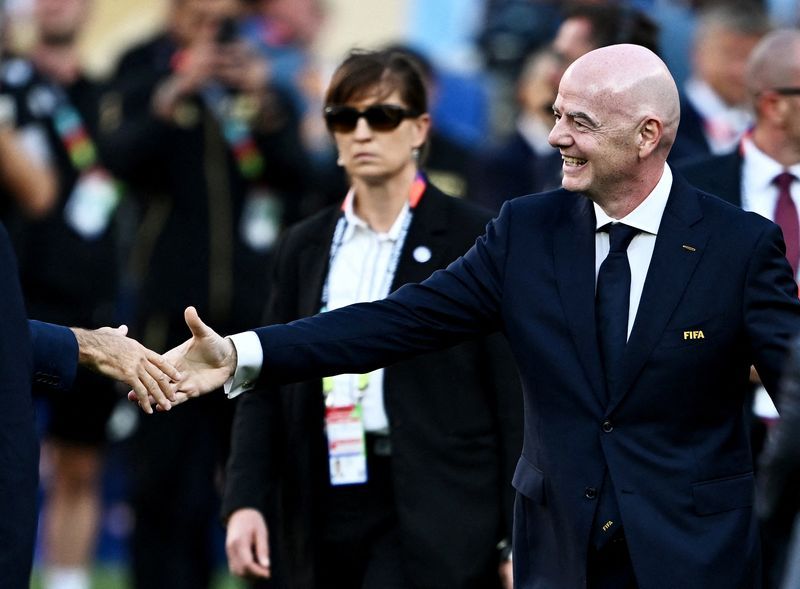
FIFA President Gianni Infantino's grip on power remains contested as the world football governing body navigates a deepening institutional crisis, with major football nations now openly split on whether he should continue leading the organization. The Mexican Football Federation and Argentina's football association have declared their backing for Infantino, providing crucial support as he faces a firestorm of criticism stemming from his abandoned scheme to monetize portions of World Cup commercial rights. Their interventions underscore the profound geographic and ideological fault lines now fracturing FIFA's membership base ahead of critical elections scheduled for Morocco in March.
The Mexican Football Federation's decision to support Infantino represents a notable fracture within North American football governance, positioning itself at odds with its own continental confederation CONCACAF, which recently demanded a thorough reassessment of the FIFA presidency. Mexico's move carries particular weight given its role as co-host of the World Cup tournament that concluded recently, suggesting that Infantino retains meaningful backing among major footballing nations despite the escalating international controversy. In a carefully worded statement, the Mexican federation rejected any institutional challenge to Infantino that circumvented the established voting procedures governing all 211 FIFA member associations, effectively drawing a line around constitutional propriety even as disagreeing with specific policy decisions.
Argentina's endorsement, delivered through its national football association in a formal letter, proved equally significant given the nation's status as the reigning World Cup champion. The Argentine football association acknowledged that Infantino's World Cup rights proposal had generated considerable uncertainty and represented genuine administrative mistakes, yet maintained that such lapses should not necessitate his removal from office. Rather than advocating for his departure, Argentina's leadership counselled continued collaboration under FIFA's institutional framework, arguing that transparent governance improvements introduced over the previous decade remained adequate to correct course. This moderate positioning from Buenos Aires contrasted sharply with the more forceful criticism emanating from other regions.
The continental split has become impossible to ignore. Africa's confederation unanimously reaffirmed support for Infantino's leadership, while Europe's football governing body UEFA hardened its stance by threatening a boycott of FIFA competitions. Asia's confederation aligned itself explicitly with UEFA and CONCACAF in expressing solidarity with those demanding greater accountability. South America's CONMEBOL, meanwhile, articulated concerns about unilateral decision-making at FIFA while simultaneously insisting that any presidential challenge must proceed through democratic voting procedures involving the full membership. This fragmentation reflects deeper anxieties about FIFA's operational culture and Infantino's leadership style.
The controversy originated from Infantino's proposal to sell commercial broadcasting and sponsorship rights covering multiple future World Cup editions. The scheme triggered immediate backlash from multiple confederations and international observers who viewed it as an overreach of presidential authority and a fundamental betrayal of collective governance principles. Following meetings in Rabat this week, FIFA issued a formal apology acknowledging procedural failures and promised comprehensive reviews of the decision-making processes that enabled the proposal to advance so far without broad consultation. Nevertheless, FIFA maintained that its actions complied with existing regulations, characterizing the failures as matters of communication and process rather than substantive governance violations.
Infantino's reelection prospects, which appeared virtually certain merely two months ago, have become markedly less predictable following this institutional turbulence. No clear rival candidate has yet materialized willing to contest him in March's election, yet the level of organized opposition has expanded considerably. Individual national associations including Croatia, England, and Albania have withdrawn their endorsements, citing the World Cup rights controversy and broader concerns about FIFA's institutional direction. FIFPRO, the international players' union, went further by characterizing Infantino's initiative not merely as administrative mismanagement but as an outright abuse of concentrated presidential power, framing the controversy in terms of fundamental democratic principles.
For Malaysian readers and Southeast Asian observers, this FIFA crisis carries implications extending beyond abstract questions of football governance. Asia's confederation has positioned itself alongside UEFA and CONCACAF in resisting what it perceives as arbitrary executive overreach, suggesting that regional football bodies increasingly demand greater voice in FIFA's major decisions. The outcome of the March election will signal whether member associations have developed sufficient institutional mechanisms to constrain presidential authority or whether FIFA's leadership structure remains dangerously concentrated. Should Infantino secure reelection despite this opposition, it would indicate that support from major continental confederations can overcome organized resistance from individual nations and player organizations.
The episode also reveals persistent tensions within FIFA regarding how global football's commercial wealth should be distributed and managed. Infantino's World Cup rights proposal effectively threatened to centralize control over revenues that traditionally flowed to host nations and individual associations, sparking what essentially amounted to a rebellion by confederations fearing marginalization from decision-making that affected their member states directly. Mexico and Argentina's support for Infantino, despite criticizing specific proposals, reflects a calculation that maintaining institutional stability and preserving existing revenue-sharing arrangements matters more than enforcing accountability for procedural failures. This pragmatic approach contrasts with the more principled stance adopted by UEFA and CONCACAF, which appear willing to accept institutional disruption to prevent presidential overreach.
As FIFA approaches its electoral moment, the organization faces a fundamental choice about whether it will strengthen democratic accountability mechanisms or permit concentrated executive power to persist. The split support from continental confederations suggests that FIFA membership has not reached consensus on this question, creating uncertainty extending well beyond Infantino's personal political future. The resolution of this crisis will likely establish precedents affecting how FIFA governance functions for years to come, particularly regarding the balance between presidential prerogative and member association sovereignty. For Malaysian football stakeholders monitoring these developments, the outcome will influence the degree to which regional voices can meaningfully shape FIFA's institutional evolution and policy direction.

